Committee reviews emergency-rule use after lapses at AG and Risk Management; staff cite notification failures
July 22, 2025 | 2025 Utah Legislature, Utah Legislature, Utah Legislative Branch, Utah
This article was created by AI summarizing key points discussed. AI makes mistakes, so for full details and context, please refer to the video of the full meeting. Please report any errors so we can fix them. Report an error »
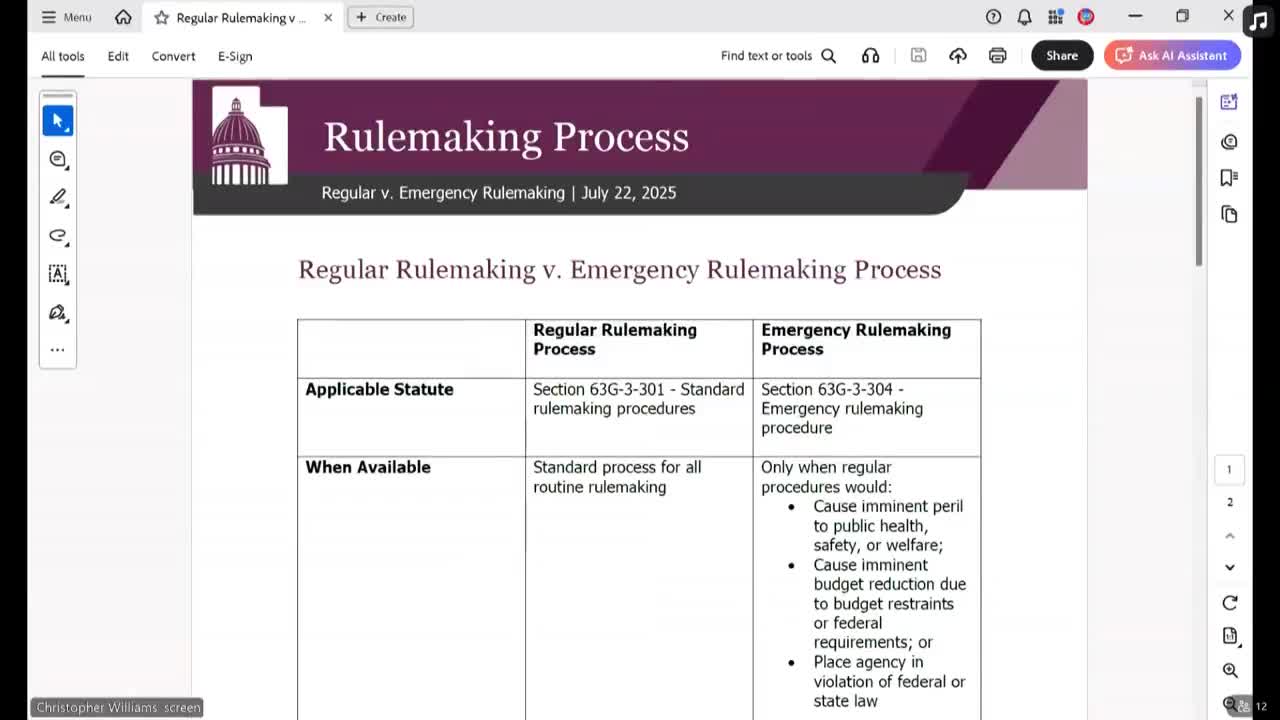
Lawmakers reviewed two emergency-rule filings from the attorney general’s office and an emergency rule from the Division of Risk Management after required administrative reviews or statutory publication deadlines were missed.
Paul Tonks, assistant attorney general, told the committee the attorney general’s administrative rules implementing the child protection registry and the white-collar-crime registry lapsed because the office failed to complete required five-year rule reviews. Tonks said the office immediately filed emergency rules on May 21, citing the statutory requirement that those registries be implemented and asserting that absence of rules would place the office in violation of state law. He said the office also concurrently filed substantive rulemaking to replace the temporary emergency rules.
Mike Brashinsky, director of the Office of Administrative Rules, said the office sends automatic 180-day notices when rules are due for five-year review but those notices were sent to former employees at the attorney general’s office; no current staff had been assigned to receive them, so the reminders were missed. Brashinsky said the lapse was a process failure and that the Office of Administrative Rules and the attorney general’s office coordinated to enact emergency rules and to refile permanent rules before the 120-day emergency period lapsed.
On a separate emergency rule, the Division of Risk Management filed emergency revisions after missing a statutory July 1 deadline to publish updated judgment-limitation caps under the Governmental Immunity Act. The legislative fiscal analyst computes updated caps by May 1 of even-numbered years; Risk Management is required to publish a rule by July 1. Dennis Flynn, assistant attorney general representing Risk Management, explained that staff turnover and an unclear assignment of responsibilities led to the missed July 1 publication; Risk filed an emergency rule to keep those limits current and has since submitted substantive changes that staff expect will take effect before the emergency rule expires.
Committee counsel and legislators raised concerns that emergency rules are intended for imminent harm or to meet federal or state compliance requirements and should not routinely be used to fix administrative oversights. Multiple staff described operational fixes: reassigning notification recipients, adding redundancy to compliance calendars, and ensuring named contacts are current so five-year reviews are not missed.
Ending: Committee members asked agencies to provide updated procedures and to minimize future emergency filings by ensuring timely five-year reviews and staff handoffs; no committee vote was required on the emergency rules themselves during the hearing.
Paul Tonks, assistant attorney general, told the committee the attorney general’s administrative rules implementing the child protection registry and the white-collar-crime registry lapsed because the office failed to complete required five-year rule reviews. Tonks said the office immediately filed emergency rules on May 21, citing the statutory requirement that those registries be implemented and asserting that absence of rules would place the office in violation of state law. He said the office also concurrently filed substantive rulemaking to replace the temporary emergency rules.
Mike Brashinsky, director of the Office of Administrative Rules, said the office sends automatic 180-day notices when rules are due for five-year review but those notices were sent to former employees at the attorney general’s office; no current staff had been assigned to receive them, so the reminders were missed. Brashinsky said the lapse was a process failure and that the Office of Administrative Rules and the attorney general’s office coordinated to enact emergency rules and to refile permanent rules before the 120-day emergency period lapsed.
On a separate emergency rule, the Division of Risk Management filed emergency revisions after missing a statutory July 1 deadline to publish updated judgment-limitation caps under the Governmental Immunity Act. The legislative fiscal analyst computes updated caps by May 1 of even-numbered years; Risk Management is required to publish a rule by July 1. Dennis Flynn, assistant attorney general representing Risk Management, explained that staff turnover and an unclear assignment of responsibilities led to the missed July 1 publication; Risk filed an emergency rule to keep those limits current and has since submitted substantive changes that staff expect will take effect before the emergency rule expires.
Committee counsel and legislators raised concerns that emergency rules are intended for imminent harm or to meet federal or state compliance requirements and should not routinely be used to fix administrative oversights. Multiple staff described operational fixes: reassigning notification recipients, adding redundancy to compliance calendars, and ensuring named contacts are current so five-year reviews are not missed.
Ending: Committee members asked agencies to provide updated procedures and to minimize future emergency filings by ensuring timely five-year reviews and staff handoffs; no committee vote was required on the emergency rules themselves during the hearing.
View the Full Meeting & All Its Details
This article offers just a summary. Unlock complete video, transcripts, and insights as a Founder Member.
✓
Watch full, unedited meeting videos
✓
Search every word spoken in unlimited transcripts
✓
AI summaries & real-time alerts (all government levels)
✓
Permanent access to expanding government content
30-day money-back guarantee
