Council debate over Geraldine Road development agreement, council members question land purchase and tax rebates
July 22, 2025 | Waterloo, Black Hawk County, Iowa
This article was created by AI summarizing key points discussed. AI makes mistakes, so for full details and context, please refer to the video of the full meeting. Please report any errors so we can fix them. Report an error »
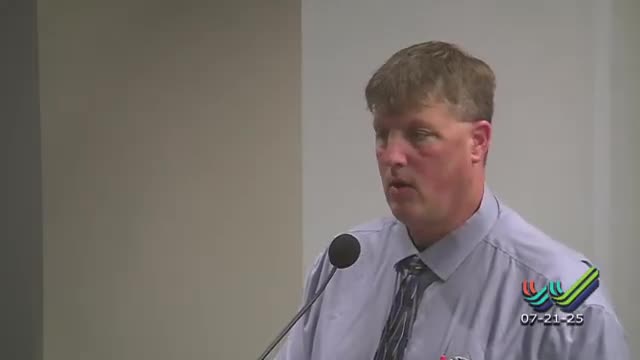
The Waterloo City Council discussed a proposed development agreement with 3 Stooges LLC for the construction of an 8,200-square-foot commercial building south of 2661 Geraldine Road that included a land-acquisition grant of about $604,613 and a 7-year, 50% tax rebate. Public comment and multiple council members raised concerns about the city buying lots and large upfront incentives.
During public comment, resident David Dreyer said the city was “giving them the lots for a dollar” and questioned the benefit to taxpayers: “We don't get 1 bit of value out of it ... all of the rebates you're giving him ... this does not help the taxpayer.” Councilmembers echoed fiscal concerns. Councilmember Bozen said he was “against number 2 on the purchasing of the lots,” noting the city already owns lots nearby and warning that buying lots and giving rebates creates an expanding expense for taxpayers.
Noel Anderson, community planning and development director, explained the $604,613 figure is intended to compensate for development-related work already done on the property and is based on a $4-per-square-foot valuation for development land. Anderson said portions of the Geraldine Road area sit inside the East Unified TIF (tax increment financing) district and that TIF funds have paid for prior infrastructure; he said the city has previously invested in three phases of Geraldine Road and that nine projects there had produced about $11,050,000 in new taxable value since 2010.
Council members asked for more clarity on where up-front incentive money comes from and how the city calculates the land value. Anderson said the $604,613 is essentially meant to put the prospective developer in the same position as if the city had given land for $1 — the city has invested in roads, utilities and other infrastructure and the grant compensates for land acquisition as part of a TIF-funded strategy. He said the East Unified TIF is “doing very well” and that prior projects have met minimum assessed values.
Council debate included requests for clearer budget breakdowns up front in future proposals and expressed unease about long-term tax abatements. Councilmembers said they supported new development in principle but not necessarily the size or structure of the incentives as written.
The transcript records motions to adopt the resolution authorizing the development agreement; council discussion and a roll-call sequence followed. Several members expressed opposition or requested more detail before supporting similar future agreements. The transcript did not record a complete final tally in one place; named councilmembers recorded votes during roll call and some members explicitly said they would not support the land-purchase approach.
During public comment, resident David Dreyer said the city was “giving them the lots for a dollar” and questioned the benefit to taxpayers: “We don't get 1 bit of value out of it ... all of the rebates you're giving him ... this does not help the taxpayer.” Councilmembers echoed fiscal concerns. Councilmember Bozen said he was “against number 2 on the purchasing of the lots,” noting the city already owns lots nearby and warning that buying lots and giving rebates creates an expanding expense for taxpayers.
Noel Anderson, community planning and development director, explained the $604,613 figure is intended to compensate for development-related work already done on the property and is based on a $4-per-square-foot valuation for development land. Anderson said portions of the Geraldine Road area sit inside the East Unified TIF (tax increment financing) district and that TIF funds have paid for prior infrastructure; he said the city has previously invested in three phases of Geraldine Road and that nine projects there had produced about $11,050,000 in new taxable value since 2010.
Council members asked for more clarity on where up-front incentive money comes from and how the city calculates the land value. Anderson said the $604,613 is essentially meant to put the prospective developer in the same position as if the city had given land for $1 — the city has invested in roads, utilities and other infrastructure and the grant compensates for land acquisition as part of a TIF-funded strategy. He said the East Unified TIF is “doing very well” and that prior projects have met minimum assessed values.
Council debate included requests for clearer budget breakdowns up front in future proposals and expressed unease about long-term tax abatements. Councilmembers said they supported new development in principle but not necessarily the size or structure of the incentives as written.
The transcript records motions to adopt the resolution authorizing the development agreement; council discussion and a roll-call sequence followed. Several members expressed opposition or requested more detail before supporting similar future agreements. The transcript did not record a complete final tally in one place; named councilmembers recorded votes during roll call and some members explicitly said they would not support the land-purchase approach.
View the Full Meeting & All Its Details
This article offers just a summary. Unlock complete video, transcripts, and insights as a Founder Member.
✓
Watch full, unedited meeting videos
✓
Search every word spoken in unlimited transcripts
✓
AI summaries & real-time alerts (all government levels)
✓
Permanent access to expanding government content
30-day money-back guarantee
