Local Motion presents transportation security index and maps showing concentrated need in Columbia
June 17, 2025 | Columbia, Boone County, Missouri
This article was created by AI summarizing key points discussed. AI makes mistakes, so for full details and context, please refer to the video of the full meeting. Please report any errors so we can fix them. Report an error »
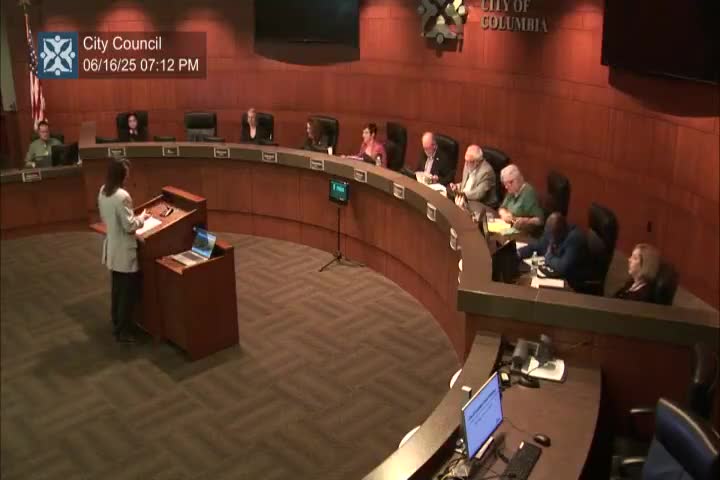
Local Motion presented results from its annual community survey on transportation access to the Columbia City Council on Monday, highlighting a new analysis that uses the University of Michigan's Transportation Security Index (TSI) and geocoded survey responses to locate transportation insecurity in the city.
Ricky Uskani, identified in public comment as Local Motion's community engagement director, told the council that the survey (open Oct. 1'Nov. 1) had 22 questions and more than 1,100 responses last year, with a broad spread across wards but heavier responses from Wards 1, 3 and 4. The new TSI measure is a six-question module scored 0'12, where higher scores indicate greater transportation insecurity. Uskani said average TSI for all respondents was about 2.2 (marginal insecurity); for respondents with annual incomes under $40,000 the average TSI was about 3.3; for respondents who cannot drive the average TSI was about 6.5 (moderate insecurity).
Why it matters: Local Motion argued that the TSI combined with voluntary address-level data provides a more granular picture than census tracts or aggregate statistics, and could help the city and partners target transit, pedestrian and bikeway investments where transportation insecurity is concentrated.
What Local Motion reported: Uskani described outreach methods (online, printed postcards downtown, tabling at the bus station and food distribution sites) and said the group supplemented the survey with in-person engagement. He asked the council to consider partnering on next year's effort and invited council members to participate in a 'Week Without Driving' challenge planned for Sept. 29'Oct. 5 to increase awareness of living without a car.
Public response and follow-up: Council members thanked Local Motion for the data and asked about potential collaboration on mapping and outreach. Uskani said the group keeps address data private and uses it in aggregated maps to indicate locations with higher TSI. He suggested the city could help with future partnerships to expand sample sizes and integrate the TSI into local planning.
Ending: Local Motion asked for the council's consideration of a partnership for next year's survey and for city staff to explore collaborative ways to deploy the TSI and mapping into planning and equity analyses.
Ricky Uskani, identified in public comment as Local Motion's community engagement director, told the council that the survey (open Oct. 1'Nov. 1) had 22 questions and more than 1,100 responses last year, with a broad spread across wards but heavier responses from Wards 1, 3 and 4. The new TSI measure is a six-question module scored 0'12, where higher scores indicate greater transportation insecurity. Uskani said average TSI for all respondents was about 2.2 (marginal insecurity); for respondents with annual incomes under $40,000 the average TSI was about 3.3; for respondents who cannot drive the average TSI was about 6.5 (moderate insecurity).
Why it matters: Local Motion argued that the TSI combined with voluntary address-level data provides a more granular picture than census tracts or aggregate statistics, and could help the city and partners target transit, pedestrian and bikeway investments where transportation insecurity is concentrated.
What Local Motion reported: Uskani described outreach methods (online, printed postcards downtown, tabling at the bus station and food distribution sites) and said the group supplemented the survey with in-person engagement. He asked the council to consider partnering on next year's effort and invited council members to participate in a 'Week Without Driving' challenge planned for Sept. 29'Oct. 5 to increase awareness of living without a car.
Public response and follow-up: Council members thanked Local Motion for the data and asked about potential collaboration on mapping and outreach. Uskani said the group keeps address data private and uses it in aggregated maps to indicate locations with higher TSI. He suggested the city could help with future partnerships to expand sample sizes and integrate the TSI into local planning.
Ending: Local Motion asked for the council's consideration of a partnership for next year's survey and for city staff to explore collaborative ways to deploy the TSI and mapping into planning and equity analyses.
Don't Miss a Word: See the Full Meeting!
Go beyond summaries. Unlock every video, transcript, and key insight with a Founder Membership.
✓
Get instant access to full meeting videos
✓
Search and clip any phrase from complete transcripts
✓
Receive AI-powered summaries & custom alerts
✓
Enjoy lifetime, unrestricted access to government data
30-day money-back guarantee
