Kandiyohi County moves to lock purchase price on parcels adjacent to landfill as monitoring concerns continue
June 17, 2025 | Kandiyohi County, Minnesota
This article was created by AI summarizing key points discussed. AI makes mistakes, so for full details and context, please refer to the video of the full meeting. Please report any errors so we can fix them. Report an error »
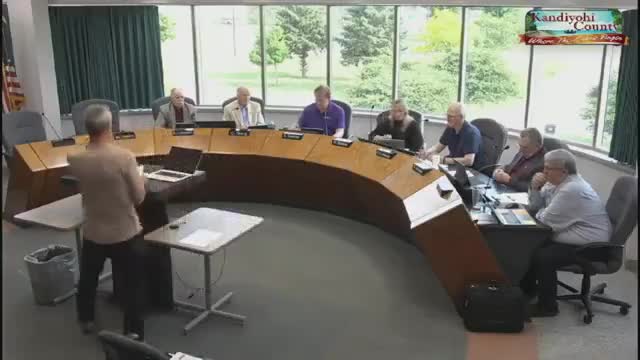
Kandiyohi County officials told the board June 17 they had reached a tentative purchase price for two parcels adjacent to the county landfill and asked authorization to sign a purchase agreement to hold that price while the county completes its review; final approval is scheduled for the board’s July 1 meeting.
Gary Geer, Kandiyohi County Environmental Services Director, said staff have been evaluating the parcels (parcel numbers 203-2460 and 203-2546) to limit future development around the landfill and reduce potential environmental liabilities. "It gains us time and space to research and implement remedial action and assess natural attenuation," Geer said, describing non‑invasive survey techniques and potential cost savings compared with extensive off‑site monitoring.
Why it matters: county staff told commissioners that owning the adjacent land would allow the county to change the landfill's compliance boundary to its property line, lowering the need for extensive off‑site plume delineation or source‑removal work. Staff estimated avoiding up to $7 million in source‑removal costs and up to $4.4 million in off‑site plume delineation in certain scenarios, though those are estimates and would depend on further study.
Price, funding and timeline: Administrator Kelsey Baker said the sellers originally asked $2.8 million; the county initially offered $2.3 million and settled on $2.5 million to hold in a purchase agreement pending final board vote July 1. The board voted to authorize the administrator to sign a purchase agreement that would be contingent on the board’s later approval. Baker told the board the recommended funding split would draw half from landfill reserves and half from the landfill long‑term care trust fund; she said each fund holds roughly $10 million and the county can repay the trust fund from reserves if needed.
Board scrutiny and next steps: Commissioners pressed staff for additional details, including what monitoring and mitigation steps would follow acquisition, alternative funding possibilities and whether state resources are available for mitigation. Geer said some newer, lower‑cost technologies can provide detailed subsurface data for roughly $100,000–$200,000 versus multimillion‑dollar traditional monitoring programs. Board members asked staff to describe the post‑purchase workplan ahead of the July 1 vote; staff agreed to provide a step‑by‑step timeline and cost estimates for monitoring and remediation options.
The board approved the motion to authorize the administrator to sign a purchase agreement that would be brought back for final board approval at the July 1 meeting by voice vote.
Gary Geer, Kandiyohi County Environmental Services Director, said staff have been evaluating the parcels (parcel numbers 203-2460 and 203-2546) to limit future development around the landfill and reduce potential environmental liabilities. "It gains us time and space to research and implement remedial action and assess natural attenuation," Geer said, describing non‑invasive survey techniques and potential cost savings compared with extensive off‑site monitoring.
Why it matters: county staff told commissioners that owning the adjacent land would allow the county to change the landfill's compliance boundary to its property line, lowering the need for extensive off‑site plume delineation or source‑removal work. Staff estimated avoiding up to $7 million in source‑removal costs and up to $4.4 million in off‑site plume delineation in certain scenarios, though those are estimates and would depend on further study.
Price, funding and timeline: Administrator Kelsey Baker said the sellers originally asked $2.8 million; the county initially offered $2.3 million and settled on $2.5 million to hold in a purchase agreement pending final board vote July 1. The board voted to authorize the administrator to sign a purchase agreement that would be contingent on the board’s later approval. Baker told the board the recommended funding split would draw half from landfill reserves and half from the landfill long‑term care trust fund; she said each fund holds roughly $10 million and the county can repay the trust fund from reserves if needed.
Board scrutiny and next steps: Commissioners pressed staff for additional details, including what monitoring and mitigation steps would follow acquisition, alternative funding possibilities and whether state resources are available for mitigation. Geer said some newer, lower‑cost technologies can provide detailed subsurface data for roughly $100,000–$200,000 versus multimillion‑dollar traditional monitoring programs. Board members asked staff to describe the post‑purchase workplan ahead of the July 1 vote; staff agreed to provide a step‑by‑step timeline and cost estimates for monitoring and remediation options.
The board approved the motion to authorize the administrator to sign a purchase agreement that would be brought back for final board approval at the July 1 meeting by voice vote.
View the Full Meeting & All Its Details
This article offers just a summary. Unlock complete video, transcripts, and insights as a Founder Member.
✓
Watch full, unedited meeting videos
✓
Search every word spoken in unlimited transcripts
✓
AI summaries & real-time alerts (all government levels)
✓
Permanent access to expanding government content
30-day money-back guarantee
