Metropolitan Council advances 10 arterial BRT corridors for detailed study; public engagement opens
July 25, 2025 | Metropolitan Council, Agencies, Boards, & Commissions, Executive, Minnesota
This article was created by AI summarizing key points discussed. AI makes mistakes, so for full details and context, please refer to the video of the full meeting. Please report any errors so we can fix them. Report an error »
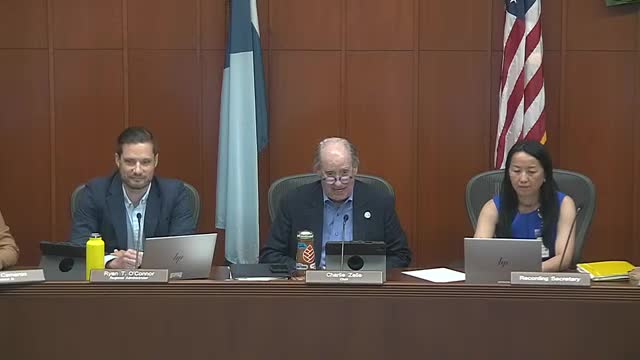
The Metropolitan Council voted on July 23 to accept a staff update identifying 10 arterial bus rapid transit (BRT) corridors that will advance to more detailed study and public engagement.
Metro Transit planner Kyle O’Donnell Burrows told the council the screening narrowed an initial list of 17 candidate corridors down to 10 “to identify the next programmed arterial BRT lines to be implemented in the 2030s.” He said the work will feed into the 2026 regional solicitation and an amendment to the region’s 2050 transportation policy plan.
Why it matters: arterial BRT is the council’s ridership-focused arterial bus investment. Staff said arterial BRT has the region’s highest productivity target — about 25 or more riders per in-service hour — and should be prioritized in transit market areas with the strongest ridership potential. The screening used four goals — building on success, advancing equity, balancing investment, and connecting transit-supportive land uses — and applied 2–4 criteria per goal.
What staff presented: the screening scored corridors on existing ridership and productivity, transit demand, presence of essential destinations, projected bus delay, and readiness where roadwork or development already scheduled could align with transit upgrades. Staff reported that natural breaks in the screening results produced a clear cutoff at 10 corridors advancing to step three, the detailed evaluation.
Public engagement and next steps: staff opened a comment period beginning July 24 and running through Sept. 1 and said outreach will include an interactive online map, pop-up events at transit centers and major stops on advancing corridors, onboard surveys and targeted outreach with municipal partners. After engagement, staff will perform a technical evaluation that pairs technical scores with readiness and partner coordination to help select the next lettered arterial BRT lines (the J, K and L lines).
Council discussion and context: members welcomed the narrow set and emphasized coordination with roadway partners and local municipal planning. Council Member Wolf flagged the importance of aligning corridor work with roadway projects and community plans; Council Member Lindstrom and others urged local partners to resolve outstanding local issues that could delay delivery. Several members noted that past selections of lettered lines did not correspond strictly to top screening scores and that readiness and partner alignment matter for final selection.
Public comment that day included a rider, Leah Mathis, who credited the Beeline BRT with saving time on her commute: “With this new beeline my commute to work takes 15 minutes… That means I get an extra hour every morning,” she said during the public comment period. Chair Zelle asked staff to ensure planners and marketing capture rider impacts such as time saved.
What the council did: the presentation was received as an information item; staff will use feedback from the public and partner agencies to refine concept station locations, potential local-service changes, and to produce the more detailed technical evaluation later this year.
What to watch: staff said they will submit a proposed priority line into the 2026 regional solicitation and will seek adoption of corridor outcomes into the 2050 transportation policy plan via amendment.
Metro Transit planner Kyle O’Donnell Burrows told the council the screening narrowed an initial list of 17 candidate corridors down to 10 “to identify the next programmed arterial BRT lines to be implemented in the 2030s.” He said the work will feed into the 2026 regional solicitation and an amendment to the region’s 2050 transportation policy plan.
Why it matters: arterial BRT is the council’s ridership-focused arterial bus investment. Staff said arterial BRT has the region’s highest productivity target — about 25 or more riders per in-service hour — and should be prioritized in transit market areas with the strongest ridership potential. The screening used four goals — building on success, advancing equity, balancing investment, and connecting transit-supportive land uses — and applied 2–4 criteria per goal.
What staff presented: the screening scored corridors on existing ridership and productivity, transit demand, presence of essential destinations, projected bus delay, and readiness where roadwork or development already scheduled could align with transit upgrades. Staff reported that natural breaks in the screening results produced a clear cutoff at 10 corridors advancing to step three, the detailed evaluation.
Public engagement and next steps: staff opened a comment period beginning July 24 and running through Sept. 1 and said outreach will include an interactive online map, pop-up events at transit centers and major stops on advancing corridors, onboard surveys and targeted outreach with municipal partners. After engagement, staff will perform a technical evaluation that pairs technical scores with readiness and partner coordination to help select the next lettered arterial BRT lines (the J, K and L lines).
Council discussion and context: members welcomed the narrow set and emphasized coordination with roadway partners and local municipal planning. Council Member Wolf flagged the importance of aligning corridor work with roadway projects and community plans; Council Member Lindstrom and others urged local partners to resolve outstanding local issues that could delay delivery. Several members noted that past selections of lettered lines did not correspond strictly to top screening scores and that readiness and partner alignment matter for final selection.
Public comment that day included a rider, Leah Mathis, who credited the Beeline BRT with saving time on her commute: “With this new beeline my commute to work takes 15 minutes… That means I get an extra hour every morning,” she said during the public comment period. Chair Zelle asked staff to ensure planners and marketing capture rider impacts such as time saved.
What the council did: the presentation was received as an information item; staff will use feedback from the public and partner agencies to refine concept station locations, potential local-service changes, and to produce the more detailed technical evaluation later this year.
What to watch: staff said they will submit a proposed priority line into the 2026 regional solicitation and will seek adoption of corridor outcomes into the 2050 transportation policy plan via amendment.
View the Full Meeting & All Its Details
This article offers just a summary. Unlock complete video, transcripts, and insights as a Founder Member.
✓
Watch full, unedited meeting videos
✓
Search every word spoken in unlimited transcripts
✓
AI summaries & real-time alerts (all government levels)
✓
Permanent access to expanding government content
30-day money-back guarantee
