Commissioners deny McElroy Rentals rezoning for convenience store at Williamson Road after residents raise drainage, septic and buffer concerns
July 25, 2025 | Spalding County, Georgia
This article was created by AI summarizing key points discussed. AI makes mistakes, so for full details and context, please refer to the video of the full meeting. Please report any errors so we can fix them. Report an error »
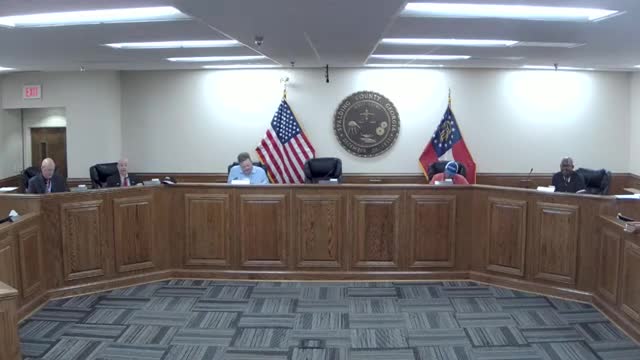
The Board of Commissioners voted to deny a rezoning request by McElroy Rentals LLC that would have turned roughly 12.5 acres near Williamson Road into C‑1 commercial for a convenience store with fuel service. Planning staff had recommended denial and the Planning Commission had recommended denial at its June meeting.
Kirk Felschule, attorney for the applicant, described a revised proposal that reduced the project footprint from an earlier submission and emphasized architectural treatments and fewer parking spaces. He told commissioners the applicant had tried to address community concerns by reducing acreage, removing truck parking and improving building materials.
Dozens of nearby residents opposed the rezoning during a lengthy public comment period. Speakers cited stormwater and drainage problems, failing septic systems in nearby properties, traffic and safety at the intersection, potential negative impacts on property values, and loss of neighborhood character. “If you are going to approve commercial buildings up and down that corridor… you need to provide the infrastructure that goes along with that,” Hobby Davenport said, describing existing septic pumping needs at nearby businesses.
Staff and some commissioners noted that the site sits at an intersection identified in the county’s Comprehensive Plan as a “community crossroads,” which can allow limited commercial uses. Supporters pointed to that designation and to architectural commitments; opponents argued the crossroads standard anticipates only up to two contiguous commercial parcels and that two commercial parcels already exist at the location.
After discussion, the Board voted to deny the rezoning. Commissioners who voted against the proposal cited the magnitude of community opposition and unresolved infrastructure and buffering concerns. The recorded tally was three in favor of denial and one opposed.
Why it matters: The decision preserves the area’s current agricultural/residential zoning and leaves in place the status quo for stormwater and septic reliance until a future, differently configured proposal might be brought forward. The outcome also illustrates the county’s focus on requiring infrastructure and buffering when evaluating commercial zoning in historically rural areas.
Next steps: The applicant may revise and return at a later date; county staff will continue to monitor development proposals in the corridor and ensure future proposals respond to sewer availability, stormwater management and traffic safety.
Speakers and staff cited in this article appeared during application 2409Z (McElroy Rentals LLC) public hearing.
Kirk Felschule, attorney for the applicant, described a revised proposal that reduced the project footprint from an earlier submission and emphasized architectural treatments and fewer parking spaces. He told commissioners the applicant had tried to address community concerns by reducing acreage, removing truck parking and improving building materials.
Dozens of nearby residents opposed the rezoning during a lengthy public comment period. Speakers cited stormwater and drainage problems, failing septic systems in nearby properties, traffic and safety at the intersection, potential negative impacts on property values, and loss of neighborhood character. “If you are going to approve commercial buildings up and down that corridor… you need to provide the infrastructure that goes along with that,” Hobby Davenport said, describing existing septic pumping needs at nearby businesses.
Staff and some commissioners noted that the site sits at an intersection identified in the county’s Comprehensive Plan as a “community crossroads,” which can allow limited commercial uses. Supporters pointed to that designation and to architectural commitments; opponents argued the crossroads standard anticipates only up to two contiguous commercial parcels and that two commercial parcels already exist at the location.
After discussion, the Board voted to deny the rezoning. Commissioners who voted against the proposal cited the magnitude of community opposition and unresolved infrastructure and buffering concerns. The recorded tally was three in favor of denial and one opposed.
Why it matters: The decision preserves the area’s current agricultural/residential zoning and leaves in place the status quo for stormwater and septic reliance until a future, differently configured proposal might be brought forward. The outcome also illustrates the county’s focus on requiring infrastructure and buffering when evaluating commercial zoning in historically rural areas.
Next steps: The applicant may revise and return at a later date; county staff will continue to monitor development proposals in the corridor and ensure future proposals respond to sewer availability, stormwater management and traffic safety.
Speakers and staff cited in this article appeared during application 2409Z (McElroy Rentals LLC) public hearing.
View the Full Meeting & All Its Details
This article offers just a summary. Unlock complete video, transcripts, and insights as a Founder Member.
✓
Watch full, unedited meeting videos
✓
Search every word spoken in unlimited transcripts
✓
AI summaries & real-time alerts (all government levels)
✓
Permanent access to expanding government content
30-day money-back guarantee
