Board OKs first reading of data‑center zoning changes; requires closed‑loop cooling and utility availability statements
July 25, 2025 | Spalding County, Georgia
This article was created by AI summarizing key points discussed. AI makes mistakes, so for full details and context, please refer to the video of the full meeting. Please report any errors so we can fix them. Report an error »
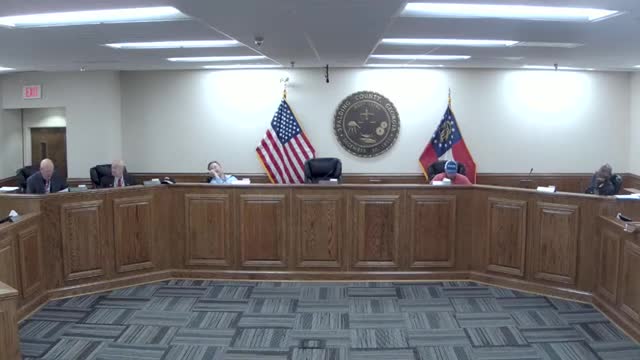
Spalding County commissioners approved a first reading on July 24 to revise the zoning ordinance’s data‑center standards, adding water‑conservation and infrastructure requirements drawn from recent project experience.
Key changes in the draft ordinance include: requiring full utility availability statements for water, sewer, natural gas and electricity; mandatory acoustic and noise studies; a requirement that cooling systems be closed‑loop to limit water consumption; and a detailed decommissioning plan for facilities at end of life. The amendments were proposed after county staff and commissioners reviewed recent data‑center projects and identified gaps in existing standards.
Industry counsel and applicants discussed practical clarifications with staff during the hearing. Attorney Stephen Jones asked that utility availability letters (particularly for electricity) be permitted at the time of land‑disturbance permitting rather than at zoning, because power providers often do not execute final power agreements at the zoning stage. County staff agreed to clarify that availability letters and noise studies can be provided at the permit/LDP stage; the Board asked staff to incorporate that and other technical clarifications for the second reading.
The Board voted unanimously on the first reading and instructed staff to prepare a final ordinance for a second reading incorporating the clarifications. Staff said the closed‑loop cooling requirement is intended to conserve local water supplies and distinguish Spalding’s policy from nearby counties that do not require closed‑loop systems.
Why it matters: Data centers can consume large volumes of water and electricity. The ordinance changes impose stronger local controls to protect water resources and require documentation that utility providers can serve the project.
Next steps: Staff will prepare revised language reflecting the Board’s clarifications for the second reading; applicants seeking zoning for data centers must supply the required availability statements and studies at the permit stage as specified in the finalized code.
Speakers and staff cited in this article participated in a public hearing and staff presentation on the proposed data‑center ordinance amendments.
Key changes in the draft ordinance include: requiring full utility availability statements for water, sewer, natural gas and electricity; mandatory acoustic and noise studies; a requirement that cooling systems be closed‑loop to limit water consumption; and a detailed decommissioning plan for facilities at end of life. The amendments were proposed after county staff and commissioners reviewed recent data‑center projects and identified gaps in existing standards.
Industry counsel and applicants discussed practical clarifications with staff during the hearing. Attorney Stephen Jones asked that utility availability letters (particularly for electricity) be permitted at the time of land‑disturbance permitting rather than at zoning, because power providers often do not execute final power agreements at the zoning stage. County staff agreed to clarify that availability letters and noise studies can be provided at the permit/LDP stage; the Board asked staff to incorporate that and other technical clarifications for the second reading.
The Board voted unanimously on the first reading and instructed staff to prepare a final ordinance for a second reading incorporating the clarifications. Staff said the closed‑loop cooling requirement is intended to conserve local water supplies and distinguish Spalding’s policy from nearby counties that do not require closed‑loop systems.
Why it matters: Data centers can consume large volumes of water and electricity. The ordinance changes impose stronger local controls to protect water resources and require documentation that utility providers can serve the project.
Next steps: Staff will prepare revised language reflecting the Board’s clarifications for the second reading; applicants seeking zoning for data centers must supply the required availability statements and studies at the permit stage as specified in the finalized code.
Speakers and staff cited in this article participated in a public hearing and staff presentation on the proposed data‑center ordinance amendments.
Don't Miss a Word: See the Full Meeting!
Go beyond summaries. Unlock every video, transcript, and key insight with a Founder Membership.
✓
Get instant access to full meeting videos
✓
Search and clip any phrase from complete transcripts
✓
Receive AI-powered summaries & custom alerts
✓
Enjoy lifetime, unrestricted access to government data
30-day money-back guarantee
