Monroe council adopts formal criteria for lodging tax awards to guide tourism funding
July 25, 2025 | Monroe City, Snohomish County, Washington
This article was created by AI summarizing key points discussed. AI makes mistakes, so for full details and context, please refer to the video of the full meeting. Please report any errors so we can fix them. Report an error »
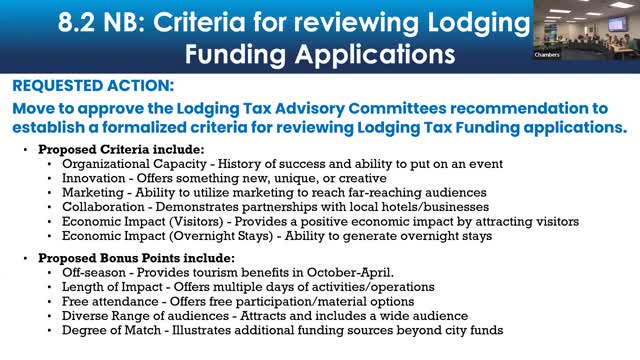
Monroe, Wash. — The Monroe City Council on July 22 approved by a 7-0 vote a formal set of criteria recommended by the Lodging Tax Advisory Committee (LTAC) to guide lodging tax awards for the 2026 cycle.
Why it matters: Lodging tax funding supports events and activities intended to attract overnight visitors. Formal criteria aim to make award decisions more predictable and to prioritize programs that demonstrate visitor economic impact, collaboration and innovation.
What was approved: Liam (staff) told the council that in May the council adopted "ordinance 7 20 25" authorizing LTAC to establish rules and criteria. LTAC met July 10 and finalized recommended evaluation criteria and methodology. The recommended criteria include organizational capacity, innovation, marketing, collaboration, and demonstrated economic impact toward increasing overnight stays; the matrix also includes bonus points for off-season programming and free public attendance when applicable. LTAC intends to reevaluate the criteria after the fiscal-year 2026 application round to adjust weights or scoring if needed.
Council discussion and vote: Councilmember Beaumont said she supported the criteria and welcomed the focus on outcomes and novelty: "That is important. And also awards to organizations or events that offer something new, unique, or creative." Beaumont moved to approve the committee’s recommendation; Councilmember Hanford seconded. The council voted 7-0 to adopt the criteria.
Next steps: The LTAC will use the approved criteria to evaluate lodging tax applications for the fiscal-year 2026 cycle; final award amounts remain at LTAC and council discretion. Staff and LTAC plan to review the criteria after the first formal cycle and propose adjustments if warranted.
Background and context: Staff said LTAC reviewed criteria used by six other cities as part of its work. Councilmembers thanked LTAC members and staff for additional meetings and analysis leading to the recommendation. No changes to the lodging tax rate or funding pool were proposed during the meeting.
Why it matters: Lodging tax funding supports events and activities intended to attract overnight visitors. Formal criteria aim to make award decisions more predictable and to prioritize programs that demonstrate visitor economic impact, collaboration and innovation.
What was approved: Liam (staff) told the council that in May the council adopted "ordinance 7 20 25" authorizing LTAC to establish rules and criteria. LTAC met July 10 and finalized recommended evaluation criteria and methodology. The recommended criteria include organizational capacity, innovation, marketing, collaboration, and demonstrated economic impact toward increasing overnight stays; the matrix also includes bonus points for off-season programming and free public attendance when applicable. LTAC intends to reevaluate the criteria after the fiscal-year 2026 application round to adjust weights or scoring if needed.
Council discussion and vote: Councilmember Beaumont said she supported the criteria and welcomed the focus on outcomes and novelty: "That is important. And also awards to organizations or events that offer something new, unique, or creative." Beaumont moved to approve the committee’s recommendation; Councilmember Hanford seconded. The council voted 7-0 to adopt the criteria.
Next steps: The LTAC will use the approved criteria to evaluate lodging tax applications for the fiscal-year 2026 cycle; final award amounts remain at LTAC and council discretion. Staff and LTAC plan to review the criteria after the first formal cycle and propose adjustments if warranted.
Background and context: Staff said LTAC reviewed criteria used by six other cities as part of its work. Councilmembers thanked LTAC members and staff for additional meetings and analysis leading to the recommendation. No changes to the lodging tax rate or funding pool were proposed during the meeting.
View the Full Meeting & All Its Details
This article offers just a summary. Unlock complete video, transcripts, and insights as a Founder Member.
✓
Watch full, unedited meeting videos
✓
Search every word spoken in unlimited transcripts
✓
AI summaries & real-time alerts (all government levels)
✓
Permanent access to expanding government content
30-day money-back guarantee
