Commission discusses downtown blight cases, enforcement tools and funding; staff seeking legal support to file cases
July 25, 2025 | Augusta City, Richmond County, Georgia
This article was created by AI summarizing key points discussed. AI makes mistakes, so for full details and context, please refer to the video of the full meeting. Please report any errors so we can fix them. Report an error »
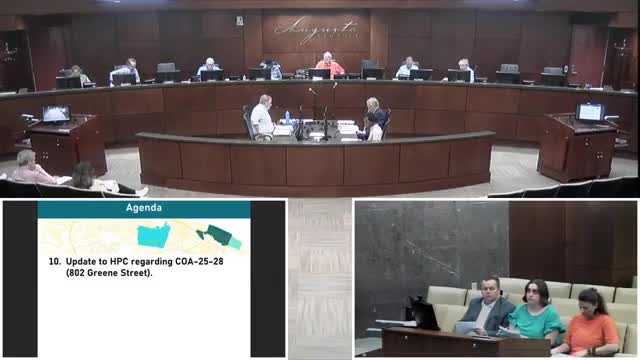
Members of the Augusta Historic Preservation Commission discussed multiple downtown properties identified in staff materials as neglected or blighted — including 739 Broad Street, 753 Broad Street (the Lamar Building), 1140 and 1160 Broad Street, and 935 Jones Street — and sought clarity on enforcement and funding under the city’s blight ordinance.
Ashley Caterton, development services administrator in Planning & Development, relayed code enforcement’s status: 739 Broad Street is vacant with no open code cases; 753 Broad Street has an open IPMC (International Property Maintenance Code) blight case awaiting reinspection and potential referral to the legal department; 1140 Broad Street had an open demolition order active since November 18, 2021, and demolition funding is awaited; and 935 Jones Street has an open IPMC case related to fire damage pending issuance of a violation letter and due process.
Commission members asked how long properties must deteriorate before being deemed blighted and what the city’s remedies are. Assistant/acting city attorney (name not specified in the transcript) explained the local blight ordinance process: code/inspections produce cases that the law department packages for court review; the court can declare a property blighted and the county’s millage may be increased (a 7-mill increase was discussed) for the next tax cycle to generate funds for a blight fund. That fund may be used to close, repair, clean up or demolish unfit buildings and structures. The attorney said the city has recently engaged two outside lawyers to help bring more blight cases to court more quickly.
Commissioners expressed urgency about downtown structures with graffiti and open conditions, and discussed tradeoffs between judicial findings of blight (which provide formal legitimacy and appeal protections) and possible administrative approaches. They discussed that revenue from added levy goes to a blight fund until rehabilitation occurs, and that enforcement and litigation costs and the court’s factual determinations can affect outcomes. The commission asked staff to continue coordinating with code enforcement and legal to expedite cases and to consider incentives — including a possible recommendation about Senate Bill 141 (discussed later) that could extend property-tax freezes for certified rehabilitation projects.
Ashley Caterton, development services administrator in Planning & Development, relayed code enforcement’s status: 739 Broad Street is vacant with no open code cases; 753 Broad Street has an open IPMC (International Property Maintenance Code) blight case awaiting reinspection and potential referral to the legal department; 1140 Broad Street had an open demolition order active since November 18, 2021, and demolition funding is awaited; and 935 Jones Street has an open IPMC case related to fire damage pending issuance of a violation letter and due process.
Commission members asked how long properties must deteriorate before being deemed blighted and what the city’s remedies are. Assistant/acting city attorney (name not specified in the transcript) explained the local blight ordinance process: code/inspections produce cases that the law department packages for court review; the court can declare a property blighted and the county’s millage may be increased (a 7-mill increase was discussed) for the next tax cycle to generate funds for a blight fund. That fund may be used to close, repair, clean up or demolish unfit buildings and structures. The attorney said the city has recently engaged two outside lawyers to help bring more blight cases to court more quickly.
Commissioners expressed urgency about downtown structures with graffiti and open conditions, and discussed tradeoffs between judicial findings of blight (which provide formal legitimacy and appeal protections) and possible administrative approaches. They discussed that revenue from added levy goes to a blight fund until rehabilitation occurs, and that enforcement and litigation costs and the court’s factual determinations can affect outcomes. The commission asked staff to continue coordinating with code enforcement and legal to expedite cases and to consider incentives — including a possible recommendation about Senate Bill 141 (discussed later) that could extend property-tax freezes for certified rehabilitation projects.
View the Full Meeting & All Its Details
This article offers just a summary. Unlock complete video, transcripts, and insights as a Founder Member.
✓
Watch full, unedited meeting videos
✓
Search every word spoken in unlimited transcripts
✓
AI summaries & real-time alerts (all government levels)
✓
Permanent access to expanding government content
30-day money-back guarantee
