Planning commission recommends zoning and subdivision changes to require sidewalks on development plans
July 26, 2025 | Montgomery City, Montgomery County, Alabama
This article was created by AI summarizing key points discussed. AI makes mistakes, so for full details and context, please refer to the video of the full meeting. Please report any errors so we can fix them. Report an error »
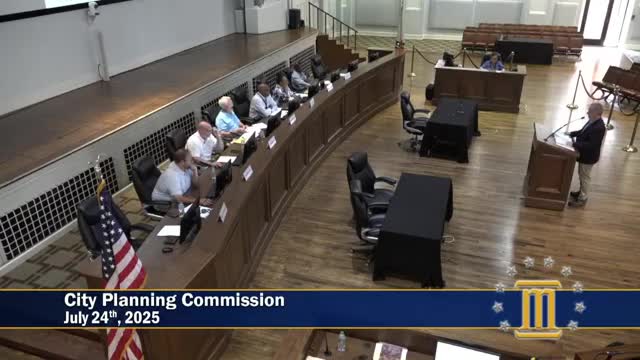
Planning Commission members recommended changes to the city code requiring developers to show sidewalks on development plans and clarified minimum sidewalk widths. Warren Adams, planning department staff, told the commission the amendments reconcile inconsistencies between the subdivision regulations and zoning code and make explicit that sidewalks must be shown on any development plan where required.
The change matters because planners said previous language contradicted itself: one section identified sidewalk widths as a minimum while another incorrectly listed them as a maximum. “The subdivision regulations and the zoning code were not consistent with each other,” Adams said. He told commissioners the amendment ties sidewalk requirements to the zoning code so it is clear where sidewalks are required and what widths apply.
Under the recommended changes, sidewalks would be shown on preliminary and final plats and on development plans. The planning staff clarified sidewalks are required in many built areas but not in rural/agricultural zones where sidewalks are not expected. The amendment also aligns the regulations so residential sidewalks are a minimum of 5 feet and sidewalks in business/nonresidential areas are a minimum of 7 feet.
Commissioners asked how sidewalk maintenance would be handled after construction. Adams said the process would follow existing practice: maintenance responsibility is determined during development and in many cases the city assumes ownership, but that depends on the specific project and location. A motion to recommend approval of the text amendments was made and seconded and carried unanimously.
The ordinance amendments now go to city council for final action. Staff said the changes are intended to reduce engineering and construction conflicts by making sidewalk requirements explicit earlier in the review process.
The change matters because planners said previous language contradicted itself: one section identified sidewalk widths as a minimum while another incorrectly listed them as a maximum. “The subdivision regulations and the zoning code were not consistent with each other,” Adams said. He told commissioners the amendment ties sidewalk requirements to the zoning code so it is clear where sidewalks are required and what widths apply.
Under the recommended changes, sidewalks would be shown on preliminary and final plats and on development plans. The planning staff clarified sidewalks are required in many built areas but not in rural/agricultural zones where sidewalks are not expected. The amendment also aligns the regulations so residential sidewalks are a minimum of 5 feet and sidewalks in business/nonresidential areas are a minimum of 7 feet.
Commissioners asked how sidewalk maintenance would be handled after construction. Adams said the process would follow existing practice: maintenance responsibility is determined during development and in many cases the city assumes ownership, but that depends on the specific project and location. A motion to recommend approval of the text amendments was made and seconded and carried unanimously.
The ordinance amendments now go to city council for final action. Staff said the changes are intended to reduce engineering and construction conflicts by making sidewalk requirements explicit earlier in the review process.
Don't Miss a Word: See the Full Meeting!
Go beyond summaries. Unlock every video, transcript, and key insight with a Founder Membership.
✓
Get instant access to full meeting videos
✓
Search and clip any phrase from complete transcripts
✓
Receive AI-powered summaries & custom alerts
✓
Enjoy lifetime, unrestricted access to government data
30-day money-back guarantee
