Recovery specialist outlines options for Clark County opioid-settlement funds; offers $90/hour advisory contract
July 26, 2025 | Clark County, Kentucky
This article was created by AI summarizing key points discussed. AI makes mistakes, so for full details and context, please refer to the video of the full meeting. Please report any errors so we can fix them. Report an error »
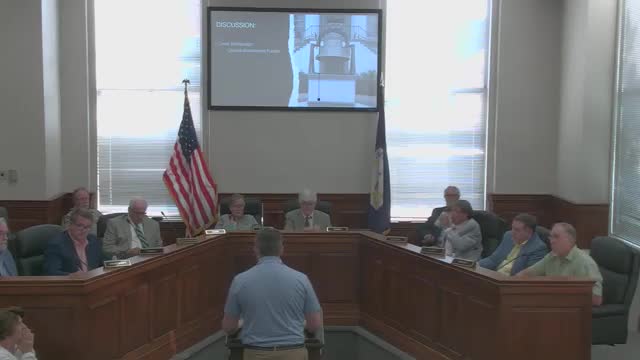
Gene Detherich, a recovery support specialist with the Bluegrass Area Health District, told the Clark County Fiscal Court that opioid-settlement money must be spent on opioid-mitigation efforts and outlined steps the court could take to manage the funds.
Detherich said he would help the court form a local advisory board, coordinate existing services to avoid duplication, and assist with reporting requirements from the state. He offered an hourly administrative contract of $90 for those services and said the work could include governance and strategic planning that the settlement framework allows.
The specialist told the court the settlement framework is outlined in the National Settlement Agreement (referenced by the speaker as “Exhibit B”) and cited corresponding Kentucky law as ‘‘KRS 152.91 through 152.93’’ as constraining how money can be used. He described the Kentucky advisory body that will administer the funds, saying the state-level commission will distribute 50% of Kentucky’s receipts while the other 50% is divided among municipal and county governments.
Detherich listed examples of permissible spending he said the state and settlement documents support: purchasing naloxone, making medications for opioid use disorder available in the jail, funding recovery community centers and recovery housing, supporting quick response teams connected to the sheriff’s office, and evidence-based prevention programs. He said some jail-related expenses may be eligible (the speaker estimated “up to 20%” but did not provide a firm statutory citation in the meeting) and that limited reimbursement for recent past expenses may be possible.
Magistrates and the presiding judge asked questions about where the funds originate and whether local taxes would be used; Detherich repeatedly said the money comes from settlements with manufacturers and distributors and ‘‘does not come from local tax dollars.’’ He also noted that receipt timing and amounts can vary by settlement and vendor payment schedules and recommended the court engage the state advisory process to confirm allowable uses.
No formal motion or contract vote was made during the meeting. Several members asked that Detherich or county staff circulate the cited documentation and a draft contract by email for review.
Detherich said his organization can assist with grant review, reporting and governance, and that the Bluegrass Area Health District already provides related services to some local governments. He said best practice is to avoid supplanting existing funding and to coordinate a local advisory board to screen and prioritize applications before the fiscal court makes final allocations.
The court did not take an action at the meeting beyond directing staff to receive the materials for review and to circulate the contract language by email.
Detherich said he would help the court form a local advisory board, coordinate existing services to avoid duplication, and assist with reporting requirements from the state. He offered an hourly administrative contract of $90 for those services and said the work could include governance and strategic planning that the settlement framework allows.
The specialist told the court the settlement framework is outlined in the National Settlement Agreement (referenced by the speaker as “Exhibit B”) and cited corresponding Kentucky law as ‘‘KRS 152.91 through 152.93’’ as constraining how money can be used. He described the Kentucky advisory body that will administer the funds, saying the state-level commission will distribute 50% of Kentucky’s receipts while the other 50% is divided among municipal and county governments.
Detherich listed examples of permissible spending he said the state and settlement documents support: purchasing naloxone, making medications for opioid use disorder available in the jail, funding recovery community centers and recovery housing, supporting quick response teams connected to the sheriff’s office, and evidence-based prevention programs. He said some jail-related expenses may be eligible (the speaker estimated “up to 20%” but did not provide a firm statutory citation in the meeting) and that limited reimbursement for recent past expenses may be possible.
Magistrates and the presiding judge asked questions about where the funds originate and whether local taxes would be used; Detherich repeatedly said the money comes from settlements with manufacturers and distributors and ‘‘does not come from local tax dollars.’’ He also noted that receipt timing and amounts can vary by settlement and vendor payment schedules and recommended the court engage the state advisory process to confirm allowable uses.
No formal motion or contract vote was made during the meeting. Several members asked that Detherich or county staff circulate the cited documentation and a draft contract by email for review.
Detherich said his organization can assist with grant review, reporting and governance, and that the Bluegrass Area Health District already provides related services to some local governments. He said best practice is to avoid supplanting existing funding and to coordinate a local advisory board to screen and prioritize applications before the fiscal court makes final allocations.
The court did not take an action at the meeting beyond directing staff to receive the materials for review and to circulate the contract language by email.
View the Full Meeting & All Its Details
This article offers just a summary. Unlock complete video, transcripts, and insights as a Founder Member.
✓
Watch full, unedited meeting videos
✓
Search every word spoken in unlimited transcripts
✓
AI summaries & real-time alerts (all government levels)
✓
Permanent access to expanding government content
30-day money-back guarantee
