Scott County to approve termination of regional 28E and sign new 28E for mental-health advocate services
June 17, 2025 | Scott County, Iowa
This article was created by AI summarizing key points discussed. AI makes mistakes, so for full details and context, please refer to the video of the full meeting. Please report any errors so we can fix them. Report an error »
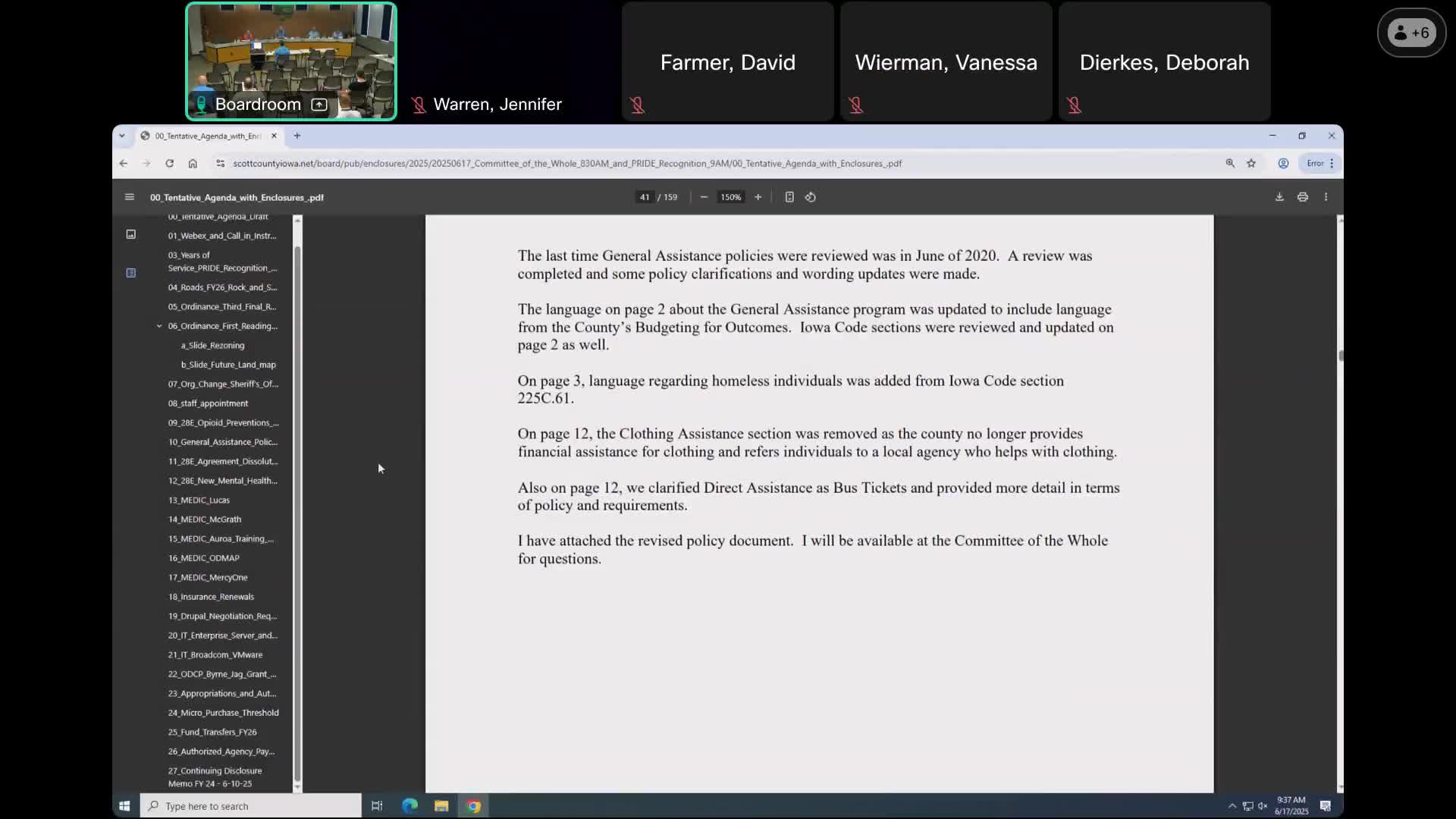
Scott County officials told the Board of Supervisors on June 10 that the Eastern Iowa Mental Health Regions 28E intergovernmental agreement will be terminated as the region winds down and that the county will join a new 28E to provide mental-health advocate services.
The county will participate in a closeout period from July 1 through Dec. 31 to pay final bills, finish contracts and transition clients to new providers under a new system alignment. “With this new alignment, new system coming on board, we don't want anyone falling through the cracks,” Laurie said during the meeting, describing coordination with Human Services, the Iowa Primary Care Association and disability access points.
The new 28E will name Greg Burnett as the mental-health advocate with Scott County serving as the employer of record. Staff said Scott County will bill the Administrative Services Organization (ASO) quarterly for Burnett’s salary, benefits and training; if the ASO does not reimburse Scott County in full, the four other participating counties would pay a share based on the number of cases Burnett has in each county. “If a county decides they don't want to sign this 28E, then they will be responsible for hiring their own mental health advocate,” Laurie said.
The county noted that Iowa Code requires appointing and hiring a mental-health advocate to monitor care during commitments; historically the position’s cost had been split among the five counties and at times funded by the state. Laurie said Scott County does not maintain a dedicated mental-health fund and that she repeatedly pushed HHS and the ASO for a definition of “reasonable expenses” for reimbursement. She presented pay and budget figures for 2024–26 and said the ASO responded by email that the county could proceed with the 28E.
A supervisor asked staff to report back if reimbursement from the ASO becomes an issue; staff agreed to keep the board apprised. The termination of the regional 28E and the new 28E agreement were presented for the board’s consideration at a follow-up meeting.
Officials emphasized that the July–Dec. 31 closeout will be used to ensure continuity of care and that they are coordinating across county and state partners to avoid service gaps.
The county will participate in a closeout period from July 1 through Dec. 31 to pay final bills, finish contracts and transition clients to new providers under a new system alignment. “With this new alignment, new system coming on board, we don't want anyone falling through the cracks,” Laurie said during the meeting, describing coordination with Human Services, the Iowa Primary Care Association and disability access points.
The new 28E will name Greg Burnett as the mental-health advocate with Scott County serving as the employer of record. Staff said Scott County will bill the Administrative Services Organization (ASO) quarterly for Burnett’s salary, benefits and training; if the ASO does not reimburse Scott County in full, the four other participating counties would pay a share based on the number of cases Burnett has in each county. “If a county decides they don't want to sign this 28E, then they will be responsible for hiring their own mental health advocate,” Laurie said.
The county noted that Iowa Code requires appointing and hiring a mental-health advocate to monitor care during commitments; historically the position’s cost had been split among the five counties and at times funded by the state. Laurie said Scott County does not maintain a dedicated mental-health fund and that she repeatedly pushed HHS and the ASO for a definition of “reasonable expenses” for reimbursement. She presented pay and budget figures for 2024–26 and said the ASO responded by email that the county could proceed with the 28E.
A supervisor asked staff to report back if reimbursement from the ASO becomes an issue; staff agreed to keep the board apprised. The termination of the regional 28E and the new 28E agreement were presented for the board’s consideration at a follow-up meeting.
Officials emphasized that the July–Dec. 31 closeout will be used to ensure continuity of care and that they are coordinating across county and state partners to avoid service gaps.
View the Full Meeting & All Its Details
This article offers just a summary. Unlock complete video, transcripts, and insights as a Founder Member.
✓
Watch full, unedited meeting videos
✓
Search every word spoken in unlimited transcripts
✓
AI summaries & real-time alerts (all government levels)
✓
Permanent access to expanding government content
30-day money-back guarantee
