Des Moines County imposes three-month moratorium on commercial wind permits; schedules ordinance rewrite work session
June 17, 2025 | Des Moines County, Iowa
This article was created by AI summarizing key points discussed. AI makes mistakes, so for full details and context, please refer to the video of the full meeting. Please report any errors so we can fix them. Report an error »
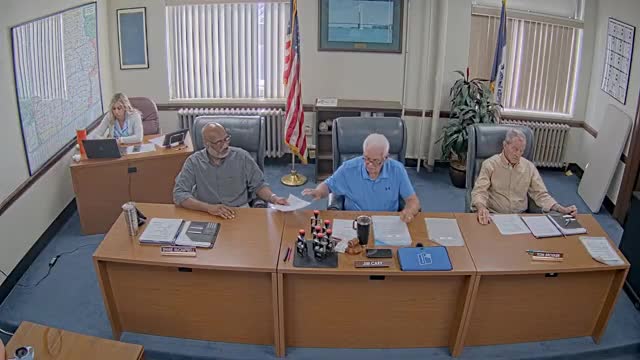
The Des Moines County Board of Supervisors on June 17 approved Resolution 2025-32, imposing a three-month moratorium on the acceptance or approval of commercial wind energy conversion system (CWES) siting permits from June 18 through Sept. 17, 2025.
The short moratorium, the board said, is intended to “keep the temperature down” in public meetings while supervisors and staff work on amendments to County Ordinance No. 62, which regulates the siting and operation of wind energy systems. Supervisor Jim Carey read the resolution aloud during the meeting: “a 3 months moratorium will create no undue hardships on any party concerned.”
The moratorium followed a contentious public work session the previous week. Board members discussed a previously proposed two-year pause but said a shorter suspension would reduce the appearance of a long-term stall while giving staff time to craft ordinance revisions. Supervisor Sarah Doherty and other supervisors supported the shorter interval during the motion to adopt the resolution; the board recorded unanimous votes in favor (Tom Broker: yes; Shane McCampbell: yes; Jim Carey: yes).
At a subsequent workshop session the board directed staff and regional planners from Southeast Regional Planning to use the Lee County wind, solar and battery-storage ordinance — adopted earlier in May — as a working template. A regional planner said Lee County’s ordinance incorporates a multi-step permitting process that provides early public notice and gives developers preliminary certainty about whether their materials meet basic requirements before major investments are made.
Board discussion at the workshop covered technical and financial safeguards the county wants to add or retain, including: decommissioning surety and bonding, liability insurance and premium coverage, emergency-response plans, debris cleanup on adjoining properties, coordination with crop-dusting operators, setbacks, shadow-flicker and noise limits, and road-use agreements for installation and decommissioning.
Supervisors and staff described how decommissioning bonding is intended to be structured under current drafts: an engineer paid for by the developer prepares an estimate to cover full removal and site restoration (including removal of concrete foundations), and developers must post a multi-year surety before construction. The board discussed changing the previously used 3x multiplier on estimated decommissioning costs to a lower multiplier (ideas discussed ranged from 1.25x to 1.5x) while preserving contingency language for unforeseen expenses. Staff described a rolling mechanism by which the bond is re-evaluated and renewed every three years; if a developer fails to replace an expiring bond, the county may declare default and require decommissioning at the developer’s expense.
Insurance provisions were also discussed in general terms: supervisors asked that liability coverage explicitly include property damage, bodily injury and death, that per-occurrence limits be specified, and that an umbrella policy be required above base liability limits. The county’s legal advisor warned against issuing a preliminary “conditional” permit that might create a perceived property interest for a developer; several supervisors said they preferred a single permit granted only after full review.
The board scheduled a follow-up workstation for July 1 to review draft ordinance language adapted from Lee County and to address items supervisors identified for tighter controls. Public comment at the June 17 meeting included Rose Fisher, who thanked the board for adopting the moratorium.
While the moratorium halts new CWES permit approvals for three months, supervisors emphasized that the intent is to complete a focused revision to Ordinance No. 62 and return the matter to formal public notice and hearing when a complete draft is ready.
The short moratorium, the board said, is intended to “keep the temperature down” in public meetings while supervisors and staff work on amendments to County Ordinance No. 62, which regulates the siting and operation of wind energy systems. Supervisor Jim Carey read the resolution aloud during the meeting: “a 3 months moratorium will create no undue hardships on any party concerned.”
The moratorium followed a contentious public work session the previous week. Board members discussed a previously proposed two-year pause but said a shorter suspension would reduce the appearance of a long-term stall while giving staff time to craft ordinance revisions. Supervisor Sarah Doherty and other supervisors supported the shorter interval during the motion to adopt the resolution; the board recorded unanimous votes in favor (Tom Broker: yes; Shane McCampbell: yes; Jim Carey: yes).
At a subsequent workshop session the board directed staff and regional planners from Southeast Regional Planning to use the Lee County wind, solar and battery-storage ordinance — adopted earlier in May — as a working template. A regional planner said Lee County’s ordinance incorporates a multi-step permitting process that provides early public notice and gives developers preliminary certainty about whether their materials meet basic requirements before major investments are made.
Board discussion at the workshop covered technical and financial safeguards the county wants to add or retain, including: decommissioning surety and bonding, liability insurance and premium coverage, emergency-response plans, debris cleanup on adjoining properties, coordination with crop-dusting operators, setbacks, shadow-flicker and noise limits, and road-use agreements for installation and decommissioning.
Supervisors and staff described how decommissioning bonding is intended to be structured under current drafts: an engineer paid for by the developer prepares an estimate to cover full removal and site restoration (including removal of concrete foundations), and developers must post a multi-year surety before construction. The board discussed changing the previously used 3x multiplier on estimated decommissioning costs to a lower multiplier (ideas discussed ranged from 1.25x to 1.5x) while preserving contingency language for unforeseen expenses. Staff described a rolling mechanism by which the bond is re-evaluated and renewed every three years; if a developer fails to replace an expiring bond, the county may declare default and require decommissioning at the developer’s expense.
Insurance provisions were also discussed in general terms: supervisors asked that liability coverage explicitly include property damage, bodily injury and death, that per-occurrence limits be specified, and that an umbrella policy be required above base liability limits. The county’s legal advisor warned against issuing a preliminary “conditional” permit that might create a perceived property interest for a developer; several supervisors said they preferred a single permit granted only after full review.
The board scheduled a follow-up workstation for July 1 to review draft ordinance language adapted from Lee County and to address items supervisors identified for tighter controls. Public comment at the June 17 meeting included Rose Fisher, who thanked the board for adopting the moratorium.
While the moratorium halts new CWES permit approvals for three months, supervisors emphasized that the intent is to complete a focused revision to Ordinance No. 62 and return the matter to formal public notice and hearing when a complete draft is ready.
View the Full Meeting & All Its Details
This article offers just a summary. Unlock complete video, transcripts, and insights as a Founder Member.
✓
Watch full, unedited meeting videos
✓
Search every word spoken in unlimited transcripts
✓
AI summaries & real-time alerts (all government levels)
✓
Permanent access to expanding government content
30-day money-back guarantee
