Miami County reviews competitive RFPs to assess 1898 courthouse; ESA scope staged to limit early destructive testing
July 16, 2025 | Miami County, Kansas
This article was created by AI summarizing key points discussed. AI makes mistakes, so for full details and context, please refer to the video of the full meeting. Please report any errors so we can fix them. Report an error »
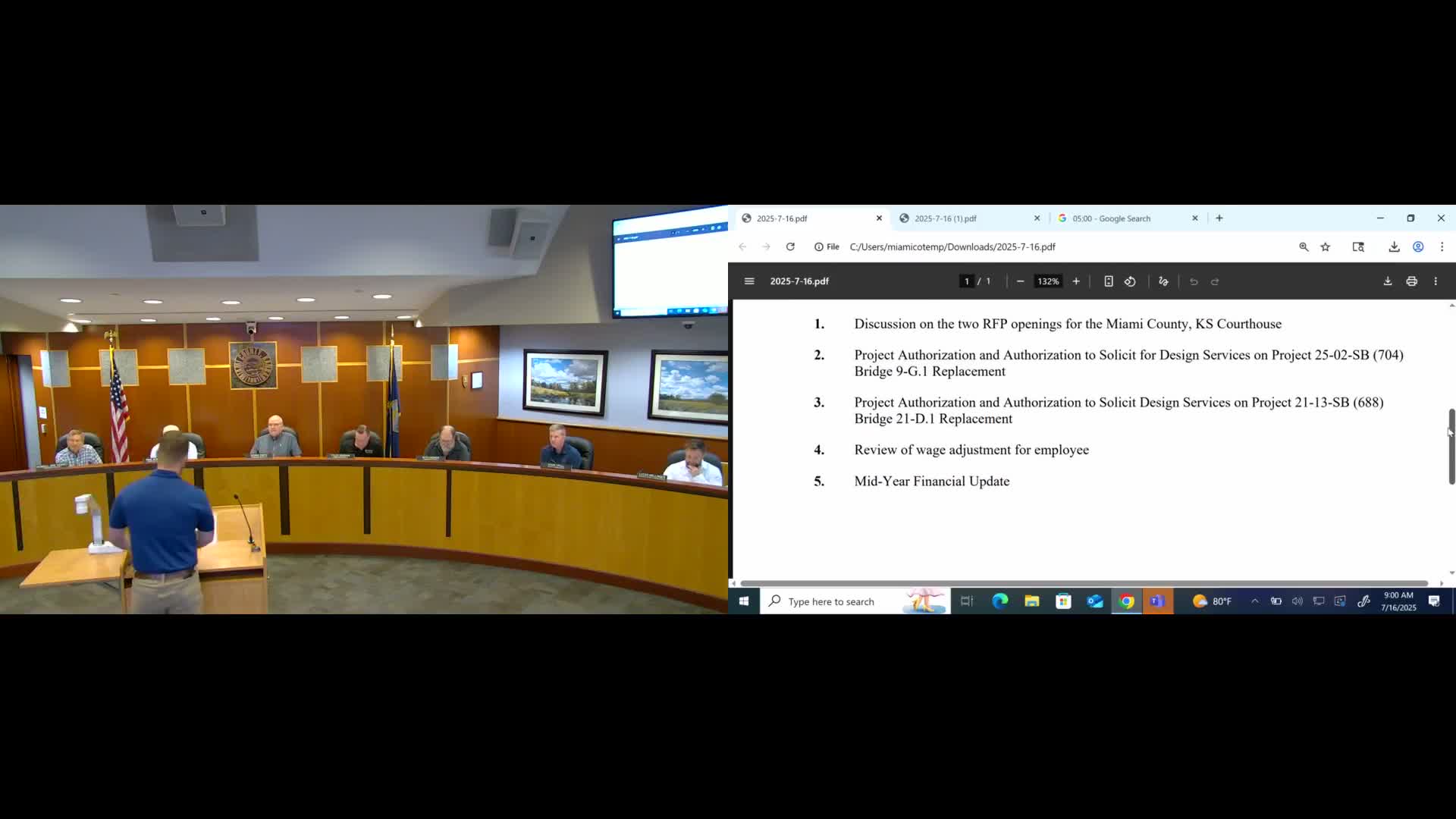
Miami County commissioners on July 16 reviewed competitive proposals for mechanical, electrical and plumbing (MEP) and structural assessments of the county courthouse and for a two‑phase environmental site assessment that would identify any hazardous materials and guide remediation.
Project manager Matt Oler said the MEP/structural RFP (No. 2025‑11) and the ESA RFPs were deliberately written to establish a baseline investigation and then allow the Board of County Commissioners to authorize additional work if the first‑phase findings indicate further testing is needed. "This RFP is 20 25 dash 11. This is for the MEP and the structural analysis," Oler said, adding the baseline work will inform capital improvement planning. He told commissioners the baseline reports would be amendable if a firm recommended, for example, destructive testing.
The baseline MEP/structural procurement drew six competitive proposers. Oler identified PST Engineering as the apparent low bidder at $19,007.50, but said PST listed optional services that are not included in the base price — a $4,500 cost‑estimate breakdown and an $8,300 measure‑and‑verify service — that, if accepted, would raise PST’s total fee into parity with other firms. "So you can see that their $19,007.50 is creeping up to that 26 to 30,000 mark," Oler said. Other proposals discussed included Martin & Martin (about $21,000, no pre‑proposal site visit), Ferris Engineering (about $26,800), Bartlett & West (about $35,000) and BG Consultants (about $43,500). Oler characterized Bartlett & West’s written approach as the most comprehensive and said Ferris’s proposal was also strong; he recommended either Bartlett & West or Ferris if the commission asked for his recommendation.
On the ESA procurement, Oler said firms were asked to perform a non‑intrusive Phase I ESA and a hazardous materials survey (lead, asbestos, mold visual inspection and indoor air sampling in roughly 10 discrete interior locations plus one outdoor sample). If Phase I identifies recognized environmental conditions, the RFP allows the county to authorize an ESA Phase II of destructive sampling (soil, groundwater, building materials) as a contract amendment. Oler said most ESA proposals included lab costs for routine sampling; he gave a historical range for 30‑day air monitoring of roughly $1,700 to $3,200 (noting those figures are several years old and likely higher today).
Oler told commissioners that some ESA respondents proposed a longer timeline: Baldridge Engineering listed a 3–4 month timeline for Phase I and an additional 4–5 months if a Phase II were needed; Oler warned that timeline could extend to seven months and may exceed the commission’s needs. He also flagged one ESA proposer (Partner Engineering & Science) that submitted hourly rates without a total price and said that made that submission non‑compliant with the RFP format.
Commissioners and staff discussed the value of firms that toured the courthouse before bidding. Oler said Bartlett & West, BG Consultants and Ferris Engineering all toured the facility. He noted the courthouse was built in 1898 and that Ferris and Bartlett cited experience with historic buildings, including some 19th‑century structures. Commissioners asked about turnaround times; Oler said most firms proposed about a 60‑day turnaround for the MEP/structural baseline after contract execution.
No award was made at the July 16 study session. Oler told the commission the proposals were provided to them and that a formal recommendation and award would appear on the agenda the following week so commissioners could review digital copies of each proposal. "There’s no decision that needs to be made this afternoon," he said. "You guys can take a week to mull it over and review all the proposals yourselves, and then next week I’ll be back up again in study session to hash it out one last time with the commission."
Why it matters: The county’s courthouse is a 19th‑century building whose structural capacity and MEP condition will shape any renovation or expansion options, and the ESA will determine whether hazardous‑materials remediation is required and, if so, at what cost and with what timeline. Commissioners emphasized the need for baseline, non‑destructive study before committing to further invasive and costly testing.
Next steps: The commission will review full proposals provided by staff and is scheduled to consider award(s) at the next meeting; if Phase I ESA work identifies recognized environmental conditions, staff said it will return to commissioners to request authorization and funding for Phase II sampling and remediation planning.
Project manager Matt Oler said the MEP/structural RFP (No. 2025‑11) and the ESA RFPs were deliberately written to establish a baseline investigation and then allow the Board of County Commissioners to authorize additional work if the first‑phase findings indicate further testing is needed. "This RFP is 20 25 dash 11. This is for the MEP and the structural analysis," Oler said, adding the baseline work will inform capital improvement planning. He told commissioners the baseline reports would be amendable if a firm recommended, for example, destructive testing.
The baseline MEP/structural procurement drew six competitive proposers. Oler identified PST Engineering as the apparent low bidder at $19,007.50, but said PST listed optional services that are not included in the base price — a $4,500 cost‑estimate breakdown and an $8,300 measure‑and‑verify service — that, if accepted, would raise PST’s total fee into parity with other firms. "So you can see that their $19,007.50 is creeping up to that 26 to 30,000 mark," Oler said. Other proposals discussed included Martin & Martin (about $21,000, no pre‑proposal site visit), Ferris Engineering (about $26,800), Bartlett & West (about $35,000) and BG Consultants (about $43,500). Oler characterized Bartlett & West’s written approach as the most comprehensive and said Ferris’s proposal was also strong; he recommended either Bartlett & West or Ferris if the commission asked for his recommendation.
On the ESA procurement, Oler said firms were asked to perform a non‑intrusive Phase I ESA and a hazardous materials survey (lead, asbestos, mold visual inspection and indoor air sampling in roughly 10 discrete interior locations plus one outdoor sample). If Phase I identifies recognized environmental conditions, the RFP allows the county to authorize an ESA Phase II of destructive sampling (soil, groundwater, building materials) as a contract amendment. Oler said most ESA proposals included lab costs for routine sampling; he gave a historical range for 30‑day air monitoring of roughly $1,700 to $3,200 (noting those figures are several years old and likely higher today).
Oler told commissioners that some ESA respondents proposed a longer timeline: Baldridge Engineering listed a 3–4 month timeline for Phase I and an additional 4–5 months if a Phase II were needed; Oler warned that timeline could extend to seven months and may exceed the commission’s needs. He also flagged one ESA proposer (Partner Engineering & Science) that submitted hourly rates without a total price and said that made that submission non‑compliant with the RFP format.
Commissioners and staff discussed the value of firms that toured the courthouse before bidding. Oler said Bartlett & West, BG Consultants and Ferris Engineering all toured the facility. He noted the courthouse was built in 1898 and that Ferris and Bartlett cited experience with historic buildings, including some 19th‑century structures. Commissioners asked about turnaround times; Oler said most firms proposed about a 60‑day turnaround for the MEP/structural baseline after contract execution.
No award was made at the July 16 study session. Oler told the commission the proposals were provided to them and that a formal recommendation and award would appear on the agenda the following week so commissioners could review digital copies of each proposal. "There’s no decision that needs to be made this afternoon," he said. "You guys can take a week to mull it over and review all the proposals yourselves, and then next week I’ll be back up again in study session to hash it out one last time with the commission."
Why it matters: The county’s courthouse is a 19th‑century building whose structural capacity and MEP condition will shape any renovation or expansion options, and the ESA will determine whether hazardous‑materials remediation is required and, if so, at what cost and with what timeline. Commissioners emphasized the need for baseline, non‑destructive study before committing to further invasive and costly testing.
Next steps: The commission will review full proposals provided by staff and is scheduled to consider award(s) at the next meeting; if Phase I ESA work identifies recognized environmental conditions, staff said it will return to commissioners to request authorization and funding for Phase II sampling and remediation planning.
View the Full Meeting & All Its Details
This article offers just a summary. Unlock complete video, transcripts, and insights as a Founder Member.
✓
Watch full, unedited meeting videos
✓
Search every word spoken in unlimited transcripts
✓
AI summaries & real-time alerts (all government levels)
✓
Permanent access to expanding government content
30-day money-back guarantee
