Commissioners review replacement options after severe corrosion closes Bridge 9G1 near Plum Creek Road
July 16, 2025 | Miami County, Kansas
This article was created by AI summarizing key points discussed. AI makes mistakes, so for full details and context, please refer to the video of the full meeting. Please report any errors so we can fix them. Report an error »
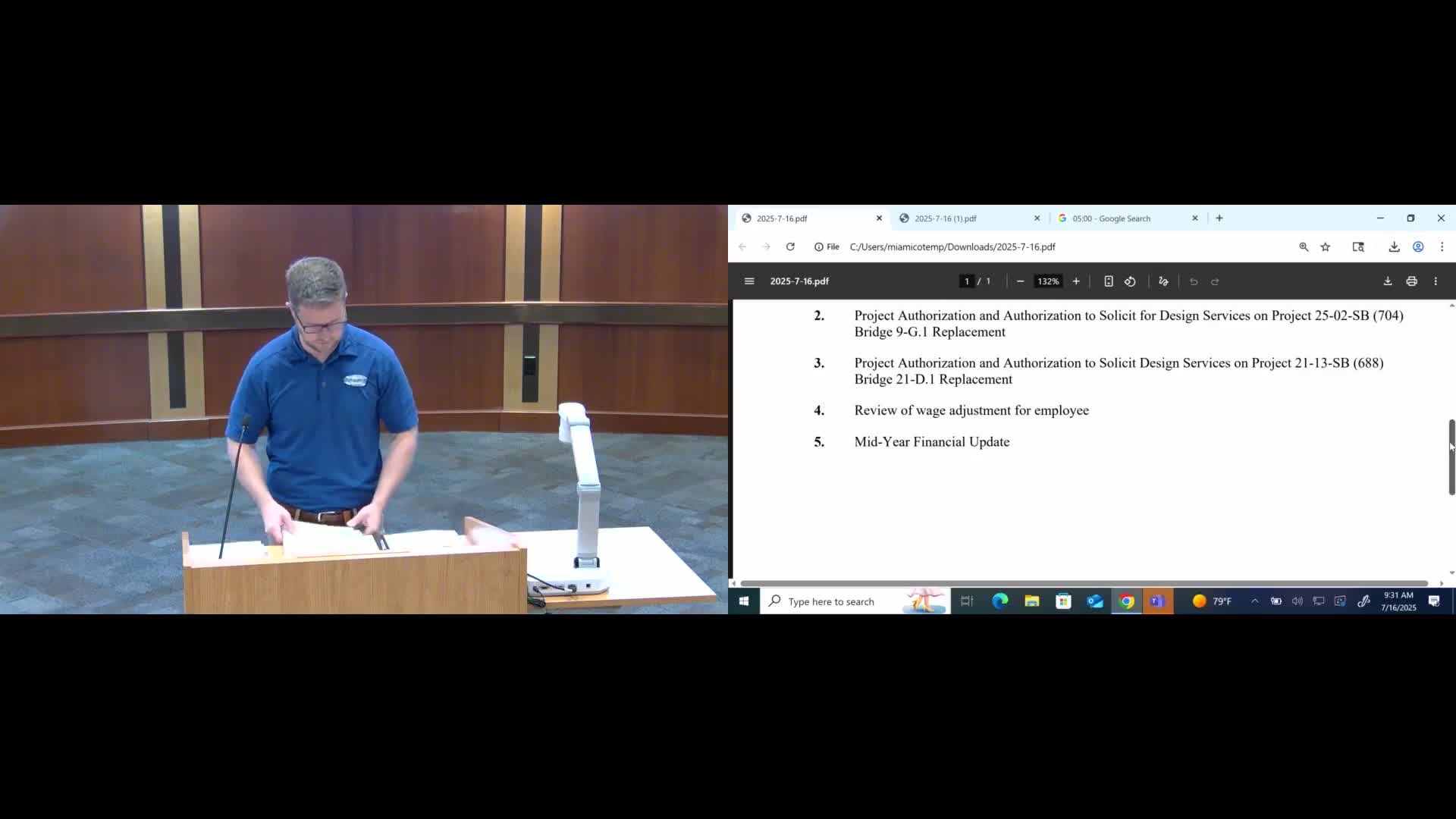
Miami County commissioners on July 16 were briefed on Bridge 9G1 (330 Fifth Street, about 385 feet east of Plum Creek Road), which county staff closed earlier this year after detailed inspection revealed severe section loss in stringers and girders.
County bridge staff described the April element‑level inspection and showed photos of stringers with substantial corrosion. "This is one of the stringers, mid span, 100% section loss," the presenter said. Staff explained element‑level inspections now require cleaning and touching structural members, which revealed corrosion previously obscured by debris.
Replacement options and costs
Staff outlined three general options: (1) low‑water crossing using multiple large steel culvert “rail car” tubes (the example shown used six tubes); (2) a steel‑girder replacement that would have to be designed to allow floodwaters to pass and would use a lightweight metal grating deck; or (3) a conventional single‑span bridge or box culvert at higher elevation. Staff estimated the low‑water option (using 10‑foot tubes for the site) would cost on the order of $200,000–$225,000 for tubes, headwalls and fill; the worst‑case steel‑girder option that must be allowed to flood was budgeted closer to $473,000 (and the staff estimate cited a project budget in the $500,000–$575,000 range if a conventional bridge is required).
Permitting and funding constraints
Staff said the low‑water crossing is likely ineligible for KDOT grants because it would not meet AASHTO design criteria; if the county installs a low‑water crossing the county would pay 100% of the cost. A conventional bridge could be eligible for state off‑system or local bridge grant programs and would therefore be partly reimbursable, but staff cautioned that permitting agencies (state and federal) control allowable structure types in floodplain locations. "If you do the low water crossing, it's a 100% funded by the County. If it's a bridge, maybe," staff said.
Timeframe and traffic impacts
Most firms discussed in other agenda items proposed roughly 60 days for design deliverables after contract execution; staff said permitting and right‑of‑way work commonly add several months. If allowed to be permitted as a low‑water crossing, staff said the county could advertise for construction in late summer of the next year and begin work in fall or winter; completion would depend on contractor schedule. The location’s low traffic volume (an older ADT cited in the record was eight vehicles per day from 2015) means the bridge is low volume but local residents have expressed frequent calls for repair since closure. Staff noted railroad crossings and blocked intersections in the area increase the practical importance of restoring the route even though official ADT is low.
Engineering detail and lifecycle
For the low‑water tube option, staff described typical construction: half‑inch to three‑quarter‑inch steel tubes priced at roughly $30,000 each, filled with flowable fill and gravel, with concrete headwalls and debris mitigation; staff said properly constructed tubes can last decades depending on corrosion rate and debris management. For the steel‑girder option staff noted a metal grating deck would allow floodwaters to pass rather than resisting the hundred‑year flow. Staff recommended permitting be pursued first; if a low‑water alternative is rejected by permitting agencies they would return to the commission to select another structure type.
Next steps
Staff requested authorization to solicit design services for the project. Commissioners asked staff to pursue permitting and grants where possible and to return with design authorization and a funding plan, with construction funding anticipated in 2026 under the county’s special bridge program if awarded. The county emphasized it would not unilaterally proceed with destructive work until a permit and funding path were established.
County bridge staff described the April element‑level inspection and showed photos of stringers with substantial corrosion. "This is one of the stringers, mid span, 100% section loss," the presenter said. Staff explained element‑level inspections now require cleaning and touching structural members, which revealed corrosion previously obscured by debris.
Replacement options and costs
Staff outlined three general options: (1) low‑water crossing using multiple large steel culvert “rail car” tubes (the example shown used six tubes); (2) a steel‑girder replacement that would have to be designed to allow floodwaters to pass and would use a lightweight metal grating deck; or (3) a conventional single‑span bridge or box culvert at higher elevation. Staff estimated the low‑water option (using 10‑foot tubes for the site) would cost on the order of $200,000–$225,000 for tubes, headwalls and fill; the worst‑case steel‑girder option that must be allowed to flood was budgeted closer to $473,000 (and the staff estimate cited a project budget in the $500,000–$575,000 range if a conventional bridge is required).
Permitting and funding constraints
Staff said the low‑water crossing is likely ineligible for KDOT grants because it would not meet AASHTO design criteria; if the county installs a low‑water crossing the county would pay 100% of the cost. A conventional bridge could be eligible for state off‑system or local bridge grant programs and would therefore be partly reimbursable, but staff cautioned that permitting agencies (state and federal) control allowable structure types in floodplain locations. "If you do the low water crossing, it's a 100% funded by the County. If it's a bridge, maybe," staff said.
Timeframe and traffic impacts
Most firms discussed in other agenda items proposed roughly 60 days for design deliverables after contract execution; staff said permitting and right‑of‑way work commonly add several months. If allowed to be permitted as a low‑water crossing, staff said the county could advertise for construction in late summer of the next year and begin work in fall or winter; completion would depend on contractor schedule. The location’s low traffic volume (an older ADT cited in the record was eight vehicles per day from 2015) means the bridge is low volume but local residents have expressed frequent calls for repair since closure. Staff noted railroad crossings and blocked intersections in the area increase the practical importance of restoring the route even though official ADT is low.
Engineering detail and lifecycle
For the low‑water tube option, staff described typical construction: half‑inch to three‑quarter‑inch steel tubes priced at roughly $30,000 each, filled with flowable fill and gravel, with concrete headwalls and debris mitigation; staff said properly constructed tubes can last decades depending on corrosion rate and debris management. For the steel‑girder option staff noted a metal grating deck would allow floodwaters to pass rather than resisting the hundred‑year flow. Staff recommended permitting be pursued first; if a low‑water alternative is rejected by permitting agencies they would return to the commission to select another structure type.
Next steps
Staff requested authorization to solicit design services for the project. Commissioners asked staff to pursue permitting and grants where possible and to return with design authorization and a funding plan, with construction funding anticipated in 2026 under the county’s special bridge program if awarded. The county emphasized it would not unilaterally proceed with destructive work until a permit and funding path were established.
View the Full Meeting & All Its Details
This article offers just a summary. Unlock complete video, transcripts, and insights as a Founder Member.
✓
Watch full, unedited meeting videos
✓
Search every word spoken in unlimited transcripts
✓
AI summaries & real-time alerts (all government levels)
✓
Permanent access to expanding government content
30-day money-back guarantee
