Council annexes 107 acres and rezones majority to RS-4 with commitments for Chase Point development
June 17, 2025 | Columbus City, Bartholomew County, Indiana
This article was created by AI summarizing key points discussed. AI makes mistakes, so for full details and context, please refer to the video of the full meeting. Please report any errors so we can fix them. Report an error »
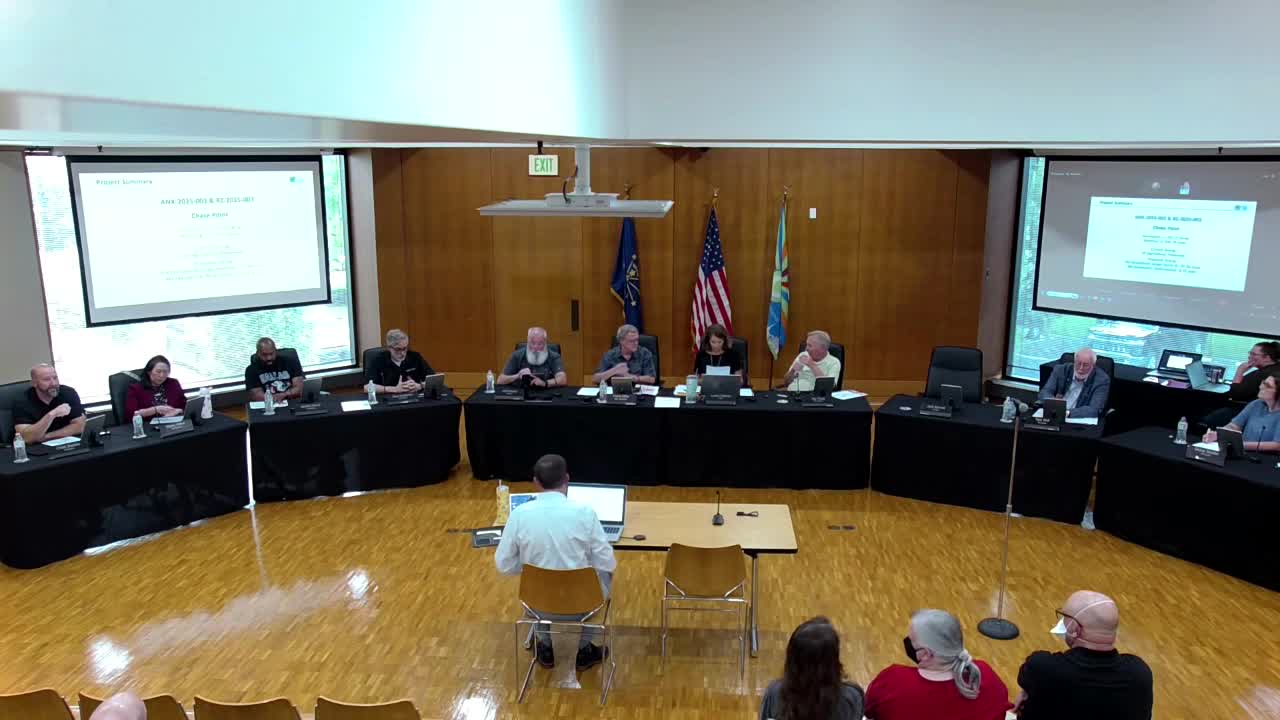
The Columbus City Council voted on June 17 to annex roughly 107 acres north of State Road 46 and to adopt first reading of a companion rezoning that would convert most of the site to RS-4 (residential single-family 4) and a smaller portion to RM (residential multifamily), with council commitments intended to limit impacts and require traffic work.
City planning staff Jeff Bergman told the council the annexation area totals about 107 acres and the rezoning covers about 106.7 acres; roughly 98 acres are proposed for RS-4 and about 9 acres for RM. Bergman said the difference reflects required roadway right-of-way that state law requires be annexed. The planning commission recommended annexation unanimously (11–0) and recommended rezoning 9–2 with five suggested commitments.
Developers Jack and Tom Lasky introduced themselves and emphasized local ties. Jack Lasky said, “Our family's roots in Columbus run generations deep,” and described the team’s intention to produce a development they would be proud to have in the community. Tim Oakes, attorney for the applicants, said the applicants’ initial emphasis is on single-family housing and that preliminary engineering and site constraints make the site’s maximum theoretical density lower than simple acreage calculations suggest.
Key commitments and conditions included in the planning commission recommendation and in council discussion were:
- A cap of 300 homes in the RS-4 portion (the planning commission recommended a maximum of 300; developers indicated they expect a build of about 250 units).
- A buffer between existing homes and the proposed multifamily area.
- An updated traffic study that includes this development and the planned Maple Grove Elementary School; the study is intended to show INDOT whether a traffic signal is warranted at the Belmont–Tipton Lakes–State Road 46 intersection.
- Two points of access for any multifamily development, providing redundancy for safety and emergency access.
- Improvements to the 500 West/State Road 46 intersection as INDOT may require (striping, visibility improvements, minor geometry adjustments).
At the council meeting, public commenters raised traffic safety and congestion concerns on State Road 46 and 500 West, potential impacts to rural character, wildlife and property values, and uncertainty about the multifamily component. Several residents asked whether an INDOT signal or other intersection improvements would be provided; in response Eric Fry, executive director of administration, said the “city, BCSC and Chase Point will be partnering on light to signal funding.” The applicants also committed to pay for the updated traffic study to evaluate signal warrants.
Council deliberations produced two additional council-level actions: an added rezoning commitment limiting any multi-unit building in the RM zone to a maximum of two stories, and discussion that the applicants would return with more detailed proposed limitations (for example on density or unit counts) before second reading. Council members also noted subdivision-control rules that limit a single-access subdivision to no more than 30 lots before a second access is required; staff confirmed that any multifamily development would also be withheld until two access points exist.
Votes: The annexation ordinance passed on a roll call vote of 8–0 with one abstention (Grace Kessler). When council added the two-story maximum commitment for RM, that motion passed 7–1 with one abstention. The rezoning first-reading motion passed 7–1 with one abstention; council said the second reading will occur on July 1, at which point further conditions may be refined.
Why it matters: The annexation and rezoning clear statutory and zoning steps that would permit a large residential subdivision on Columbus’s northwest edge. The council’s additional commitments — a cap on RS-4 units, buffering, traffic-study and access requirements, and a two-story limit for multifamily — are intended to reduce neighborhood impacts and address safety and traffic concerns during later engineering and platting steps.
Next steps: With annexation approved and rezoning passed on first reading (with added commitment), developers will proceed with engineering, an updated traffic study, and subsequent administrative subdivision and site-plan work. The rezoning returns for second reading on July 1, when council may add or refine conditions before final approval.
City planning staff Jeff Bergman told the council the annexation area totals about 107 acres and the rezoning covers about 106.7 acres; roughly 98 acres are proposed for RS-4 and about 9 acres for RM. Bergman said the difference reflects required roadway right-of-way that state law requires be annexed. The planning commission recommended annexation unanimously (11–0) and recommended rezoning 9–2 with five suggested commitments.
Developers Jack and Tom Lasky introduced themselves and emphasized local ties. Jack Lasky said, “Our family's roots in Columbus run generations deep,” and described the team’s intention to produce a development they would be proud to have in the community. Tim Oakes, attorney for the applicants, said the applicants’ initial emphasis is on single-family housing and that preliminary engineering and site constraints make the site’s maximum theoretical density lower than simple acreage calculations suggest.
Key commitments and conditions included in the planning commission recommendation and in council discussion were:
- A cap of 300 homes in the RS-4 portion (the planning commission recommended a maximum of 300; developers indicated they expect a build of about 250 units).
- A buffer between existing homes and the proposed multifamily area.
- An updated traffic study that includes this development and the planned Maple Grove Elementary School; the study is intended to show INDOT whether a traffic signal is warranted at the Belmont–Tipton Lakes–State Road 46 intersection.
- Two points of access for any multifamily development, providing redundancy for safety and emergency access.
- Improvements to the 500 West/State Road 46 intersection as INDOT may require (striping, visibility improvements, minor geometry adjustments).
At the council meeting, public commenters raised traffic safety and congestion concerns on State Road 46 and 500 West, potential impacts to rural character, wildlife and property values, and uncertainty about the multifamily component. Several residents asked whether an INDOT signal or other intersection improvements would be provided; in response Eric Fry, executive director of administration, said the “city, BCSC and Chase Point will be partnering on light to signal funding.” The applicants also committed to pay for the updated traffic study to evaluate signal warrants.
Council deliberations produced two additional council-level actions: an added rezoning commitment limiting any multi-unit building in the RM zone to a maximum of two stories, and discussion that the applicants would return with more detailed proposed limitations (for example on density or unit counts) before second reading. Council members also noted subdivision-control rules that limit a single-access subdivision to no more than 30 lots before a second access is required; staff confirmed that any multifamily development would also be withheld until two access points exist.
Votes: The annexation ordinance passed on a roll call vote of 8–0 with one abstention (Grace Kessler). When council added the two-story maximum commitment for RM, that motion passed 7–1 with one abstention. The rezoning first-reading motion passed 7–1 with one abstention; council said the second reading will occur on July 1, at which point further conditions may be refined.
Why it matters: The annexation and rezoning clear statutory and zoning steps that would permit a large residential subdivision on Columbus’s northwest edge. The council’s additional commitments — a cap on RS-4 units, buffering, traffic-study and access requirements, and a two-story limit for multifamily — are intended to reduce neighborhood impacts and address safety and traffic concerns during later engineering and platting steps.
Next steps: With annexation approved and rezoning passed on first reading (with added commitment), developers will proceed with engineering, an updated traffic study, and subsequent administrative subdivision and site-plan work. The rezoning returns for second reading on July 1, when council may add or refine conditions before final approval.
View the Full Meeting & All Its Details
This article offers just a summary. Unlock complete video, transcripts, and insights as a Founder Member.
✓
Watch full, unedited meeting videos
✓
Search every word spoken in unlimited transcripts
✓
AI summaries & real-time alerts (all government levels)
✓
Permanent access to expanding government content
30-day money-back guarantee
