Iowa City council, community police review board debate options after state limits on citizen review
June 17, 2025 | Iowa City, Johnson County, Iowa
This article was created by AI summarizing key points discussed. AI makes mistakes, so for full details and context, please refer to the video of the full meeting. Please report any errors so we can fix them. Report an error »
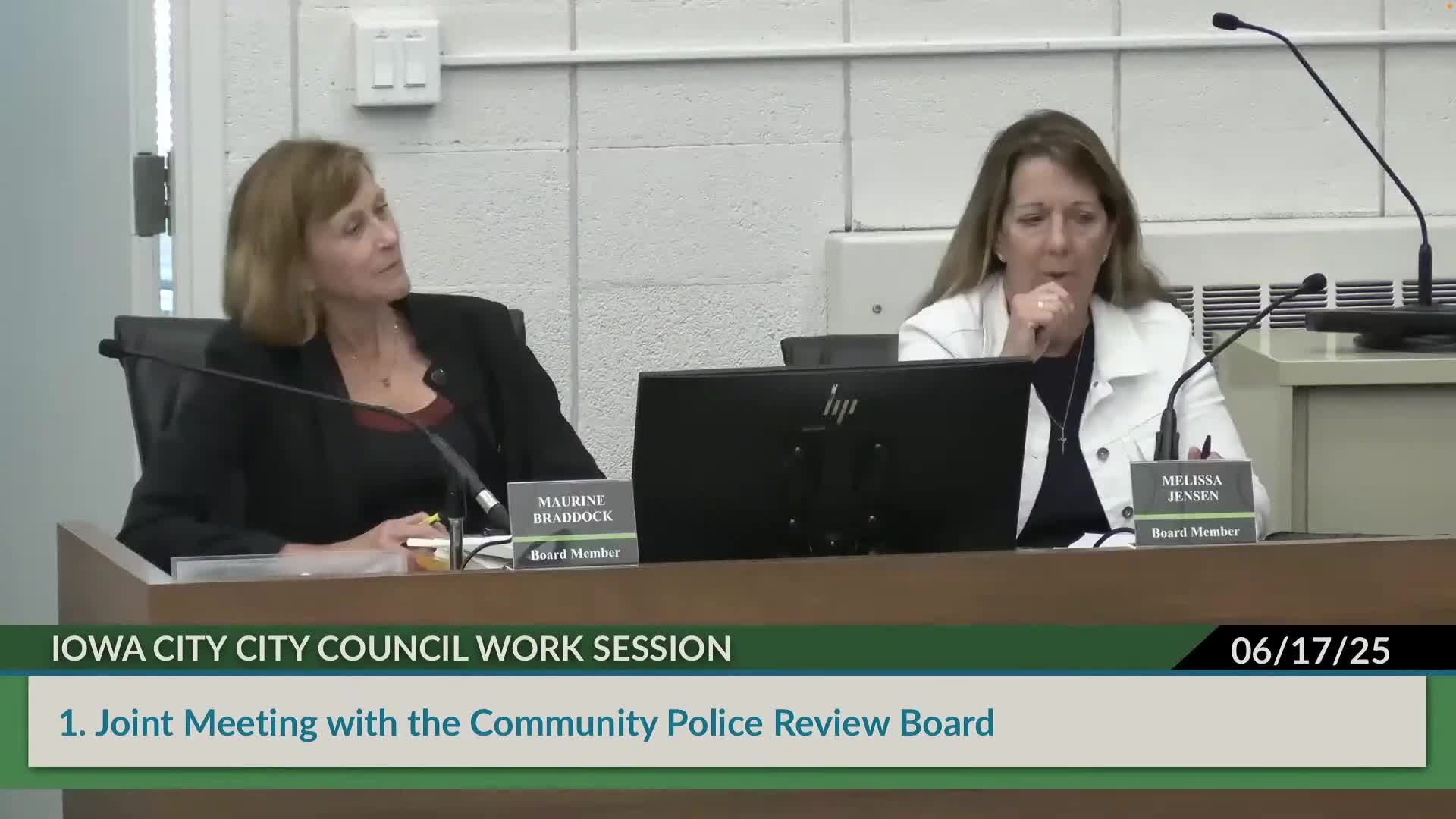
Members of the Iowa City Community Police Review Board (CPRB) and City Council met June 16 to discuss how recent state legislation changes the board's role in reviewing police conduct and to consider alternatives for preserving public input on policing.
The CPRB members said the state law removes the board's authority to review individual officer conduct, narrowing the CPRB's function to policy review. CPRB members recommended ways the city could continue community engagement and provide a public forum, including creating a committee of volunteers to study advisory-board models, establishing police-department-led advisory groups, improving the CPRB web page with complaint filing guidance, and holding regular town-hall style public forums.
Why it matters: The CPRB previously had access to non-public investigative material and executive-session review of complaints, a function board members said added credibility for complainants. Board members and councilors said losing that ability reduces public channels for independent review and that the city should act to retain community trust and an accessible complaint process.
Board members described two broad responses. Some CPRB members favor forming an ad hoc citizen committee to design a new advisory structure to recommend to council. Others recommended that the police chief appoint an informal advisory panel that could meet more frequently and handle community outreach. The CPRB and councilors also discussed using town halls and joint outreach events to bridge perceived distrust between some community members and uniformed officers.
Legal limits and options:
- Eric Horace, the city attorney, advised the council that state legislation (referred to in meeting discussion as Senate File 311) prohibits citizen-review-style bodies from reviewing individual officer conduct. Horace said the city's existing civil service commission (chapter 400) means Iowa City cannot avoid those statutory limits by creating a government body that performs citizen review of conduct.
- Horace told the group that an informal, non-governmental group convened by the chief or city manager could receive public concerns and pass them to the police department, but once the city formally appoints members to a body, open meetings laws would apply and the statutory restriction would likely control whether that body could review individual officer conduct.
Council discussion and next steps:
- Councilors asked the CPRB to return a formal recommendation. Mayor Bruce Teague and several councilors urged the board to meet again, craft a single recommendation on a preferred local structure (for example: a publicly appointed advisory board, a department-run advisory committee, or a town-hall model), and submit it to council before the CPRB's statutory sunset date later this summer.
- Councilor comments stressed two priorities: preserving accessible public pathways for complaint filing and explanation of process, and avoiding keeping out-of-date city-code language on the books in a way that confuses residents.
The CPRB signaled it would continue internal discussions and was open to convening a volunteer committee to draft proposals. No formal council action was taken at the meeting; council requested a formal, written recommendation from the CPRB.
The CPRB members said the state law removes the board's authority to review individual officer conduct, narrowing the CPRB's function to policy review. CPRB members recommended ways the city could continue community engagement and provide a public forum, including creating a committee of volunteers to study advisory-board models, establishing police-department-led advisory groups, improving the CPRB web page with complaint filing guidance, and holding regular town-hall style public forums.
Why it matters: The CPRB previously had access to non-public investigative material and executive-session review of complaints, a function board members said added credibility for complainants. Board members and councilors said losing that ability reduces public channels for independent review and that the city should act to retain community trust and an accessible complaint process.
Board members described two broad responses. Some CPRB members favor forming an ad hoc citizen committee to design a new advisory structure to recommend to council. Others recommended that the police chief appoint an informal advisory panel that could meet more frequently and handle community outreach. The CPRB and councilors also discussed using town halls and joint outreach events to bridge perceived distrust between some community members and uniformed officers.
Legal limits and options:
- Eric Horace, the city attorney, advised the council that state legislation (referred to in meeting discussion as Senate File 311) prohibits citizen-review-style bodies from reviewing individual officer conduct. Horace said the city's existing civil service commission (chapter 400) means Iowa City cannot avoid those statutory limits by creating a government body that performs citizen review of conduct.
- Horace told the group that an informal, non-governmental group convened by the chief or city manager could receive public concerns and pass them to the police department, but once the city formally appoints members to a body, open meetings laws would apply and the statutory restriction would likely control whether that body could review individual officer conduct.
Council discussion and next steps:
- Councilors asked the CPRB to return a formal recommendation. Mayor Bruce Teague and several councilors urged the board to meet again, craft a single recommendation on a preferred local structure (for example: a publicly appointed advisory board, a department-run advisory committee, or a town-hall model), and submit it to council before the CPRB's statutory sunset date later this summer.
- Councilor comments stressed two priorities: preserving accessible public pathways for complaint filing and explanation of process, and avoiding keeping out-of-date city-code language on the books in a way that confuses residents.
The CPRB signaled it would continue internal discussions and was open to convening a volunteer committee to draft proposals. No formal council action was taken at the meeting; council requested a formal, written recommendation from the CPRB.
Don't Miss a Word: See the Full Meeting!
Go beyond summaries. Unlock every video, transcript, and key insight with a Founder Membership.
✓
Get instant access to full meeting videos
✓
Search and clip any phrase from complete transcripts
✓
Receive AI-powered summaries & custom alerts
✓
Enjoy lifetime, unrestricted access to government data
30-day money-back guarantee
