Iowa City council narrows ballot language: aims to use local option sales tax for housing, infrastructure and partnerships
June 17, 2025 | Iowa City, Johnson County, Iowa
This article was created by AI summarizing key points discussed. AI makes mistakes, so for full details and context, please refer to the video of the full meeting. Please report any errors so we can fix them. Report an error »
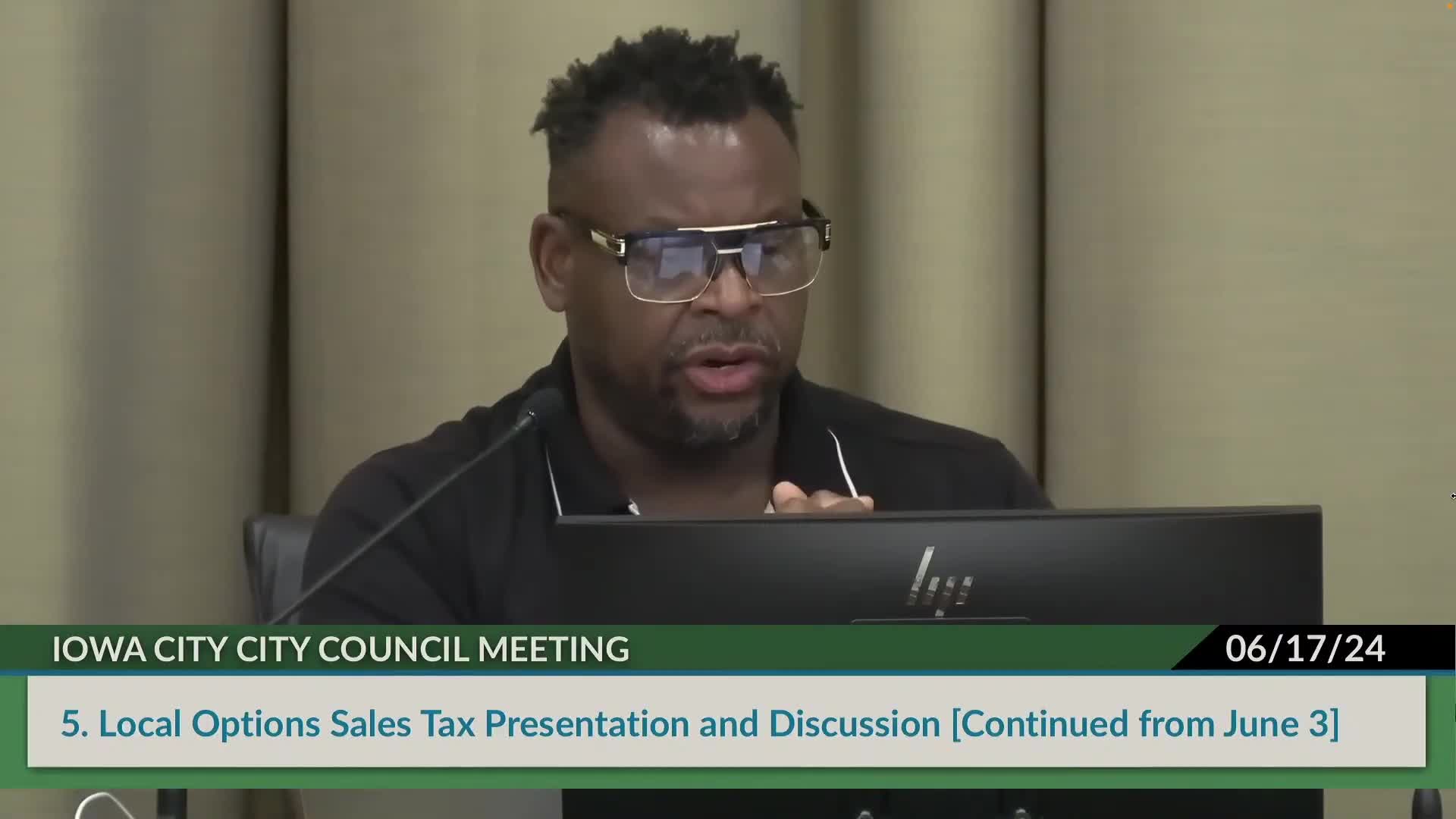
Iowa City's council spent extensive time June 16 discussing draft ballot language for a proposed local option sales tax (LOST) that would fund a mix of housing, infrastructure and community partnership priorities if voters approve it.
What the council asked for: After a long discussion of wording and trade-offs, a majority of councilors directed staff to prepare ballot language that would allocate the proposed new revenue roughly as follows: 25% for affordable housing and related shelter/transitional housing supports; 10% for maintenance and construction of public streets, sidewalks, trails, parks and public facilities; and 15% for community partnerships, including social services, intergovernmental agreements, economic development and arts and culture. The remaining 50% of revenue would be used for property-tax relief, as required by state guidance and the city's budget priorities.
Why it matters: Councilors repeatedly cited housing affordability and the need to backfill lost property-tax revenue as the central drivers for the measure. The proposed tax is regressive in structure (a sales tax), so the council sought language that directs a substantial share to housing and social-service uses to address equity concerns.
Draft language and specificity:
- Councilors debated wording trade-offs between specificity and flexibility. City staff presented a draft that identified broad categories; local advocacy groups submitted more specific language focused on preserving and increasing affordable housing stock, shelter supports and services for low-income households. Several councilors favored the more explicit housing language for clarity and public messaging; others warned that overly specific ballot language can constrain future councils.
- Councilors asked staff to clarify whether transitional housing and shelter supports are demonstrably covered by the housing bucket. Staff advised that both interpretations were reasonable and that council could add explicit mention of transitional housing to avoid ambiguity.
Timing and election date:
- The council expressed a majority preference for placing the issue on the November regular election rather than a special or spring election. Members argued November draws higher turnout and better public awareness for ballot measures. Staff reminded the council that a fall election pushes the effective date to the following July 1 (state rules allow January 1 or July 1 implementation depending on which election is used).
Sunset and governance:
- Councilors debated whether the tax should include a sunset clause. Some argued a sunset could reassure voters and require a future review; others warned a sunset could constrain long-term planning and leave the city vulnerable to future state changes. A majority of councilors leaned away from a sunset clause, preferring that future councils and voters retain the option to change course if needed.
Next steps:
- Staff was directed to prepare refined ballot language based on the council's direction (25% housing, 10% infrastructure, 15% community partnerships and 50% for property-tax relief), to return language that clarifies eligible uses (including transitional housing) and to prepare materials for council review at an upcoming work session and the August meeting timeline staff identified for final ballot-setting. Several councilors also urged that the city proactively develop an explanatory outreach plan for voters.
No final ballot resolution was adopted at this meeting. Councilors said they would continue edits and outreach before returning for a formal vote required to place the measure on the November ballot.
What the council asked for: After a long discussion of wording and trade-offs, a majority of councilors directed staff to prepare ballot language that would allocate the proposed new revenue roughly as follows: 25% for affordable housing and related shelter/transitional housing supports; 10% for maintenance and construction of public streets, sidewalks, trails, parks and public facilities; and 15% for community partnerships, including social services, intergovernmental agreements, economic development and arts and culture. The remaining 50% of revenue would be used for property-tax relief, as required by state guidance and the city's budget priorities.
Why it matters: Councilors repeatedly cited housing affordability and the need to backfill lost property-tax revenue as the central drivers for the measure. The proposed tax is regressive in structure (a sales tax), so the council sought language that directs a substantial share to housing and social-service uses to address equity concerns.
Draft language and specificity:
- Councilors debated wording trade-offs between specificity and flexibility. City staff presented a draft that identified broad categories; local advocacy groups submitted more specific language focused on preserving and increasing affordable housing stock, shelter supports and services for low-income households. Several councilors favored the more explicit housing language for clarity and public messaging; others warned that overly specific ballot language can constrain future councils.
- Councilors asked staff to clarify whether transitional housing and shelter supports are demonstrably covered by the housing bucket. Staff advised that both interpretations were reasonable and that council could add explicit mention of transitional housing to avoid ambiguity.
Timing and election date:
- The council expressed a majority preference for placing the issue on the November regular election rather than a special or spring election. Members argued November draws higher turnout and better public awareness for ballot measures. Staff reminded the council that a fall election pushes the effective date to the following July 1 (state rules allow January 1 or July 1 implementation depending on which election is used).
Sunset and governance:
- Councilors debated whether the tax should include a sunset clause. Some argued a sunset could reassure voters and require a future review; others warned a sunset could constrain long-term planning and leave the city vulnerable to future state changes. A majority of councilors leaned away from a sunset clause, preferring that future councils and voters retain the option to change course if needed.
Next steps:
- Staff was directed to prepare refined ballot language based on the council's direction (25% housing, 10% infrastructure, 15% community partnerships and 50% for property-tax relief), to return language that clarifies eligible uses (including transitional housing) and to prepare materials for council review at an upcoming work session and the August meeting timeline staff identified for final ballot-setting. Several councilors also urged that the city proactively develop an explanatory outreach plan for voters.
No final ballot resolution was adopted at this meeting. Councilors said they would continue edits and outreach before returning for a formal vote required to place the measure on the November ballot.
Don't Miss a Word: See the Full Meeting!
Go beyond summaries. Unlock every video, transcript, and key insight with a Founder Membership.
✓
Get instant access to full meeting videos
✓
Search and clip any phrase from complete transcripts
✓
Receive AI-powered summaries & custom alerts
✓
Enjoy lifetime, unrestricted access to government data
30-day money-back guarantee
