Ames MPO presents draft 2050 Metropolitan Transportation Plan and Safety Action Plan; planners propose fiscally constrained projects and public engagement next
June 18, 2025 | Ames City, Story County, Iowa
This article was created by AI summarizing key points discussed. AI makes mistakes, so for full details and context, please refer to the video of the full meeting. Please report any errors so we can fix them. Report an error »
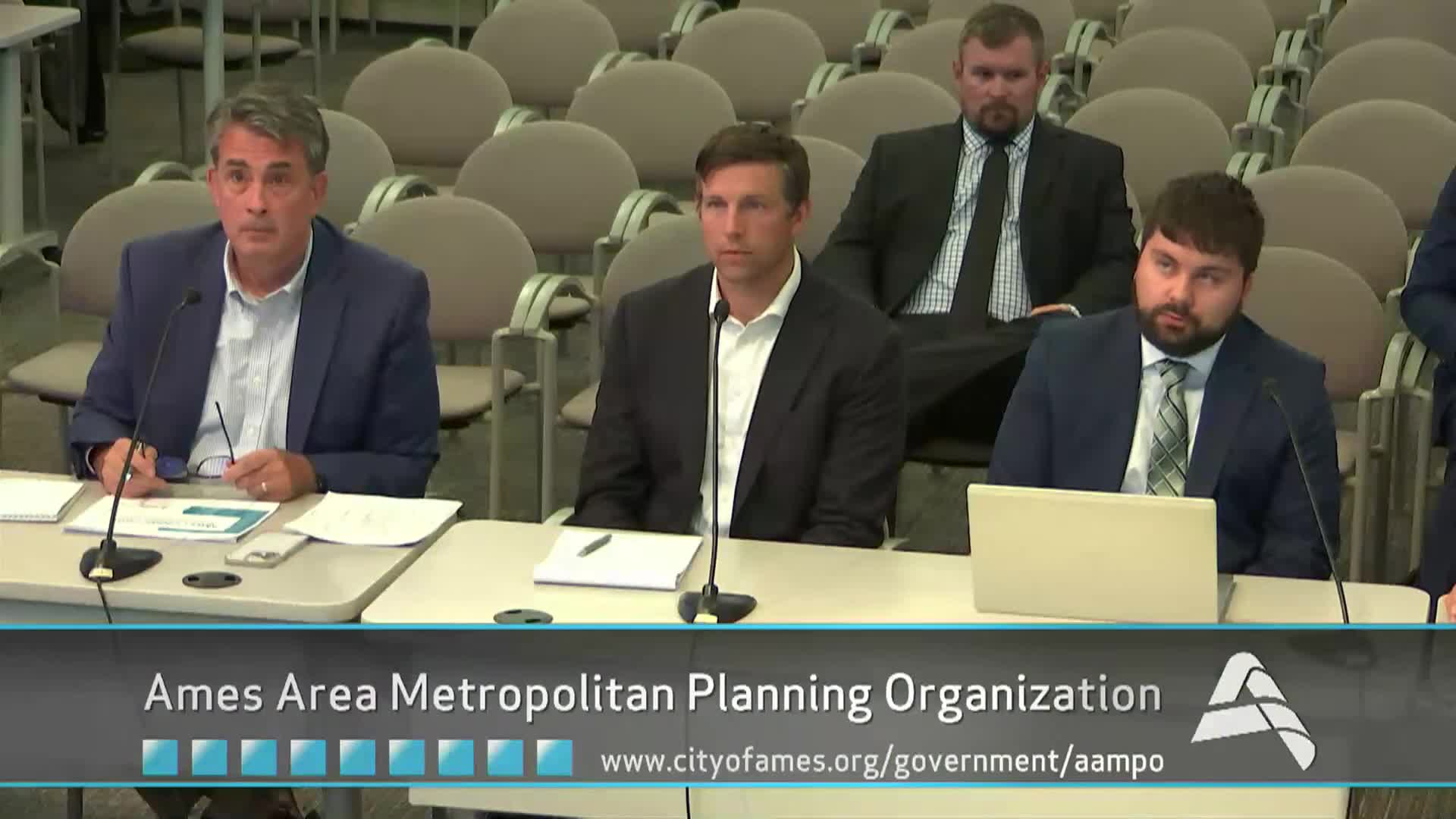
Metropolitan-planning staff presented a draft Metropolitan Transportation Plan and an aligned Comprehensive Safety Action Plan to the Ames-area policy committee on June 17, outlining how the region will guide multimodal transportation investments through 2050.
The draft MTP looks “at least 20 years” ahead, staff said, and is renewed every five years. It combines multimodal project planning — including bicycle, pedestrian, vehicle, freight and transit investments — with a safety-focused CSAP funded through the federal Safe Streets and Roads for All (SS4A) program.
The plans matter because they set priorities used to distribute limited federal formula funds such as the Surface Transportation Block Grant (STBG) and the Transportation Alternatives Program (TAP), and because CSAP projects can make jurisdictions eligible for future USDOT discretionary grants. Staff said the MPO currently estimates roughly $2 million per year in STBG funding and about $200,000 per year in TAP funding for the region, and that those amounts shaped a fiscally constrained project list.
Staff outlined how planners combined technical analyses (traffic operations, crash history, pavement and bridge conditions, freight movement, transit access) with a robust public-engagement program. Kyle, staff member, said the MPO used in-person pop-ups, an online presence and a statistically valid household survey of just over 400 households to weigh local priorities. “That tells us what the high-priority projects, what the medium, and what the low priority [are],” Kyle said, describing how public weighting was folded into project scoring.
The draft plan identifies five goal areas: accessibility and connectivity, safety, sustainability, efficiency and reliability, and placemaking/quality of life. Planners noted the CSAP’s narrower focus on “life‑altering” crashes and explained how CSAP findings were used to add depth to the MTP’s multimodal recommendations.
Technical findings presented by staff and consultants include a regional model projecting about 1% annual population growth in the MPO urbanized area and roughly 25–30% growth in households and jobs by 2050. That growth, staff said, drives a projected 35% increase in vehicle miles traveled and a 37% increase in vehicle hours traveled in the MPO area under the planning assumptions.
The CSAP team identified a relatively small share of lane miles that account for more than three-quarters of current fatalities and serious injuries, and proposed a mix of near‑term, systemic and policy strategies. Recommended countermeasures include roundabouts and left-turn management at conflict-prone intersections, access-management and lane reconfiguration on corridors where four lanes are creating unsafe speeds, pedestrian/cyclist separations in high-conflict areas, and intersection retiming or signal adjustments to improve safety for all users. John, staff member, described eight contributing crash factors the CSAP used (distracted driving, impaired driving, speeding, and age‑related vulnerabilities among them) to target treatments.
Planners presented a prioritized project list grouped into short-term (committed projects through 2029), mid-term (2030–2040) and long-term (2041–2050) buckets. The list includes system-management projects (turn lanes, medians, intersection reconfigurations), road diets and lane reconfigurations, new interchanges in select corridors, roundabouts at selected intersections, and bicycle/pedestrian projects consistent with the city’s Walk, Bike, Roll plan. Staff noted that many projects identified as “illustrative” could be advanced sooner if competitive grants or local funding became available.
Staff emphasized the role of performance measures in prioritization and said the MPO used a multi-criteria scoring system that combined technical metrics with public priorities to rank projects. Damien, staff member, told the committee the model and scoring are federally recognized approaches and are designed to preserve eligibility for federal funding and to make local project selections comparable to other MPOs in grant competitions.
Committee members pressed staff on several topics: how commuting patterns that draw workers from outside Ames affect vehicle miles traveled (staff said the MPO model counts only the portion of trips inside the urbanized boundary but does capture impacts at the MPO edge), how demographic groups (for example, younger drivers) factor into proactive safety screening (staff said crash history is the primary dataset but that further location-level study can be used to anticipate risk), and how project costs compare with the available $2 million‑per‑year STBG allocations (staff noted that typical roadway projects are often larger than a single year’s allocation and stressed the role of competitive discretionary grants and local matches).
Staff said they are working closely with CyRide (transit agency staff identified in the presentation as Syride) on transit recommendations and are coordinating with Iowa State University on projects that affect institutional roads; they also explained that SS4A grants allow local institutions that own roads to apply if projects meet eligibility.
Next steps: staff said the draft plan will be posted for agency and public review, with a policy committee review planned July 29 and a target final adoption in late September. The MPO will provide tables that match project IDs to planning-level cost estimates and further documentation of prioritization scores.
The presentation closed with committee members and staff noting that the plan is a framework: it prioritizes use of constrained federal funds, leaves many projects illustrative or contingent on grant awards or local funding, and points to follow-up corridor‑level studies and operational plans where more detailed engineering will determine final designs and schedules.
The draft MTP looks “at least 20 years” ahead, staff said, and is renewed every five years. It combines multimodal project planning — including bicycle, pedestrian, vehicle, freight and transit investments — with a safety-focused CSAP funded through the federal Safe Streets and Roads for All (SS4A) program.
The plans matter because they set priorities used to distribute limited federal formula funds such as the Surface Transportation Block Grant (STBG) and the Transportation Alternatives Program (TAP), and because CSAP projects can make jurisdictions eligible for future USDOT discretionary grants. Staff said the MPO currently estimates roughly $2 million per year in STBG funding and about $200,000 per year in TAP funding for the region, and that those amounts shaped a fiscally constrained project list.
Staff outlined how planners combined technical analyses (traffic operations, crash history, pavement and bridge conditions, freight movement, transit access) with a robust public-engagement program. Kyle, staff member, said the MPO used in-person pop-ups, an online presence and a statistically valid household survey of just over 400 households to weigh local priorities. “That tells us what the high-priority projects, what the medium, and what the low priority [are],” Kyle said, describing how public weighting was folded into project scoring.
The draft plan identifies five goal areas: accessibility and connectivity, safety, sustainability, efficiency and reliability, and placemaking/quality of life. Planners noted the CSAP’s narrower focus on “life‑altering” crashes and explained how CSAP findings were used to add depth to the MTP’s multimodal recommendations.
Technical findings presented by staff and consultants include a regional model projecting about 1% annual population growth in the MPO urbanized area and roughly 25–30% growth in households and jobs by 2050. That growth, staff said, drives a projected 35% increase in vehicle miles traveled and a 37% increase in vehicle hours traveled in the MPO area under the planning assumptions.
The CSAP team identified a relatively small share of lane miles that account for more than three-quarters of current fatalities and serious injuries, and proposed a mix of near‑term, systemic and policy strategies. Recommended countermeasures include roundabouts and left-turn management at conflict-prone intersections, access-management and lane reconfiguration on corridors where four lanes are creating unsafe speeds, pedestrian/cyclist separations in high-conflict areas, and intersection retiming or signal adjustments to improve safety for all users. John, staff member, described eight contributing crash factors the CSAP used (distracted driving, impaired driving, speeding, and age‑related vulnerabilities among them) to target treatments.
Planners presented a prioritized project list grouped into short-term (committed projects through 2029), mid-term (2030–2040) and long-term (2041–2050) buckets. The list includes system-management projects (turn lanes, medians, intersection reconfigurations), road diets and lane reconfigurations, new interchanges in select corridors, roundabouts at selected intersections, and bicycle/pedestrian projects consistent with the city’s Walk, Bike, Roll plan. Staff noted that many projects identified as “illustrative” could be advanced sooner if competitive grants or local funding became available.
Staff emphasized the role of performance measures in prioritization and said the MPO used a multi-criteria scoring system that combined technical metrics with public priorities to rank projects. Damien, staff member, told the committee the model and scoring are federally recognized approaches and are designed to preserve eligibility for federal funding and to make local project selections comparable to other MPOs in grant competitions.
Committee members pressed staff on several topics: how commuting patterns that draw workers from outside Ames affect vehicle miles traveled (staff said the MPO model counts only the portion of trips inside the urbanized boundary but does capture impacts at the MPO edge), how demographic groups (for example, younger drivers) factor into proactive safety screening (staff said crash history is the primary dataset but that further location-level study can be used to anticipate risk), and how project costs compare with the available $2 million‑per‑year STBG allocations (staff noted that typical roadway projects are often larger than a single year’s allocation and stressed the role of competitive discretionary grants and local matches).
Staff said they are working closely with CyRide (transit agency staff identified in the presentation as Syride) on transit recommendations and are coordinating with Iowa State University on projects that affect institutional roads; they also explained that SS4A grants allow local institutions that own roads to apply if projects meet eligibility.
Next steps: staff said the draft plan will be posted for agency and public review, with a policy committee review planned July 29 and a target final adoption in late September. The MPO will provide tables that match project IDs to planning-level cost estimates and further documentation of prioritization scores.
The presentation closed with committee members and staff noting that the plan is a framework: it prioritizes use of constrained federal funds, leaves many projects illustrative or contingent on grant awards or local funding, and points to follow-up corridor‑level studies and operational plans where more detailed engineering will determine final designs and schedules.
View the Full Meeting & All Its Details
This article offers just a summary. Unlock complete video, transcripts, and insights as a Founder Member.
✓
Watch full, unedited meeting videos
✓
Search every word spoken in unlimited transcripts
✓
AI summaries & real-time alerts (all government levels)
✓
Permanent access to expanding government content
30-day money-back guarantee
