Ames utility outlines plan to replace aging Unit 7, preserve Unit 8 and add flexible gas capacity plus renewables
June 18, 2025 | Ames City, Story County, Iowa
This article was created by AI summarizing key points discussed. AI makes mistakes, so for full details and context, please refer to the video of the full meeting. Please report any errors so we can fix them. Report an error »
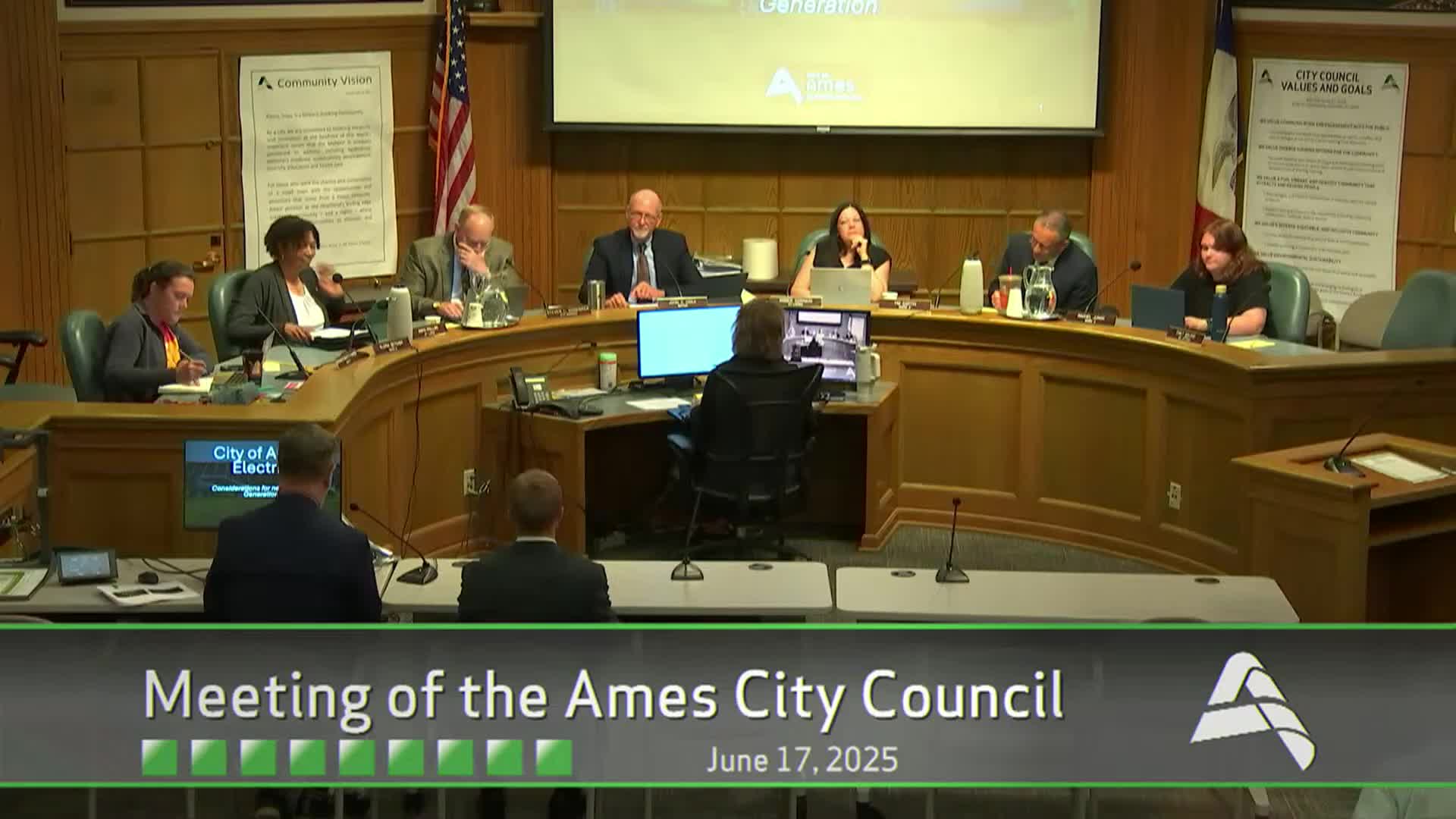
Ames electric utility staff gave a detailed briefing to City Council on June 17 about the condition of the city’s generating units, projected load growth and a staged plan to replace retiring capacity while increasing renewable energy.
Don, electric utility director, and Lane Farber, the city’s new energy services coordinator, told council that Unit 7 — a steam unit installed in 1967 that burns refuse‑derived fuel (RDF) — faces substantial near‑term maintenance needs and is likely to be retired in about five to seven years once the RDF program ends. Unit 8, commissioned in 1982 and currently burning RDF and natural gas, is in better condition but will require longer-term replacement planning, staff said.
Why it matters: MISO (the regional transmission operator) requires load‑serving entities to hold capacity to meet peak demand plus reserve margins. Staff said losing Unit 8 for the three summer months without replacement capacity would cost the utility an estimated $4 million in capacity replacement in one season alone. Council heard that prudent planning is necessary to avoid a forced, costly market purchase if an existing unit becomes unavailable.
Staff reviewed an engineering life assessment by a consultant that used a green/yellow/red scoring of equipment condition. The assessment flagged several critical components on Unit 7 (boiler tubes, generator/turbine overhaul, condenser/circulating water piping and the unit’s generator step‑up transformer) and noted the unit’s age and heavy wear from burning RDF. The consultant concluded that completing necessary repairs on Unit 7 would approach roughly two‑thirds of the cost of installing a new generating unit of similar capacity.
Given the condition and the long lead times for some technologies, staff said the city’s preferred near‑term strategy is staged replacement. The utility’s capital-improvement plan includes funding to procure roughly 60 megawatts of flexible capacity — approximately three reciprocating internal combustion engine (RICE) units — to replace Unit 7 and provide roughly 20 megawatts of headroom for anticipated load growth. Staff said RICE machines can start rapidly (minutes) or be kept warm for quick starts, have short procurement lead times compared with combined‑cycle plants, and are cost‑competitive at the project sizes Ames needs.
Don said the draft CIP also includes funding to contract for up to 63 megawatts of wind and about 26 megawatts of solar, numbers derived from load‑shape modeling that balanced seasonal patterns of wind and solar against Ames’s summer‑peaking demand. The modeling — run across hundreds of scenarios by a consultant — suggested that around 63 MW of wind and 26 MW of solar best fills gaps in the load without causing frequent overproduction in low‑demand months unless the utility also procures storage.
Staff summarized high-level costs and timing in the utility CIP: roughly $84 million in the current CIP to procure and install the first tranche of flexible generation (three RICE units), roughly $50 million of additional capacity earmarked for renewables by the end of the decade, and associated substation and transmission work. Staff said these figures are order‑of‑magnitude and that the CIP assumes modest rate increases and savings from discontinuing RDF operations will help cash‑flow borrowing for construction. Lane said Cedar Falls and other peer utilities have pursued large data‑center or crypto‑mining loads, and councilors discussed whether Ames should adopt a policy on hosting such high‑use customers.
Council members asked about site selection and community impacts. Staff identified the existing coal yard adjacent to the Ames plant substation as the preferred site because of available space, proximity to the substation and an existing gas line. Staff acknowledged the location is near downtown and said sound attenuation and site design would be part of engineering. Councilors asked staff to evaluate alternative sites closer to the substation and to consider long‑term redevelopment options for the old plant footprint when generation is fully replaced.
Key near‑term actions and schedule staff described: issue an engineering request for proposals (RFP) for project design (staff expected to return to council with a recommended engineering contract in July), select an engineer, complete design and permitting steps and order RICE units so equipment delivery would start in 2026 with commercial operation targeted in 2029. Staff said some transformers and switchgear carry long lead times and were included in procurement planning.
Staff emphasized uncertainties: federal incentives (for example, provisions under the Inflation Reduction Act) can change project economics; wholesale market prices and MISO capacity market dynamics affect operating economics; and prospective large customers (such as data centers) could alter load forecasts and timing. Don told council the utility will continue refining cost estimates, rate impacts and funding strategies before committing to final construction contracts.
Council members asked staff to evaluate collaborations with institutional partners such as Iowa State University and to involve the city’s Utility Rate Advisory Board and community advisory bodies as design and siting proceed. No formal action was taken; staff sought council direction on next steps and will return with procurement and financing details as the design phase progresses.
Don, electric utility director, and Lane Farber, the city’s new energy services coordinator, told council that Unit 7 — a steam unit installed in 1967 that burns refuse‑derived fuel (RDF) — faces substantial near‑term maintenance needs and is likely to be retired in about five to seven years once the RDF program ends. Unit 8, commissioned in 1982 and currently burning RDF and natural gas, is in better condition but will require longer-term replacement planning, staff said.
Why it matters: MISO (the regional transmission operator) requires load‑serving entities to hold capacity to meet peak demand plus reserve margins. Staff said losing Unit 8 for the three summer months without replacement capacity would cost the utility an estimated $4 million in capacity replacement in one season alone. Council heard that prudent planning is necessary to avoid a forced, costly market purchase if an existing unit becomes unavailable.
Staff reviewed an engineering life assessment by a consultant that used a green/yellow/red scoring of equipment condition. The assessment flagged several critical components on Unit 7 (boiler tubes, generator/turbine overhaul, condenser/circulating water piping and the unit’s generator step‑up transformer) and noted the unit’s age and heavy wear from burning RDF. The consultant concluded that completing necessary repairs on Unit 7 would approach roughly two‑thirds of the cost of installing a new generating unit of similar capacity.
Given the condition and the long lead times for some technologies, staff said the city’s preferred near‑term strategy is staged replacement. The utility’s capital-improvement plan includes funding to procure roughly 60 megawatts of flexible capacity — approximately three reciprocating internal combustion engine (RICE) units — to replace Unit 7 and provide roughly 20 megawatts of headroom for anticipated load growth. Staff said RICE machines can start rapidly (minutes) or be kept warm for quick starts, have short procurement lead times compared with combined‑cycle plants, and are cost‑competitive at the project sizes Ames needs.
Don said the draft CIP also includes funding to contract for up to 63 megawatts of wind and about 26 megawatts of solar, numbers derived from load‑shape modeling that balanced seasonal patterns of wind and solar against Ames’s summer‑peaking demand. The modeling — run across hundreds of scenarios by a consultant — suggested that around 63 MW of wind and 26 MW of solar best fills gaps in the load without causing frequent overproduction in low‑demand months unless the utility also procures storage.
Staff summarized high-level costs and timing in the utility CIP: roughly $84 million in the current CIP to procure and install the first tranche of flexible generation (three RICE units), roughly $50 million of additional capacity earmarked for renewables by the end of the decade, and associated substation and transmission work. Staff said these figures are order‑of‑magnitude and that the CIP assumes modest rate increases and savings from discontinuing RDF operations will help cash‑flow borrowing for construction. Lane said Cedar Falls and other peer utilities have pursued large data‑center or crypto‑mining loads, and councilors discussed whether Ames should adopt a policy on hosting such high‑use customers.
Council members asked about site selection and community impacts. Staff identified the existing coal yard adjacent to the Ames plant substation as the preferred site because of available space, proximity to the substation and an existing gas line. Staff acknowledged the location is near downtown and said sound attenuation and site design would be part of engineering. Councilors asked staff to evaluate alternative sites closer to the substation and to consider long‑term redevelopment options for the old plant footprint when generation is fully replaced.
Key near‑term actions and schedule staff described: issue an engineering request for proposals (RFP) for project design (staff expected to return to council with a recommended engineering contract in July), select an engineer, complete design and permitting steps and order RICE units so equipment delivery would start in 2026 with commercial operation targeted in 2029. Staff said some transformers and switchgear carry long lead times and were included in procurement planning.
Staff emphasized uncertainties: federal incentives (for example, provisions under the Inflation Reduction Act) can change project economics; wholesale market prices and MISO capacity market dynamics affect operating economics; and prospective large customers (such as data centers) could alter load forecasts and timing. Don told council the utility will continue refining cost estimates, rate impacts and funding strategies before committing to final construction contracts.
Council members asked staff to evaluate collaborations with institutional partners such as Iowa State University and to involve the city’s Utility Rate Advisory Board and community advisory bodies as design and siting proceed. No formal action was taken; staff sought council direction on next steps and will return with procurement and financing details as the design phase progresses.
View the Full Meeting & All Its Details
This article offers just a summary. Unlock complete video, transcripts, and insights as a Founder Member.
✓
Watch full, unedited meeting videos
✓
Search every word spoken in unlimited transcripts
✓
AI summaries & real-time alerts (all government levels)
✓
Permanent access to expanding government content
30-day money-back guarantee
