Council sends critical‑areas ordinance update to public hearing, rejects WDFW 200‑year tree buffer tool
July 16, 2025 | Orting City, Pierce County, Washington
This article was created by AI summarizing key points discussed. AI makes mistakes, so for full details and context, please refer to the video of the full meeting. Please report any errors so we can fix them. Report an error »
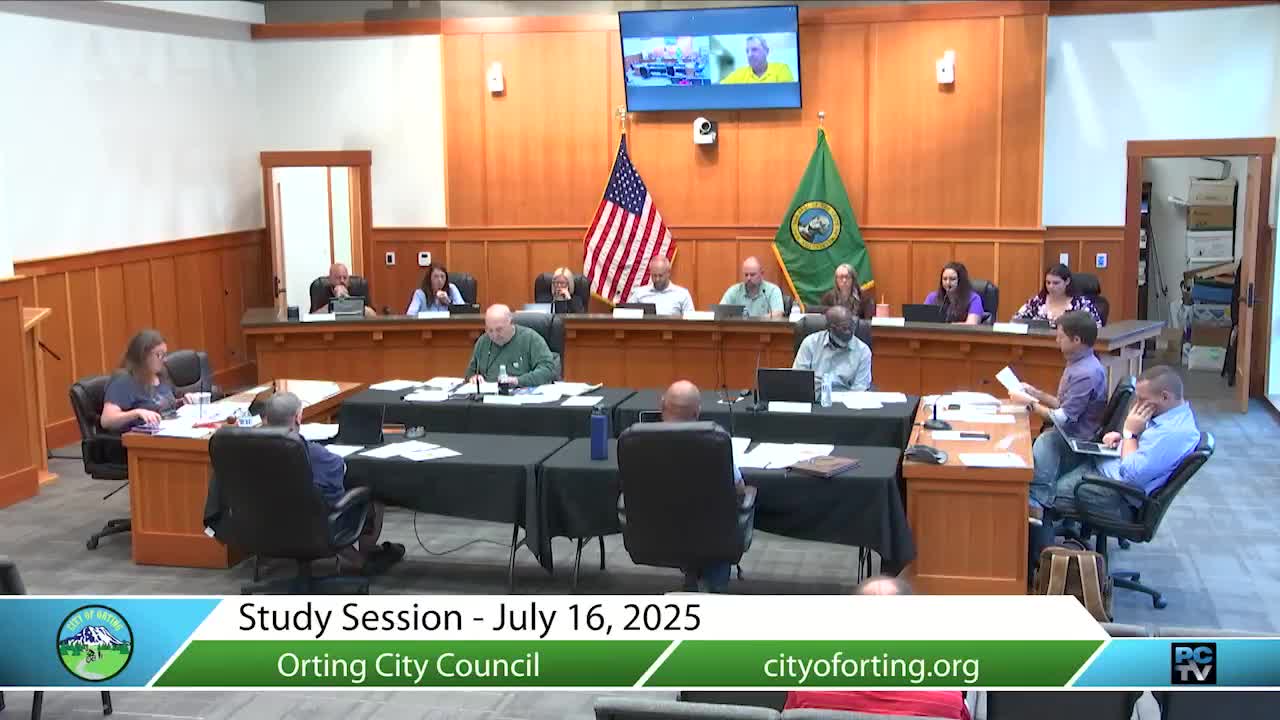
Community Development Director Scott Gunderson briefed the council July 16 on the required update to the city’s Critical Areas Ordinance (Title 11) and recommended the council move the draft ordinance to a public hearing for adoption.
Gunderson said the update is a required component of the comprehensive plan periodic update and that the city used the state’s periodic update grant (PUG) checklist in preparing the draft. The draft adds mitigation sequencing, no‑net‑loss mitigation language and a requirement that applicants use the best available science in third‑party studies, he said.
Gunderson summarized agency comments received during the staff review. The Department of Natural Resources provided mostly definitional and public‑information suggestions, and Ecology’s comments focused on clarifying wetland report and special‑study terminology. He said the Washington Department of Fish and Wildlife recommended a mapping tool that estimates the size of trees at 200 years and then prescribes buffers tied to that predicted tree size; Gunderson said staff would not recommend adopting that tool into the city code because it would produce widely varying buffer widths across town and reduce predictability for developers and property owners.
Council action: Councilmember Holland moved to set the draft ordinance for a public hearing July 30 with action to follow; councilmembers agreed to put the item on the July 30 agenda. Gunderson will distribute the draft ordinance to councilmembers in advance of the hearing.
Why this matters: The ordinance governs how the city regulates wetlands, fish and wildlife habitat, and other critical areas. Changes to buffer rules, mitigation sequencing and best‑available‑science requirements affect permitting and development timelines.
What’s next: Planning Commission recommended adoption of the draft. Staff will publish the draft ordinance and hold the public hearing July 30; council will consider action after the hearing.
Gunderson said the update is a required component of the comprehensive plan periodic update and that the city used the state’s periodic update grant (PUG) checklist in preparing the draft. The draft adds mitigation sequencing, no‑net‑loss mitigation language and a requirement that applicants use the best available science in third‑party studies, he said.
Gunderson summarized agency comments received during the staff review. The Department of Natural Resources provided mostly definitional and public‑information suggestions, and Ecology’s comments focused on clarifying wetland report and special‑study terminology. He said the Washington Department of Fish and Wildlife recommended a mapping tool that estimates the size of trees at 200 years and then prescribes buffers tied to that predicted tree size; Gunderson said staff would not recommend adopting that tool into the city code because it would produce widely varying buffer widths across town and reduce predictability for developers and property owners.
Council action: Councilmember Holland moved to set the draft ordinance for a public hearing July 30 with action to follow; councilmembers agreed to put the item on the July 30 agenda. Gunderson will distribute the draft ordinance to councilmembers in advance of the hearing.
Why this matters: The ordinance governs how the city regulates wetlands, fish and wildlife habitat, and other critical areas. Changes to buffer rules, mitigation sequencing and best‑available‑science requirements affect permitting and development timelines.
What’s next: Planning Commission recommended adoption of the draft. Staff will publish the draft ordinance and hold the public hearing July 30; council will consider action after the hearing.
View the Full Meeting & All Its Details
This article offers just a summary. Unlock complete video, transcripts, and insights as a Founder Member.
✓
Watch full, unedited meeting videos
✓
Search every word spoken in unlimited transcripts
✓
AI summaries & real-time alerts (all government levels)
✓
Permanent access to expanding government content
30-day money-back guarantee
