RCTC launches Next Generation Toll Feasibility Study 2, selects HDR for corridor evaluation
July 28, 2025 | Riverside County, California
This article was created by AI summarizing key points discussed. AI makes mistakes, so for full details and context, please refer to the video of the full meeting. Please report any errors so we can fix them. Report an error »
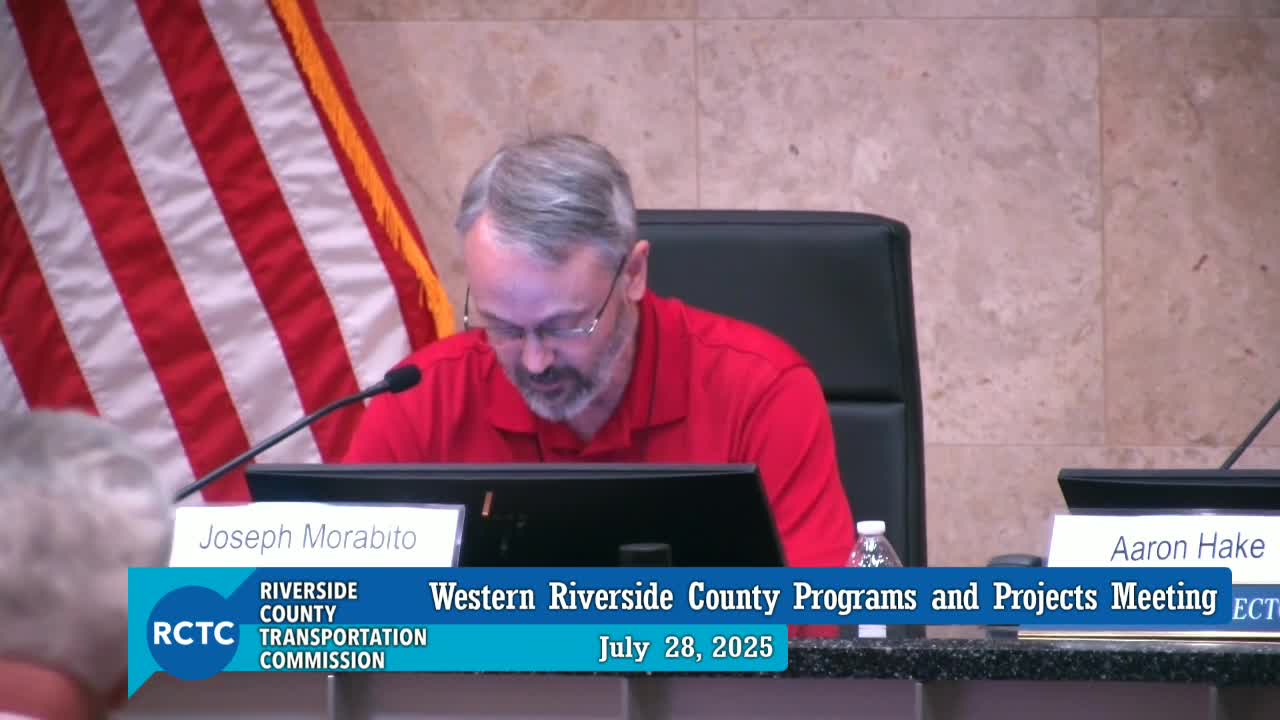
Riverside County Transportation Commission approved an agreement with HDR Engineering to complete Next Generation Toll Feasibility Study 2, a corridor‑level evaluation of potential express lanes and new capacity in western Riverside County.
“Unlike other parts of the state, Riverside County is expected to increase significantly in population,” said David Thomas, RCTC staff, framing the study as a response to future congestion. The study will re‑examine options first analyzed in a 2019 study — which had been shelved after mixed feedback — and will focus on where to add capacity, how to avoid moving congestion to termination points, toll rate implications and equity programs.
The study scope includes three components: converting and augmenting HOV/express facilities on the I‑215 and Box Springs grade; extending and adding lanes on the 91 to create two express lanes in each direction in targeted limits; and improving direct connectivity between the 91 and I‑215 express lane networks. Staff said Route 60 west of the I‑215 is excluded from this study because earlier work showed low financial feasibility and SBCTA already has parallel projects.
Staff said the RFP generated two proposals; after evaluation and interviews HDR scored highest and staff recommended awarding the roughly $1.5 million agreement with a contingency for a total of about $1.65 million. The study will include traffic simulation, updated cost estimates, study of toll‑policy options (including potential discounted or free access for HOV2), equity and VMT mitigation programs, and engagement with Caltrans and cities in the corridor. Staff noted the intention to involve City of Riverside staff and other local jurisdictions in vetting any future project recommendations before bringing them to the commission.
Commissioners raised concerns including converting HOV lanes — a politically sensitive change — and the potential for high toll rates. Staff said the study will evaluate alternatives such as keeping HOV2 free or discounted in express lanes (while maintaining transponder requirements) and that adding capacity can reduce required tolls — citing prior experience where added eastbound capacity on the 91 reduced peak tolls.
The committee voted to approve the HDR agreement; staff expects to return to the commission in 2027 with recommendations on whether to proceed with any new express‑lane projects in western Riverside County.
“Unlike other parts of the state, Riverside County is expected to increase significantly in population,” said David Thomas, RCTC staff, framing the study as a response to future congestion. The study will re‑examine options first analyzed in a 2019 study — which had been shelved after mixed feedback — and will focus on where to add capacity, how to avoid moving congestion to termination points, toll rate implications and equity programs.
The study scope includes three components: converting and augmenting HOV/express facilities on the I‑215 and Box Springs grade; extending and adding lanes on the 91 to create two express lanes in each direction in targeted limits; and improving direct connectivity between the 91 and I‑215 express lane networks. Staff said Route 60 west of the I‑215 is excluded from this study because earlier work showed low financial feasibility and SBCTA already has parallel projects.
Staff said the RFP generated two proposals; after evaluation and interviews HDR scored highest and staff recommended awarding the roughly $1.5 million agreement with a contingency for a total of about $1.65 million. The study will include traffic simulation, updated cost estimates, study of toll‑policy options (including potential discounted or free access for HOV2), equity and VMT mitigation programs, and engagement with Caltrans and cities in the corridor. Staff noted the intention to involve City of Riverside staff and other local jurisdictions in vetting any future project recommendations before bringing them to the commission.
Commissioners raised concerns including converting HOV lanes — a politically sensitive change — and the potential for high toll rates. Staff said the study will evaluate alternatives such as keeping HOV2 free or discounted in express lanes (while maintaining transponder requirements) and that adding capacity can reduce required tolls — citing prior experience where added eastbound capacity on the 91 reduced peak tolls.
The committee voted to approve the HDR agreement; staff expects to return to the commission in 2027 with recommendations on whether to proceed with any new express‑lane projects in western Riverside County.
Don't Miss a Word: See the Full Meeting!
Go beyond summaries. Unlock every video, transcript, and key insight with a Founder Membership.
✓
Get instant access to full meeting videos
✓
Search and clip any phrase from complete transcripts
✓
Receive AI-powered summaries & custom alerts
✓
Enjoy lifetime, unrestricted access to government data
30-day money-back guarantee
