Judge revokes Victor Alvarez's probation, imposes four-year prison term after substance-treatment discharge
July 28, 2025 | Judge Stephanie Boyd 187th District, District Court Judges, Judicial, Texas
This article was created by AI summarizing key points discussed. AI makes mistakes, so for full details and context, please refer to the video of the full meeting. Please report any errors so we can fix them. Report an error »
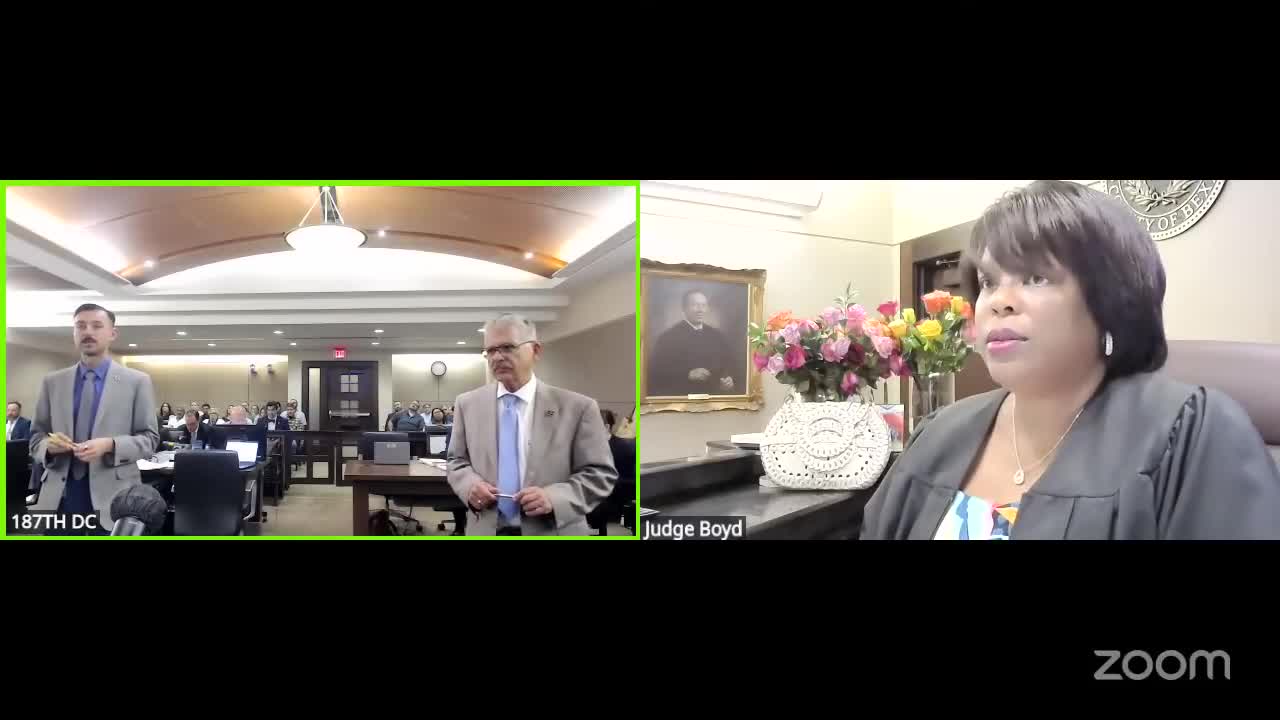
A judge found that the state proved a violation of Victor Alvarez Jr.'s community supervision related to his treatment plan and revoked his probation, sentencing him to four years in prison and imposing a $1,000 fine. The court recommended placement in a therapeutic community and credited Alvarez for time already served.
The violation alleged by the state concerned condition number 55: failure to comply with rules or instructions of the Bexar County Community Supervision and Corrections Department substance-abuse continuum of care and an unsuccessful discharge from the Austin Transitional Center. The state presented a proposed agreement that would have resulted in a three-year sentence, but after argument and a factual colloquy the court found the violation true and announced a four-year term.
Prosecutors stated the alleged violations included a refused drug test, a reported "fake UA," and possession of drug paraphernalia while in a rehabilitation center. Defense counsel acknowledged the client’s addiction history and indicated the client had refused a drug test; the defendant also addressed the court and disputed some factual details. The judge explained the consequences of a true finding, including the possible four-year sentence and the fine, and then imposed the four-year term with credit for time served and a $1,000 fine. The judge also noted the therapeutic-community recommendation and explained that the sentence carries collateral consequences, including limitations on weapons possession tied to felony convictions.
Court admonishments and the trial-court certification of rights to appeal were placed on the record; the judge described the limited right to appeal from a revocation order. The disposition reflects both the court's factual finding of the violation and the court's sentencing decision following the state's motion to revoke supervision.
The violation alleged by the state concerned condition number 55: failure to comply with rules or instructions of the Bexar County Community Supervision and Corrections Department substance-abuse continuum of care and an unsuccessful discharge from the Austin Transitional Center. The state presented a proposed agreement that would have resulted in a three-year sentence, but after argument and a factual colloquy the court found the violation true and announced a four-year term.
Prosecutors stated the alleged violations included a refused drug test, a reported "fake UA," and possession of drug paraphernalia while in a rehabilitation center. Defense counsel acknowledged the client’s addiction history and indicated the client had refused a drug test; the defendant also addressed the court and disputed some factual details. The judge explained the consequences of a true finding, including the possible four-year sentence and the fine, and then imposed the four-year term with credit for time served and a $1,000 fine. The judge also noted the therapeutic-community recommendation and explained that the sentence carries collateral consequences, including limitations on weapons possession tied to felony convictions.
Court admonishments and the trial-court certification of rights to appeal were placed on the record; the judge described the limited right to appeal from a revocation order. The disposition reflects both the court's factual finding of the violation and the court's sentencing decision following the state's motion to revoke supervision.
View the Full Meeting & All Its Details
This article offers just a summary. Unlock complete video, transcripts, and insights as a Founder Member.
✓
Watch full, unedited meeting videos
✓
Search every word spoken in unlimited transcripts
✓
AI summaries & real-time alerts (all government levels)
✓
Permanent access to expanding government content
30-day money-back guarantee
