Task Force endorses VillageReach evaluation plan; calls for county funding and coordination, while a coordinator role is put on hold
July 28, 2025 | Whatcom County, Washington
This article was created by AI summarizing key points discussed. AI makes mistakes, so for full details and context, please refer to the video of the full meeting. Please report any errors so we can fix them. Report an error »
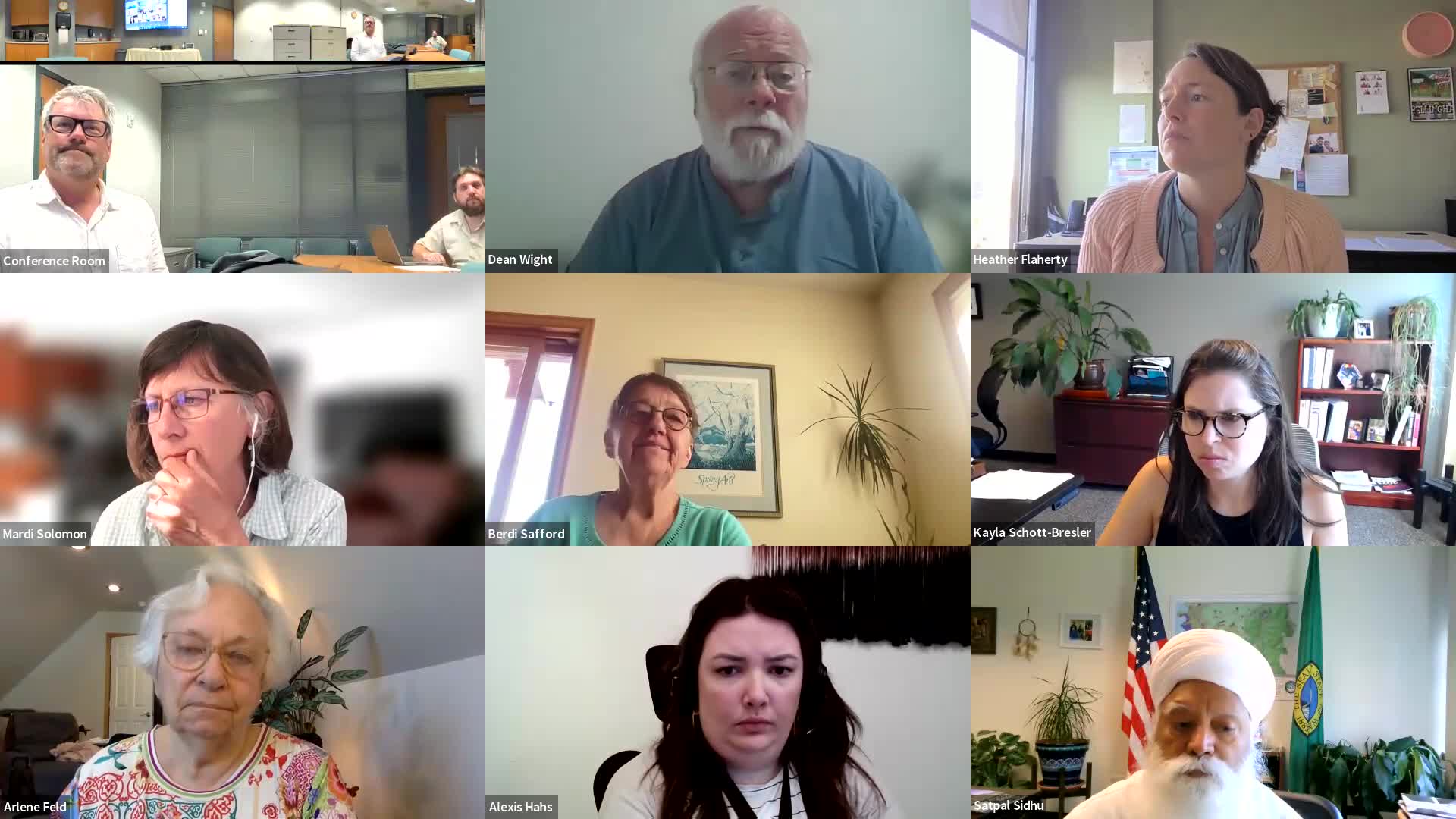
The Whatcom County Incarceration Prevention and Reduction Task Force voted on July 28 to endorse VillageReach’s final evaluation and performance measurement plan for the county’s justice project and recommended the County Council and the county executive implement and finance the report’s recommendations.
The endorsement motion was moved by Bertie Safford and seconded by Scott Cortez. The task force recorded at least one explicit “no” vote from Roger Fung; several members abstained; the motion passed. After discussion about budget, legal constraints and departmental buy‑in, a second motion that would have more narrowly defined the recommended dedicated coordinator position to operationalize the plan was moved but then held until the task force’s next meeting in September.
Why it matters
Task force members and the VillageReach report framed stronger, shared performance measurement as a prerequisite for tracking whether the county’s justice reforms and diversion investments achieve intended outcomes. Task force members said a funded coordinator and interagency data agreements will be needed to make the plan operational, and several members warned the county budget and legal limitations (data sharing and sealed records) require careful planning before hiring or assigning staff.
What the VillageReach plan recommends (summary)
- Near‑term priorities: create a sustained, dedicated coordination role to operationalize the performance plan; define shared indicator definitions (for example, recidivism, diversion eligibility, "warm handoff" and race/ethnicity categories); convene a next‑generation sequential intercept mapping workshop; and begin early reporting using existing data where feasible.
- Data infrastructure: establish data‑sharing agreements and a legal framework that allow de‑identified but linkable reporting across systems (criminal justice, courts, behavioral health, tribal partners and other agencies).
- Communication: develop dashboards and regular reporting to inform the public, elected officials and partner agencies.
Task force discussion and concerns
Speakers emphasized that implementation will require resources across multiple departments. Kayla Sharp Ressler, deputy executive, said the executive branch would want formal endorsement from criminal justice departments (courts, clerk, prosecutor, public defender and local municipal partners) before proposing budget items. Several members, including Bertie and Dean White, said outside funding partners and university research partnerships should be pursued to avoid taking funds from existing county programs.
Quotes
"Operationalizing the plan is gonna require sustained focused coordination across multiple agencies, systems, and technical domains," Bertie said when introducing the motion.
"Without a budgetary analysis, I right now, I'm voting no," Roger Fung said during the first vote.
Formal actions taken
- Motion 1 (endorse VillageReach report and recommend implementation and financing): mover — Bertie Safford; seconder — Scott Cortez; outcome — approved. The transcript records a recorded opposition from Roger Fung and multiple abstentions; the task force chair declared the motion passed.
- Motion 2 (endorse the data work group’s more detailed job/structure recommendation for a dedicated coordinator): moved and seconded, then a procedural motion to hold the matter until the task force’s September meeting passed. Members requested additional budget detail, legal review on data handling and formal buy‑in from criminal justice departments before proceeding.
What was not resolved
The task force did not adopt a hiring plan, budget, or placement (which county office would host the coordinator). How to fund the coordinator and departmental participation (for example, dedicated time from courts, prosecuting attorney, municipal partners) remains unresolved and was identified as a near‑term need.
Next steps
The data work group recommended that the task force and the county pursue a funded coordinator and begin work on shared indicator definitions, data‑sharing agreements and an initial reporting dashboard. The work group will return the coordinator/structure proposal for decision at the September meeting, with the expectation that additional budget and legal information will accompany the next presentation.
Ending
Task force members described the VillageReach plan as an important step toward performance measurement and urged county leaders to identify funding partners and secure interagency buy‑in before hiring or centralizing data authority.
The endorsement motion was moved by Bertie Safford and seconded by Scott Cortez. The task force recorded at least one explicit “no” vote from Roger Fung; several members abstained; the motion passed. After discussion about budget, legal constraints and departmental buy‑in, a second motion that would have more narrowly defined the recommended dedicated coordinator position to operationalize the plan was moved but then held until the task force’s next meeting in September.
Why it matters
Task force members and the VillageReach report framed stronger, shared performance measurement as a prerequisite for tracking whether the county’s justice reforms and diversion investments achieve intended outcomes. Task force members said a funded coordinator and interagency data agreements will be needed to make the plan operational, and several members warned the county budget and legal limitations (data sharing and sealed records) require careful planning before hiring or assigning staff.
What the VillageReach plan recommends (summary)
- Near‑term priorities: create a sustained, dedicated coordination role to operationalize the performance plan; define shared indicator definitions (for example, recidivism, diversion eligibility, "warm handoff" and race/ethnicity categories); convene a next‑generation sequential intercept mapping workshop; and begin early reporting using existing data where feasible.
- Data infrastructure: establish data‑sharing agreements and a legal framework that allow de‑identified but linkable reporting across systems (criminal justice, courts, behavioral health, tribal partners and other agencies).
- Communication: develop dashboards and regular reporting to inform the public, elected officials and partner agencies.
Task force discussion and concerns
Speakers emphasized that implementation will require resources across multiple departments. Kayla Sharp Ressler, deputy executive, said the executive branch would want formal endorsement from criminal justice departments (courts, clerk, prosecutor, public defender and local municipal partners) before proposing budget items. Several members, including Bertie and Dean White, said outside funding partners and university research partnerships should be pursued to avoid taking funds from existing county programs.
Quotes
"Operationalizing the plan is gonna require sustained focused coordination across multiple agencies, systems, and technical domains," Bertie said when introducing the motion.
"Without a budgetary analysis, I right now, I'm voting no," Roger Fung said during the first vote.
Formal actions taken
- Motion 1 (endorse VillageReach report and recommend implementation and financing): mover — Bertie Safford; seconder — Scott Cortez; outcome — approved. The transcript records a recorded opposition from Roger Fung and multiple abstentions; the task force chair declared the motion passed.
- Motion 2 (endorse the data work group’s more detailed job/structure recommendation for a dedicated coordinator): moved and seconded, then a procedural motion to hold the matter until the task force’s September meeting passed. Members requested additional budget detail, legal review on data handling and formal buy‑in from criminal justice departments before proceeding.
What was not resolved
The task force did not adopt a hiring plan, budget, or placement (which county office would host the coordinator). How to fund the coordinator and departmental participation (for example, dedicated time from courts, prosecuting attorney, municipal partners) remains unresolved and was identified as a near‑term need.
Next steps
The data work group recommended that the task force and the county pursue a funded coordinator and begin work on shared indicator definitions, data‑sharing agreements and an initial reporting dashboard. The work group will return the coordinator/structure proposal for decision at the September meeting, with the expectation that additional budget and legal information will accompany the next presentation.
Ending
Task force members described the VillageReach plan as an important step toward performance measurement and urged county leaders to identify funding partners and secure interagency buy‑in before hiring or centralizing data authority.
View the Full Meeting & All Its Details
This article offers just a summary. Unlock complete video, transcripts, and insights as a Founder Member.
✓
Watch full, unedited meeting videos
✓
Search every word spoken in unlimited transcripts
✓
AI summaries & real-time alerts (all government levels)
✓
Permanent access to expanding government content
30-day money-back guarantee
