Des Moines staff propose citywide speed-management study, offer two school-zone options
July 01, 2025 | Des Moines, Polk County, Iowa
This article was created by AI summarizing key points discussed. AI makes mistakes, so for full details and context, please refer to the video of the full meeting. Please report any errors so we can fix them. Report an error »
City Traffic Engineer John Davis told the Des Moines City Council at its June 30 work session that staff recommend a citywide speed-management study and presented two implementation options for school-zone speed limits and infrastructure.
The study recommendation would be funded through the city’s Capital Improvement Program and would be procured via a request for proposals to be issued this fall; staff said plan development would run from fall through the following summer with a council presentation planned next fall. “Automated traffic enforcement is likely will be needed and remains a viable option,” Davis said, noting that “new applications for specific locations will not reopen until July 2026.”
Why it matters: council members framed the item as part of the city’s Vision 0 DSM goal to reduce fatalities and severe injuries, and emphasized schools as the top priority. Reducing posted school-zone speeds and adding visual speed feedback are the core near-term tools under discussion; elected officials asked for cost comparisons, enforcement data and options to scale faster without added consultant cost.
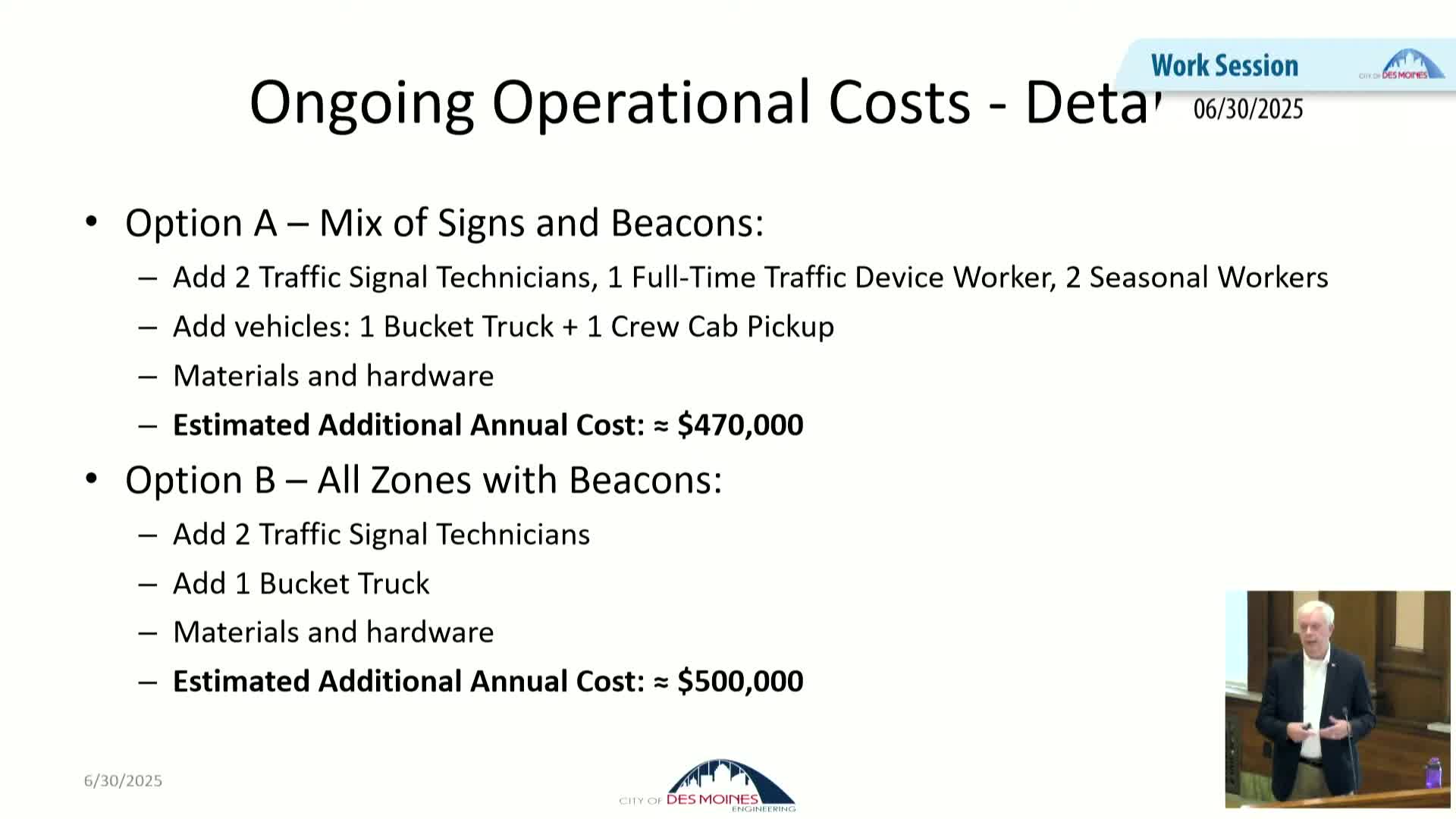
Davis described two infrastructure options for school zones. Option A is a mix of new static 20‑mph signs with selective beacon assemblies where local posted speeds are 30 mph or higher; staff estimated capital costs around $500,000 and ongoing operating costs “somewhere in the neighborhood of” $500,000. Option B would place beacon assemblies at all school zones; staff estimated that option at about $1.5 million capital and lower annual personnel costs than Option A. Davis said the capital difference stems from roughly 380 new static signs and 60 new beacons in Option A versus about 250 beacons in Option B; he stated a static sign costs “around $150” and a beacon “maybe $5,000 or a little bit more.”
Council members pressed staff on the differences in operating cost and staffing. Davis said Option A would require additional maintenance staffing — including “2 traffic signal technicians, 1 full time traffic device worker, and 2 seasonal workers” — because of the higher number of signs to install and maintain, while Option B’s higher capital cost but fewer additional static signs results in lower ongoing personnel needs. Council members questioned whether existing sign crews could absorb the work and whether hiring consultants was necessary to produce the plan.
On enforcement, Police Chief McTaggart told the council the department lacks the resources to staff every school zone consistently. “We don't have the resources to hit all the school zones all the time,” McTaggart said, and noted staffing limits for traditional enforcement. Davis added that automated traffic enforcement (ATE) is permitted only when drivers exceed the posted limit by more than 10 mph and that Iowa DOT approval is required to deploy cameras; Davis also said Iowa DOT has been reluctant to approve some prior site applications in Des Moines.
Council member Linda framed the city’s obligation to slow traffic near schools: “I think our most precious asset that we have in this city are our kids,” she said, urging beacons and other measures where data shows risk. Several council members asked staff to return with a narrower scope document describing exactly what the consultant study would include and whether the city could scale pilot infrastructure faster using in-house staff.
Staff next steps and schedule: Davis said the city will issue an RFP for a speed-management plan in fall, seek CIP funding requests this fall for projects that may arise from the study, run plan development through the following summer, and present the plan to council in the fall after that. He also said that some USDOT grant funding (Safe Streets for All grant) is awaiting final execution and that the city intends to add speed-feedback displays to about 29 existing beacon assemblies on the High Injury Network if the agreement is finalized.
Ending: Council members asked staff for additional supporting data — historical school-zone citation levels, examples of Vision 0 communities that reduced school-zone speeds to 15 or 20 mph, and a clearer budget/no-cost alternative analysis — before committing to a preferred implementation option. Staff agreed to return with a detailed scope for the proposed study and additional cost and enforcement data.
The study recommendation would be funded through the city’s Capital Improvement Program and would be procured via a request for proposals to be issued this fall; staff said plan development would run from fall through the following summer with a council presentation planned next fall. “Automated traffic enforcement is likely will be needed and remains a viable option,” Davis said, noting that “new applications for specific locations will not reopen until July 2026.”
Why it matters: council members framed the item as part of the city’s Vision 0 DSM goal to reduce fatalities and severe injuries, and emphasized schools as the top priority. Reducing posted school-zone speeds and adding visual speed feedback are the core near-term tools under discussion; elected officials asked for cost comparisons, enforcement data and options to scale faster without added consultant cost.
Davis described two infrastructure options for school zones. Option A is a mix of new static 20‑mph signs with selective beacon assemblies where local posted speeds are 30 mph or higher; staff estimated capital costs around $500,000 and ongoing operating costs “somewhere in the neighborhood of” $500,000. Option B would place beacon assemblies at all school zones; staff estimated that option at about $1.5 million capital and lower annual personnel costs than Option A. Davis said the capital difference stems from roughly 380 new static signs and 60 new beacons in Option A versus about 250 beacons in Option B; he stated a static sign costs “around $150” and a beacon “maybe $5,000 or a little bit more.”
Council members pressed staff on the differences in operating cost and staffing. Davis said Option A would require additional maintenance staffing — including “2 traffic signal technicians, 1 full time traffic device worker, and 2 seasonal workers” — because of the higher number of signs to install and maintain, while Option B’s higher capital cost but fewer additional static signs results in lower ongoing personnel needs. Council members questioned whether existing sign crews could absorb the work and whether hiring consultants was necessary to produce the plan.
On enforcement, Police Chief McTaggart told the council the department lacks the resources to staff every school zone consistently. “We don't have the resources to hit all the school zones all the time,” McTaggart said, and noted staffing limits for traditional enforcement. Davis added that automated traffic enforcement (ATE) is permitted only when drivers exceed the posted limit by more than 10 mph and that Iowa DOT approval is required to deploy cameras; Davis also said Iowa DOT has been reluctant to approve some prior site applications in Des Moines.
Council member Linda framed the city’s obligation to slow traffic near schools: “I think our most precious asset that we have in this city are our kids,” she said, urging beacons and other measures where data shows risk. Several council members asked staff to return with a narrower scope document describing exactly what the consultant study would include and whether the city could scale pilot infrastructure faster using in-house staff.
Staff next steps and schedule: Davis said the city will issue an RFP for a speed-management plan in fall, seek CIP funding requests this fall for projects that may arise from the study, run plan development through the following summer, and present the plan to council in the fall after that. He also said that some USDOT grant funding (Safe Streets for All grant) is awaiting final execution and that the city intends to add speed-feedback displays to about 29 existing beacon assemblies on the High Injury Network if the agreement is finalized.
Ending: Council members asked staff for additional supporting data — historical school-zone citation levels, examples of Vision 0 communities that reduced school-zone speeds to 15 or 20 mph, and a clearer budget/no-cost alternative analysis — before committing to a preferred implementation option. Staff agreed to return with a detailed scope for the proposed study and additional cost and enforcement data.
Don't Miss a Word: See the Full Meeting!
Go beyond summaries. Unlock every video, transcript, and key insight with a Founder Membership.
✓
Get instant access to full meeting videos
✓
Search and clip any phrase from complete transcripts
✓
Receive AI-powered summaries & custom alerts
✓
Enjoy lifetime, unrestricted access to government data
30-day money-back guarantee
