Des Moines engineering department outlines nearly $1 billion in recent and planned infrastructure work
July 01, 2025 | Des Moines, Polk County, Iowa
This article was created by AI summarizing key points discussed. AI makes mistakes, so for full details and context, please refer to the video of the full meeting. Please report any errors so we can fix them. Report an error »
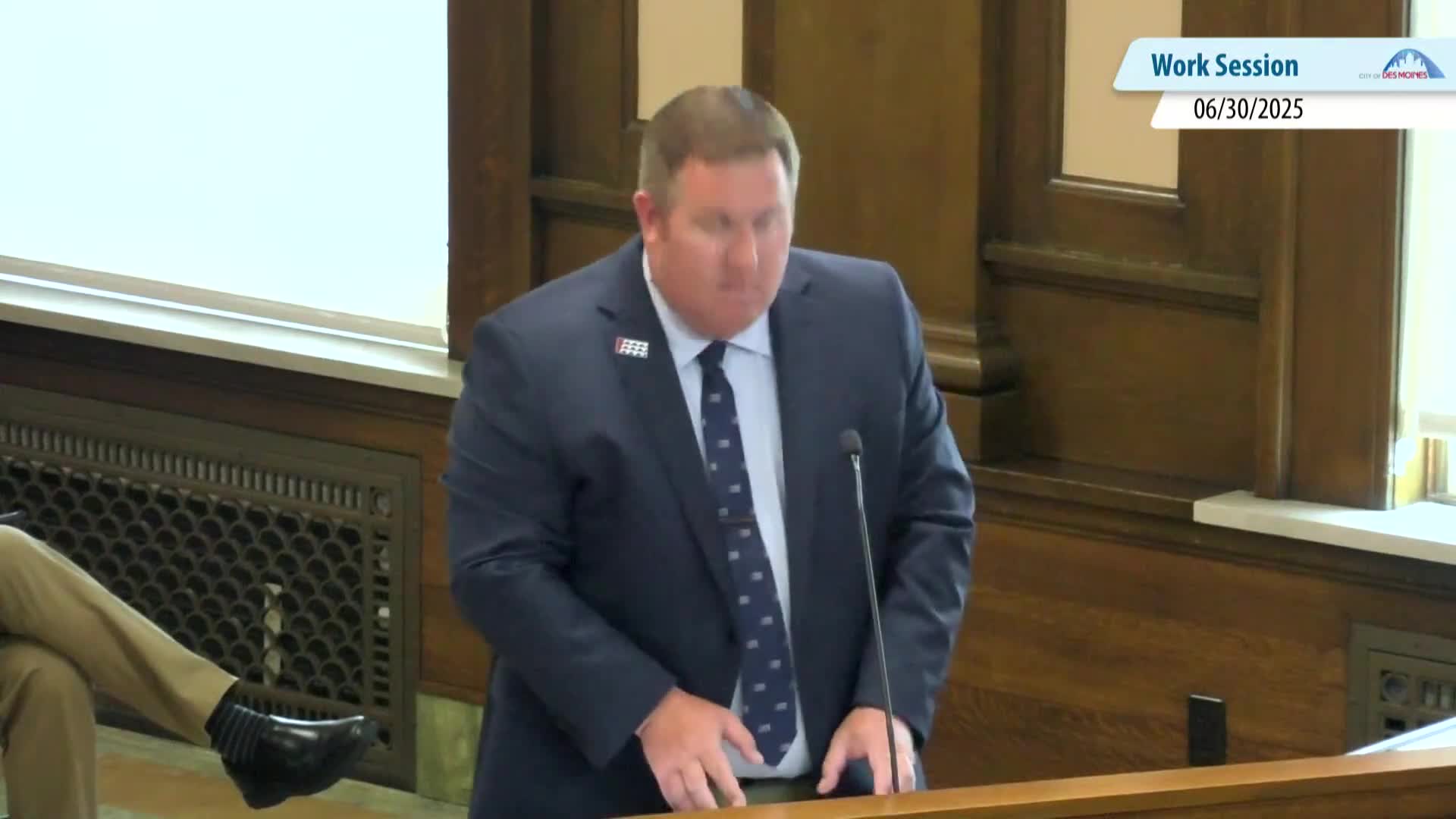
Des Moines City Engineer Steve Naber gave a wide-ranging update on the Engineering Department’s responsibilities and capital program at the June 30 work session, detailing recent accomplishments and the schedule for major projects including levee improvements, stormwater basins, bridge rehabilitation and sidewalk infill.
Naber told the council the department has roughly 102 staff across traffic and transportation, design and construction, and contracts and real estate. “We have 441 traffic signals, ... 60,000 signs, 200 miles of fiber, 2,000,000 linear feet of pavement markings, and 4,600 crosswalks,” he said, outlining the operational maintenance workload and the reasons project delivery can take multiple years.
Why it matters: Naber framed the capital work as critical to public safety and to protecting neighborhoods at risk of flooding. The presentation covered the Hamilton Drain East system (Highland Park), downtown levee alterations, bridge rehabilitation, sidewalk construction prioritized near schools, and several large street and facility projects now in design or construction.
Levees and flood mitigation: Naber described a risk-based accreditation process that the U.S. Army Corps of Engineers is using to evaluate levee systems and said the city has targeted risk areas downstream (including portions of D levee and the Four Mile Creek closure structure). He told council that the city received state flood-mitigation funding through a recent program — “about $111,000,000 total went to the city and the wastewater reclamation authority,” with roughly $60 million to the city, he said — and that federal funding applications were unsuccessful.
Stormwater and parks: Naber reviewed the Hamilton Drain East work (replacing an undersized 1930s wood box with larger conduits and detention basins) and said some detention basins are being designed and constructed to double as park space, citing the Catherine Creek Park basin as an example. He said underground detention is used where necessary (for example under Shawnee and Amherst) and that the project’s current phase is targeting substantial completion by year end.
Bridges and streets: Naber said the city has rehabilitated 21 bridges over the past 10 years and reduced the number rated “structurally deficient” from 14 in 2013 to two today; those two are in the CIP. He highlighted upcoming bridge work (including a long structure on Southwest Ninth over the Raccoon River) and said staging will be used to try to preserve at least one open lane where feasible.
Sidewalks, streetscape and Safety: Naber said the city has installed more than 30 miles of sidewalks since 2019, prioritizing gaps near schools. He also highlighted corridor projects — Hubbell Avenue realignment (50% crash reduction, 60% injury reduction, 75% reduction in fatalities in the project area since completion), East Fourth Street market-district improvements, Fleur Drive, McKinley Avenue water-main and full reconstruction work, and the Southeast Connector (underway, multi-year).
Process, timelines and public engagement: Naber walked through design-to-construction touchpoints: survey, environmental review, real-estate acquisition (which can take six months), bidding and schedule milestones. He said complex reconstruction projects often take roughly three years from programming to completion because of coordination with utilities, environmental and review boards and permitting. Council members asked whether the number of advisory reviews and board checkpoints could be streamlined; Naber and others said many reviews run concurrently but agreed to examine potential consolidation.
Facilities and other projects: Naber showed progress photos of Fire Station No. 4 (a $13.2 million, 21,000‑square‑foot project) and the Rykard Community Recreation Center, and noted work on downtown office buildout and parking infrastructure.
Ending: Council members praised the engineering team and confirmed follow-up items: provide detailed schedules for upcoming fire-station replacements, a clearer timeline for bridge staging and a scope for any proposed policy changes to accelerate project delivery. Naber said staff will share schedules and follow up on possible procedural streamlining.
Naber told the council the department has roughly 102 staff across traffic and transportation, design and construction, and contracts and real estate. “We have 441 traffic signals, ... 60,000 signs, 200 miles of fiber, 2,000,000 linear feet of pavement markings, and 4,600 crosswalks,” he said, outlining the operational maintenance workload and the reasons project delivery can take multiple years.
Why it matters: Naber framed the capital work as critical to public safety and to protecting neighborhoods at risk of flooding. The presentation covered the Hamilton Drain East system (Highland Park), downtown levee alterations, bridge rehabilitation, sidewalk construction prioritized near schools, and several large street and facility projects now in design or construction.
Levees and flood mitigation: Naber described a risk-based accreditation process that the U.S. Army Corps of Engineers is using to evaluate levee systems and said the city has targeted risk areas downstream (including portions of D levee and the Four Mile Creek closure structure). He told council that the city received state flood-mitigation funding through a recent program — “about $111,000,000 total went to the city and the wastewater reclamation authority,” with roughly $60 million to the city, he said — and that federal funding applications were unsuccessful.
Stormwater and parks: Naber reviewed the Hamilton Drain East work (replacing an undersized 1930s wood box with larger conduits and detention basins) and said some detention basins are being designed and constructed to double as park space, citing the Catherine Creek Park basin as an example. He said underground detention is used where necessary (for example under Shawnee and Amherst) and that the project’s current phase is targeting substantial completion by year end.
Bridges and streets: Naber said the city has rehabilitated 21 bridges over the past 10 years and reduced the number rated “structurally deficient” from 14 in 2013 to two today; those two are in the CIP. He highlighted upcoming bridge work (including a long structure on Southwest Ninth over the Raccoon River) and said staging will be used to try to preserve at least one open lane where feasible.
Sidewalks, streetscape and Safety: Naber said the city has installed more than 30 miles of sidewalks since 2019, prioritizing gaps near schools. He also highlighted corridor projects — Hubbell Avenue realignment (50% crash reduction, 60% injury reduction, 75% reduction in fatalities in the project area since completion), East Fourth Street market-district improvements, Fleur Drive, McKinley Avenue water-main and full reconstruction work, and the Southeast Connector (underway, multi-year).
Process, timelines and public engagement: Naber walked through design-to-construction touchpoints: survey, environmental review, real-estate acquisition (which can take six months), bidding and schedule milestones. He said complex reconstruction projects often take roughly three years from programming to completion because of coordination with utilities, environmental and review boards and permitting. Council members asked whether the number of advisory reviews and board checkpoints could be streamlined; Naber and others said many reviews run concurrently but agreed to examine potential consolidation.
Facilities and other projects: Naber showed progress photos of Fire Station No. 4 (a $13.2 million, 21,000‑square‑foot project) and the Rykard Community Recreation Center, and noted work on downtown office buildout and parking infrastructure.
Ending: Council members praised the engineering team and confirmed follow-up items: provide detailed schedules for upcoming fire-station replacements, a clearer timeline for bridge staging and a scope for any proposed policy changes to accelerate project delivery. Naber said staff will share schedules and follow up on possible procedural streamlining.
Don't Miss a Word: See the Full Meeting!
Go beyond summaries. Unlock every video, transcript, and key insight with a Founder Membership.
✓
Get instant access to full meeting videos
✓
Search and clip any phrase from complete transcripts
✓
Receive AI-powered summaries & custom alerts
✓
Enjoy lifetime, unrestricted access to government data
30-day money-back guarantee
