City staff, consultant outline New Mexico CPACE program and ask Las Cruces council to consider opt‑in resolution
July 29, 2025 | Las Cruces, Doña Ana County, New Mexico
This article was created by AI summarizing key points discussed. AI makes mistakes, so for full details and context, please refer to the video of the full meeting. Please report any errors so we can fix them. Report an error »
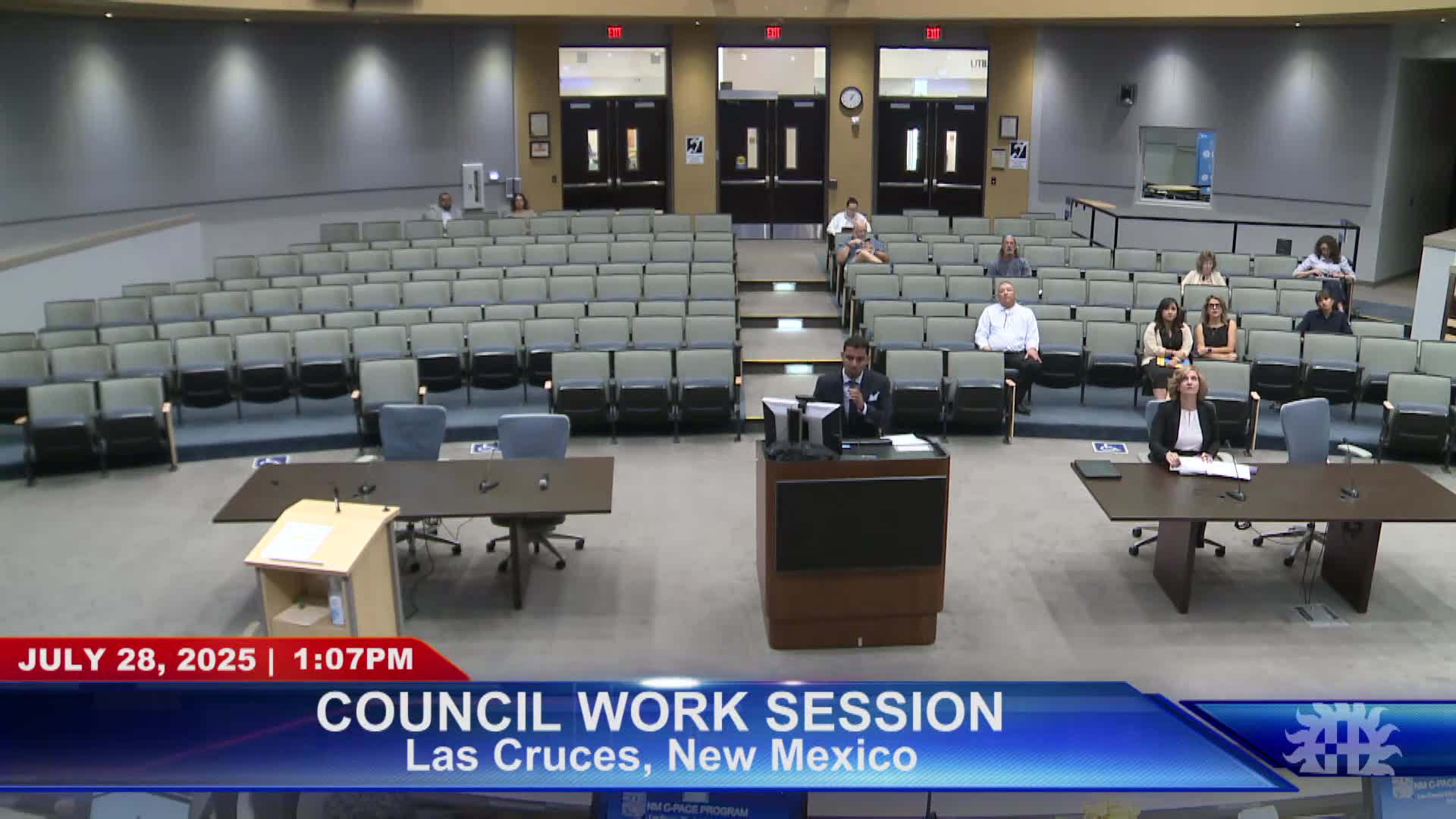
At a Las Cruces City Council work session on July 28, staff from the city’s Economic Development Department and a consultant for the state described the Commercial Property Assessed Clean Energy program, known as CPACE, and asked the council to consider a resolution allowing Dona Ana County’s CPACE ordinance to operate within Las Cruces city limits.
CPACE is a private‑sector financing mechanism for energy, water and resiliency improvements on commercial, agricultural, industrial and multifamily properties of five or more units, the consultant said. Eric Christiansen of Adelante Consulting, the statewide program administrator contracted by the New Mexico Economic Development Department, said the program pays for eligible improvements through loans arranged by private capital providers and secured by a special assessment lien on the property. “The city’s only responsibility would be passing the resolution that allows the county’s ordinance to apply within your jurisdiction,” Christiansen said.
Why it matters: proponents say CPACE can lower upfront costs for building upgrades such as lighting, HVAC, insulation, low‑flow plumbing and solar, and can make some stalled projects financially feasible. Christiansen told council members the program does not rely on state or federal subsidy; program administration is funded by a closing fee assessed to lenders and rolled into financing. He also said billing and collection are handled by lenders rather than through the property tax billing system to limit local government burden.
Key program details discussed
- Eligible properties: privately owned commercial, agricultural, industrial and multifamily properties with five or more dwelling units; not‑for‑profit owners may qualify.
- Funding: private capital providers supply funds; the statewide program administrator charges a closing fee equal to 1% of the transaction capped at $25,000, paid by the lender and typically rolled into the financed amount.
- Lien priority: the special assessment lien is senior to most liens except general ad valorem property taxes and certain improvement district liens; lenders and existing lienholders must provide consent before CPACE is used on encumbered properties.
- Repayment and transfers: lenders bill and collect from the borrower; the special assessment lien can transfer with the property sale and is nonaccelerable beyond amounts then due, per the statute excerpt read during the presentation.
Consultant examples and scale
Christiansen shared four closed case studies from other New Mexico jurisdictions to illustrate program use: a high‑end recapitalization for Bishop’s Lodge (reported at about $76 million over 25 years), a $10 million new‑construction project for the Modern Elder Academy, a $5 million boutique hotel refinance in Taos County, and a multifamily new construction financing of roughly $60 million for Rancho Santa Fe Apartments (156 units). Christiansen said many current lenders support mid‑to‑large projects (about $1 million and up), and the New Mexico Climate Investment Center — a state green‑bank entity — has joined as a lender with lower minimums that may help projects in the $200,000+ range.
Council questions and requests
Council members asked about the program’s history, who funds administration, borrower default rates, lienholder protections, and outreach to small and midsize local projects. Christiansen said CPACE programs have existed in other states for more than a decade and that Adelante’s administrator role is funded by closing fees. On defaults he said national default rates are low but that he would follow up with national associations and provide numbers to the city manager. On outreach, Christiansen said the administrator is pursuing partnerships with local credit unions and an organization called Electrify to originate smaller transactions and noted the Climate Investment Center as a partner for smaller loans.
Discussion versus direction
Discussion only: council members raised questions and expressed support; no formal resolution or ordinance was adopted during the work session.
Direction requested: council members asked staff to provide additional information (including national default statistics) to the city manager and to consider language in any future resolution that would emphasize support or prioritization of small‑ and mid‑sized projects.
Next steps and what council was asked to do
The consultant asked the council to pass a brief resolution enabling Dona Ana County’s CPACE ordinance to apply inside Las Cruces. No vote was taken during the work session; staff said they are flexible on timing and would provide sample resolution language and the county ordinance for council review.
Ending: Council members signaled general support and asked staff for follow‑up information before taking formal action.
CPACE is a private‑sector financing mechanism for energy, water and resiliency improvements on commercial, agricultural, industrial and multifamily properties of five or more units, the consultant said. Eric Christiansen of Adelante Consulting, the statewide program administrator contracted by the New Mexico Economic Development Department, said the program pays for eligible improvements through loans arranged by private capital providers and secured by a special assessment lien on the property. “The city’s only responsibility would be passing the resolution that allows the county’s ordinance to apply within your jurisdiction,” Christiansen said.
Why it matters: proponents say CPACE can lower upfront costs for building upgrades such as lighting, HVAC, insulation, low‑flow plumbing and solar, and can make some stalled projects financially feasible. Christiansen told council members the program does not rely on state or federal subsidy; program administration is funded by a closing fee assessed to lenders and rolled into financing. He also said billing and collection are handled by lenders rather than through the property tax billing system to limit local government burden.
Key program details discussed
- Eligible properties: privately owned commercial, agricultural, industrial and multifamily properties with five or more dwelling units; not‑for‑profit owners may qualify.
- Funding: private capital providers supply funds; the statewide program administrator charges a closing fee equal to 1% of the transaction capped at $25,000, paid by the lender and typically rolled into the financed amount.
- Lien priority: the special assessment lien is senior to most liens except general ad valorem property taxes and certain improvement district liens; lenders and existing lienholders must provide consent before CPACE is used on encumbered properties.
- Repayment and transfers: lenders bill and collect from the borrower; the special assessment lien can transfer with the property sale and is nonaccelerable beyond amounts then due, per the statute excerpt read during the presentation.
Consultant examples and scale
Christiansen shared four closed case studies from other New Mexico jurisdictions to illustrate program use: a high‑end recapitalization for Bishop’s Lodge (reported at about $76 million over 25 years), a $10 million new‑construction project for the Modern Elder Academy, a $5 million boutique hotel refinance in Taos County, and a multifamily new construction financing of roughly $60 million for Rancho Santa Fe Apartments (156 units). Christiansen said many current lenders support mid‑to‑large projects (about $1 million and up), and the New Mexico Climate Investment Center — a state green‑bank entity — has joined as a lender with lower minimums that may help projects in the $200,000+ range.
Council questions and requests
Council members asked about the program’s history, who funds administration, borrower default rates, lienholder protections, and outreach to small and midsize local projects. Christiansen said CPACE programs have existed in other states for more than a decade and that Adelante’s administrator role is funded by closing fees. On defaults he said national default rates are low but that he would follow up with national associations and provide numbers to the city manager. On outreach, Christiansen said the administrator is pursuing partnerships with local credit unions and an organization called Electrify to originate smaller transactions and noted the Climate Investment Center as a partner for smaller loans.
Discussion versus direction
Discussion only: council members raised questions and expressed support; no formal resolution or ordinance was adopted during the work session.
Direction requested: council members asked staff to provide additional information (including national default statistics) to the city manager and to consider language in any future resolution that would emphasize support or prioritization of small‑ and mid‑sized projects.
Next steps and what council was asked to do
The consultant asked the council to pass a brief resolution enabling Dona Ana County’s CPACE ordinance to apply inside Las Cruces. No vote was taken during the work session; staff said they are flexible on timing and would provide sample resolution language and the county ordinance for council review.
Ending: Council members signaled general support and asked staff for follow‑up information before taking formal action.
Don't Miss a Word: See the Full Meeting!
Go beyond summaries. Unlock every video, transcript, and key insight with a Founder Membership.
✓
Get instant access to full meeting videos
✓
Search and clip any phrase from complete transcripts
✓
Receive AI-powered summaries & custom alerts
✓
Enjoy lifetime, unrestricted access to government data
30-day money-back guarantee
