Staff recommends Mesquite be prioritized for redevelopment planning among four new MRAs
July 29, 2025 | Las Cruces, Doña Ana County, New Mexico
This article was created by AI summarizing key points discussed. AI makes mistakes, so for full details and context, please refer to the video of the full meeting. Please report any errors so we can fix them. Report an error »
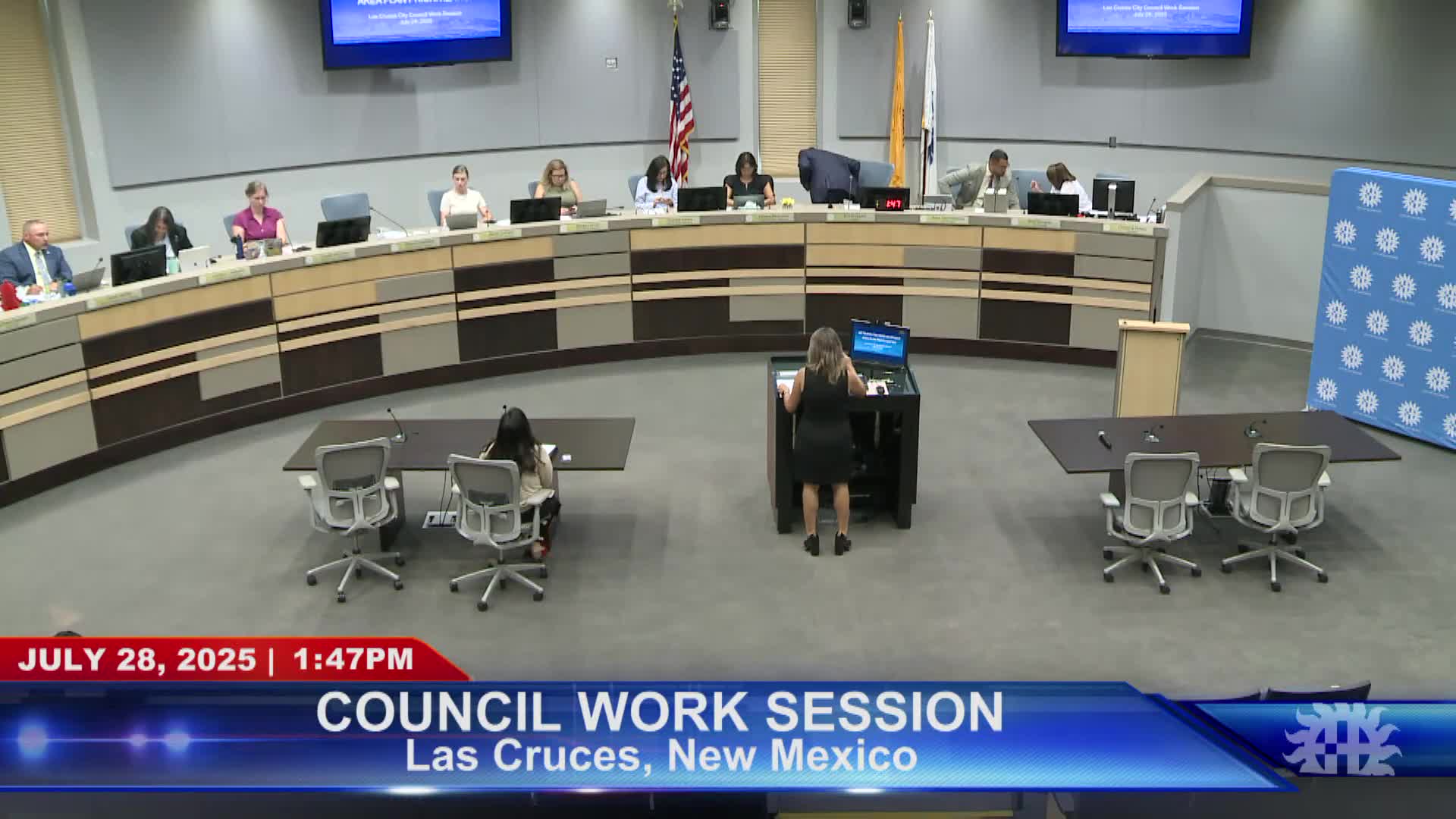
At the Las Cruces City Council work session on July 28, city economic development staff presented a prioritization proposal for four newly designated Metropolitan Redevelopment Areas and recommended starting planning in the Mesquite area, followed by Apodaca and Liftup, Amador Proximo and South, and then the East of Solano neighborhood.
Blair Flores of the city’s Economic Development Department said the prioritization balances “greatest need” and “maximum return on investment” so that redevelopment tools both advance equity in high‑need areas and generate meaningful revenue. “Our proposed order would be Mesquite, Apodaca and Liftup, Amador Proximo and South, and then East Of Solano neighborhood,” Flores said.
Why it matters: a Metropolitan Redevelopment Area plan lays out how conditions of blight or disinvestment will be addressed and identifies actions such as land acquisition, zoning adjustments, public infrastructure improvements and other redevelopment strategies. Under the program each area’s gross‑receipts tax increment is collected and intended to be reinvested in that specific MRA, staff told council.
Data and staff’s rationale
- Mesquite: 52 businesses (about 17% of the four MRAs), estimated annual tax revenue $1,600,000 with a city portion of roughly $388,000; population 2,335 (a 1% decline since 2010). Staff categorized Mesquite as highest need.
- Apodaca & Liftup: 62 businesses (about 20%); estimated annual tax revenue $4,500,000 with a city portion of about $1,800,000; added 85 new businesses between 2022 and 2024.
- Amador Proximo & South: 39 businesses (about 13%); estimated annual tax revenue $1,300,000 with a city portion near $745,000; largest population decline reported (about 22.1% since 2010).
- East of Solano: 149 businesses (about 49%); estimated annual tax revenue $4,470,000 with a city portion of about $1,070,000; population up 33% since 2010 and highest business activity.
Council questions and reactions
Councilor Curran asked how revenue collected under the MRA designations is distributed. Blair Flores replied, “Each area will collect its own GRT and then that money will be reinvested into that specific MRA.” Several council members, including Councilor McClure and Mayor Pro Tem Bencomo, voiced support for prioritizing high‑need areas in order to address vacancy, blight and resource disparities. Bencomo said the MRAs should be treated as targeted interventions: “These MRAs are an intervention,” Bencomo said, urging the council to act on strategies that help communities with fewer resources.
Discussion versus direction
Discussion only: staff presented priorities and answered questions; no formal vote was taken. Direction implied: staff proposed initiating planning for the Mesquite area first; council expressed support for moving forward and for additional tools to address vacant or abandoned properties.
Next steps
Staff said the outcome of the prioritization will determine which area enters the planning phase next; the West Picacho and Motel MRA is already in a final planning stage with a draft expected for public review in September and final adoption projected in December.
Ending: Council members expressed support for the proposed balanced approach—prioritizing high‑need areas first while including at least one high‑impact area early in the schedule.
Blair Flores of the city’s Economic Development Department said the prioritization balances “greatest need” and “maximum return on investment” so that redevelopment tools both advance equity in high‑need areas and generate meaningful revenue. “Our proposed order would be Mesquite, Apodaca and Liftup, Amador Proximo and South, and then East Of Solano neighborhood,” Flores said.
Why it matters: a Metropolitan Redevelopment Area plan lays out how conditions of blight or disinvestment will be addressed and identifies actions such as land acquisition, zoning adjustments, public infrastructure improvements and other redevelopment strategies. Under the program each area’s gross‑receipts tax increment is collected and intended to be reinvested in that specific MRA, staff told council.
Data and staff’s rationale
- Mesquite: 52 businesses (about 17% of the four MRAs), estimated annual tax revenue $1,600,000 with a city portion of roughly $388,000; population 2,335 (a 1% decline since 2010). Staff categorized Mesquite as highest need.
- Apodaca & Liftup: 62 businesses (about 20%); estimated annual tax revenue $4,500,000 with a city portion of about $1,800,000; added 85 new businesses between 2022 and 2024.
- Amador Proximo & South: 39 businesses (about 13%); estimated annual tax revenue $1,300,000 with a city portion near $745,000; largest population decline reported (about 22.1% since 2010).
- East of Solano: 149 businesses (about 49%); estimated annual tax revenue $4,470,000 with a city portion of about $1,070,000; population up 33% since 2010 and highest business activity.
Council questions and reactions
Councilor Curran asked how revenue collected under the MRA designations is distributed. Blair Flores replied, “Each area will collect its own GRT and then that money will be reinvested into that specific MRA.” Several council members, including Councilor McClure and Mayor Pro Tem Bencomo, voiced support for prioritizing high‑need areas in order to address vacancy, blight and resource disparities. Bencomo said the MRAs should be treated as targeted interventions: “These MRAs are an intervention,” Bencomo said, urging the council to act on strategies that help communities with fewer resources.
Discussion versus direction
Discussion only: staff presented priorities and answered questions; no formal vote was taken. Direction implied: staff proposed initiating planning for the Mesquite area first; council expressed support for moving forward and for additional tools to address vacant or abandoned properties.
Next steps
Staff said the outcome of the prioritization will determine which area enters the planning phase next; the West Picacho and Motel MRA is already in a final planning stage with a draft expected for public review in September and final adoption projected in December.
Ending: Council members expressed support for the proposed balanced approach—prioritizing high‑need areas first while including at least one high‑impact area early in the schedule.
View the Full Meeting & All Its Details
This article offers just a summary. Unlock complete video, transcripts, and insights as a Founder Member.
✓
Watch full, unedited meeting videos
✓
Search every word spoken in unlimited transcripts
✓
AI summaries & real-time alerts (all government levels)
✓
Permanent access to expanding government content
30-day money-back guarantee
