Planning board grants conditional approval for 28‑unit Mill Street apartment building amid neighbor concerns
June 17, 2025 | Milford Boards & Committees of Selectmen, Milford, Hillsborough County, New Hampshire
This article was created by AI summarizing key points discussed. AI makes mistakes, so for full details and context, please refer to the video of the full meeting. Please report any errors so we can fix them. Report an error »
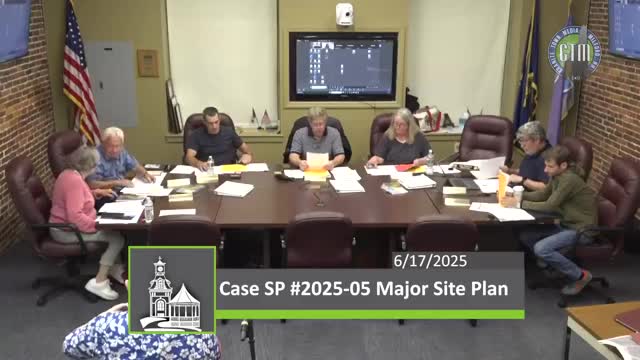
The Milford Planning Board on June 17 granted conditional site‑plan approval for a proposed three‑story, 28‑unit multifamily building at 30 Mill Street, subject to several conditions including formal owner signatures on the final plans, preservation of the rear Residence A parcel as permanent open space, a sidewalk modification to allow additional on‑site snow storage, and satisfactory resolution of staff and department comments.
Sam Ingram of Meridian Land Services, the applicant’s agent, described the proposal as "a 28 unit multifamily building" and walked the board through the plan set, noting stormwater basins, a proposed Mill Street realignment to improve sight lines and safety, landscaping, lighting, and amenity space including a small fenced dog‑play area and a gazebo placeholder.
Why it mattered: the project sits at the interface of commercial zoning along Mill Street and a larger residential parcel to the rear. The applicant obtained a zoning‑board variance earlier in the process; the Zoning Board of Adjustment limited the project to 28 units to avoid additional height and density impacts, ZBA member Mike Thornton told the meeting: "The reason the ZBA restricted to 28 units was to avoid the extra height and density."
Board discussion focused on stormwater management, culvert maintenance, roadway safety, building massing and aesthetics, snow storage and plowing practicality, parking and traffic, and coordination with town departments. Several abutters raised public‑comment concerns. Jeff Damon, who said he lives at 45 Cottage Street and identified himself as an abutter, said his basement sump pump had been running repeatedly while the culvert under Mill Street was clogged: "My sump pump is running, like, nonstop… That very day that that water was able to go through that culvert, it stopped and the pressure was relieved."
Officials and consultants said the site design adds stormwater treatment where none exists today. The engineering team described ponded systems intended to infiltrate runoff on site and noted the town’s stormwater review and permits would require runoff rates that do not exceed current conditions.
Public‑safety and utilities checks remained outstanding: town staff had submitted memos from the conservation commission, town engineer, fire department and utilities on June 4 and staff said they would work with the applicant to resolve a set of mostly technical comments. Utilities director Jim Poliot (comment noted in the staff packet) requested additional engineering review for water/sewer connections and millings along the Mill Street frontage.
Board actions recorded in the meeting included: a motion accepting the application with a requirement that signed plans be provided within the next 36 hours; a motion that there was no potential regional impact; and a final conditional approval motion that included four conditions: (1) remove the proposed west‑side sidewalk or make it flush to grade to provide more on‑site snow storage; (2) designate the remaining Residence A parcel (the rear, forested/wetland area) as permanent open space; (3) final plan set to be signed by the landowner; and (4) satisfy the town staff memoranda (town engineer, fire, utilities, conservation). The conditional approval motion passed with board members voting aye.
The board also discussed where to show binding language (variance reference and open‑space restriction) on the final plan set and recommended including deed restrictions or conservation language to ensure the rear parcel remains reserved from further development.
What to watch: the applicant must submit signed final plans and respond to outstanding department comments. The board noted stormwater and fire‑access details—turning‑radius and hydrant locations—will require verification before administrative signoff.
Sam Ingram of Meridian Land Services, the applicant’s agent, described the proposal as "a 28 unit multifamily building" and walked the board through the plan set, noting stormwater basins, a proposed Mill Street realignment to improve sight lines and safety, landscaping, lighting, and amenity space including a small fenced dog‑play area and a gazebo placeholder.
Why it mattered: the project sits at the interface of commercial zoning along Mill Street and a larger residential parcel to the rear. The applicant obtained a zoning‑board variance earlier in the process; the Zoning Board of Adjustment limited the project to 28 units to avoid additional height and density impacts, ZBA member Mike Thornton told the meeting: "The reason the ZBA restricted to 28 units was to avoid the extra height and density."
Board discussion focused on stormwater management, culvert maintenance, roadway safety, building massing and aesthetics, snow storage and plowing practicality, parking and traffic, and coordination with town departments. Several abutters raised public‑comment concerns. Jeff Damon, who said he lives at 45 Cottage Street and identified himself as an abutter, said his basement sump pump had been running repeatedly while the culvert under Mill Street was clogged: "My sump pump is running, like, nonstop… That very day that that water was able to go through that culvert, it stopped and the pressure was relieved."
Officials and consultants said the site design adds stormwater treatment where none exists today. The engineering team described ponded systems intended to infiltrate runoff on site and noted the town’s stormwater review and permits would require runoff rates that do not exceed current conditions.
Public‑safety and utilities checks remained outstanding: town staff had submitted memos from the conservation commission, town engineer, fire department and utilities on June 4 and staff said they would work with the applicant to resolve a set of mostly technical comments. Utilities director Jim Poliot (comment noted in the staff packet) requested additional engineering review for water/sewer connections and millings along the Mill Street frontage.
Board actions recorded in the meeting included: a motion accepting the application with a requirement that signed plans be provided within the next 36 hours; a motion that there was no potential regional impact; and a final conditional approval motion that included four conditions: (1) remove the proposed west‑side sidewalk or make it flush to grade to provide more on‑site snow storage; (2) designate the remaining Residence A parcel (the rear, forested/wetland area) as permanent open space; (3) final plan set to be signed by the landowner; and (4) satisfy the town staff memoranda (town engineer, fire, utilities, conservation). The conditional approval motion passed with board members voting aye.
The board also discussed where to show binding language (variance reference and open‑space restriction) on the final plan set and recommended including deed restrictions or conservation language to ensure the rear parcel remains reserved from further development.
What to watch: the applicant must submit signed final plans and respond to outstanding department comments. The board noted stormwater and fire‑access details—turning‑radius and hydrant locations—will require verification before administrative signoff.
View the Full Meeting & All Its Details
This article offers just a summary. Unlock complete video, transcripts, and insights as a Founder Member.
✓
Watch full, unedited meeting videos
✓
Search every word spoken in unlimited transcripts
✓
AI summaries & real-time alerts (all government levels)
✓
Permanent access to expanding government content
30-day money-back guarantee
