House Finance Committee hears testimony on HB 344 to legalize VLTs and electronic instant bingo for retailers and hospitality sites
June 17, 2025 | Finance, House of Representatives, Committees, Legislative, Ohio
This article was created by AI summarizing key points discussed. AI makes mistakes, so for full details and context, please refer to the video of the full meeting. Please report any errors so we can fix them. Report an error »
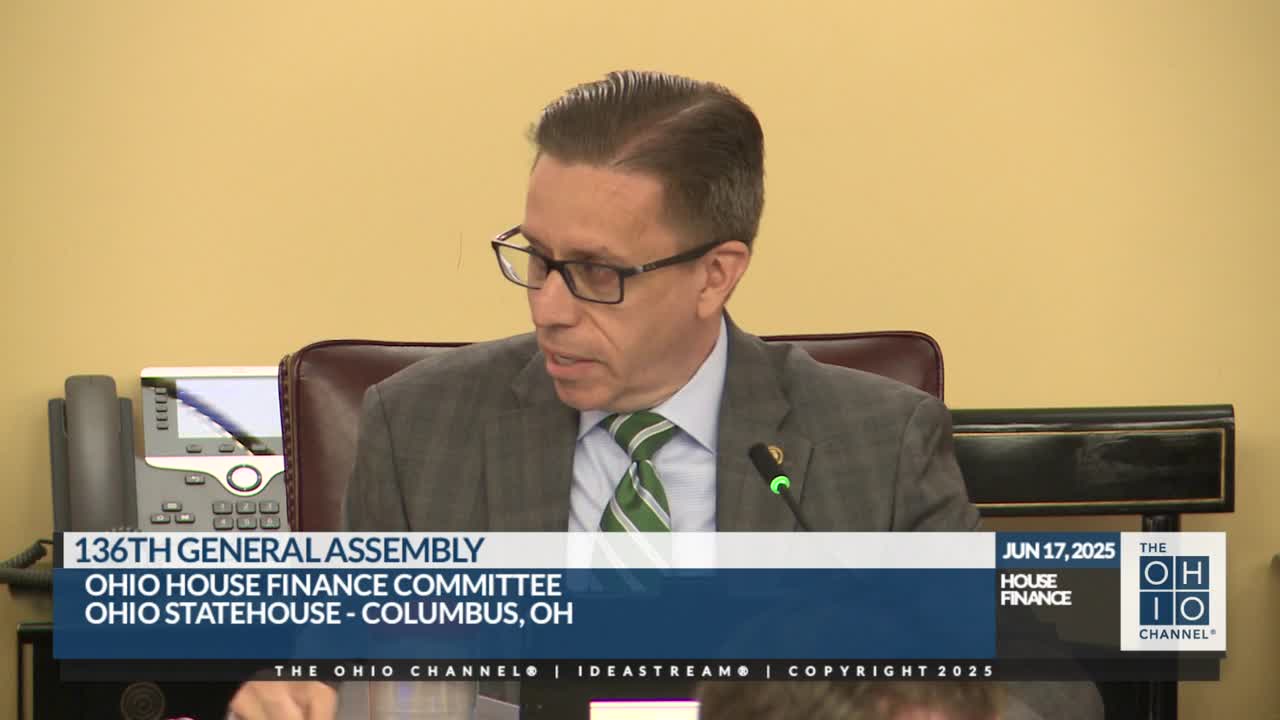
Columbus — The House Finance Committee held the first formal hearing on House Bill 344 (HB 344), where owners of bowling centers, bars and retail suppliers urged the legislature to legalize and regulate video lottery terminals (VLTs) and electronic instant-bingo devices for retailers and hospitality businesses, while at least one charity-gaming supplier opposed the VLT retail expansion.
Proponents told the committee HB 344 would give long-standing, family-owned hospitality businesses a regulated revenue stream and tools to reduce an extensive illegal “gray” gaming market. Marty Tifke, of Timbers Bowling Center, said, “House Bill 344 is not simply about entertainment, it's about economic equity,” arguing the current regulatory framework has left small legal operators at a disadvantage compared with illegal parlors and some fraternal clubs. Multiple witnesses testified that illegal devices are widespread and divert customers and revenue from lawful businesses.
The bill would authorize limited VLTs (witnesses referenced a three-machine-per-location rollout discussed in committee) and expand electronic instant-bingo in bars, bowling centers and other retail lottery locations under Ohio Lottery Commission oversight. Michael Zappa, president of Lorraine Music and Vending Company, testified that “currently we estimate that there are over 40,000 plus illegal devices in Ohio and growing,” and that legalization and regulation would capture revenue for businesses and the state while cutting the illegal market.
Industry witnesses described economic and employment impacts. Dan Beddinghaus said his four-family centers employ 89 Ohioans; Glenn Gable said his company’s seven centers employ about 370 people; Michael Zappa said his company has more than 30 employees and could double hiring if licensed to operate retail terminals; and testimony from the Bowling Centers Association of Ohio included a cited University of Cincinnati applied economics executive summary estimating roughly 7,000 new Ohio jobs in a modeled rollout.
Vendors and out-of-state terminal operators urged strong regulatory standards. Matt Hortonstein of J & J Gaming said certification and testing of devices, oversight to prevent underage play and point-of-entry controls would be essential. Hortonstein also told the committee that a tax rate in the mid-30 percent range (he referenced 34–35 percent as a plausible band) is common and can strike a balance between revenue for the state and reinvestment incentives for operators.
Supporters argued legalization would simplify enforcement. Witnesses said making non‑approved machines illegal “per se” would allow law enforcement and regulators to act without lengthy investigations—an approach they said has reduced illegal parlors in other states.
Not all witnesses supported retail VLTs. Mary Magnuson, vice president of government affairs for Arrow International (a longstanding supplier to charitable gaming), testified that Arrow opposes the VLT portion of the bill while supporting the electronic instant‑bingo provisions. Magnuson told the committee that the bill’s retail VLT proposal would expand terminals to many lottery retail locations including convenience stores and grocery stores, and that could harm existing charity gaming revenue; she said electronic instant‑bingo for age‑controlled establishments is a different matter and cited the $200 million figure for charity gaming revenues in Ohio reported to the Attorney General’s office.
Bar- and restaurant-owners’ associations emphasized controls to prevent underage play and urged placement and camera monitoring rules; Andy Hereff, executive director of the Ohio Bar Owners Association, said establishments already have age-verification training and that adding VLTs could be managed with camera monitoring and cordoned, age-restricted areas.
Retailers such as Giant Eagle supported the bill’s retailer-based VLT model, noting existing lottery compliance systems and experience with age-restricted products. Supporters also suggested lottery-centered marketing could increase foot traffic and supplement state education funding through lottery revenue.
The committee did not take a vote. Chairman Stewart opened the item as the bill’s first formal hearing, multiple witnesses provided three-minute statements, and members asked questions about enforcement, tax rates, potential cannibalization of existing gaming and problem-gambling mitigation. The hearing record includes several written submissions referenced by the chair. The committee adjourned after concluding the scheduled testimony.
Votes and formal actions: none recorded at this hearing.
Proponents told the committee HB 344 would give long-standing, family-owned hospitality businesses a regulated revenue stream and tools to reduce an extensive illegal “gray” gaming market. Marty Tifke, of Timbers Bowling Center, said, “House Bill 344 is not simply about entertainment, it's about economic equity,” arguing the current regulatory framework has left small legal operators at a disadvantage compared with illegal parlors and some fraternal clubs. Multiple witnesses testified that illegal devices are widespread and divert customers and revenue from lawful businesses.
The bill would authorize limited VLTs (witnesses referenced a three-machine-per-location rollout discussed in committee) and expand electronic instant-bingo in bars, bowling centers and other retail lottery locations under Ohio Lottery Commission oversight. Michael Zappa, president of Lorraine Music and Vending Company, testified that “currently we estimate that there are over 40,000 plus illegal devices in Ohio and growing,” and that legalization and regulation would capture revenue for businesses and the state while cutting the illegal market.
Industry witnesses described economic and employment impacts. Dan Beddinghaus said his four-family centers employ 89 Ohioans; Glenn Gable said his company’s seven centers employ about 370 people; Michael Zappa said his company has more than 30 employees and could double hiring if licensed to operate retail terminals; and testimony from the Bowling Centers Association of Ohio included a cited University of Cincinnati applied economics executive summary estimating roughly 7,000 new Ohio jobs in a modeled rollout.
Vendors and out-of-state terminal operators urged strong regulatory standards. Matt Hortonstein of J & J Gaming said certification and testing of devices, oversight to prevent underage play and point-of-entry controls would be essential. Hortonstein also told the committee that a tax rate in the mid-30 percent range (he referenced 34–35 percent as a plausible band) is common and can strike a balance between revenue for the state and reinvestment incentives for operators.
Supporters argued legalization would simplify enforcement. Witnesses said making non‑approved machines illegal “per se” would allow law enforcement and regulators to act without lengthy investigations—an approach they said has reduced illegal parlors in other states.
Not all witnesses supported retail VLTs. Mary Magnuson, vice president of government affairs for Arrow International (a longstanding supplier to charitable gaming), testified that Arrow opposes the VLT portion of the bill while supporting the electronic instant‑bingo provisions. Magnuson told the committee that the bill’s retail VLT proposal would expand terminals to many lottery retail locations including convenience stores and grocery stores, and that could harm existing charity gaming revenue; she said electronic instant‑bingo for age‑controlled establishments is a different matter and cited the $200 million figure for charity gaming revenues in Ohio reported to the Attorney General’s office.
Bar- and restaurant-owners’ associations emphasized controls to prevent underage play and urged placement and camera monitoring rules; Andy Hereff, executive director of the Ohio Bar Owners Association, said establishments already have age-verification training and that adding VLTs could be managed with camera monitoring and cordoned, age-restricted areas.
Retailers such as Giant Eagle supported the bill’s retailer-based VLT model, noting existing lottery compliance systems and experience with age-restricted products. Supporters also suggested lottery-centered marketing could increase foot traffic and supplement state education funding through lottery revenue.
The committee did not take a vote. Chairman Stewart opened the item as the bill’s first formal hearing, multiple witnesses provided three-minute statements, and members asked questions about enforcement, tax rates, potential cannibalization of existing gaming and problem-gambling mitigation. The hearing record includes several written submissions referenced by the chair. The committee adjourned after concluding the scheduled testimony.
Votes and formal actions: none recorded at this hearing.
Don't Miss a Word: See the Full Meeting!
Go beyond summaries. Unlock every video, transcript, and key insight with a Founder Membership.
✓
Get instant access to full meeting videos
✓
Search and clip any phrase from complete transcripts
✓
Receive AI-powered summaries & custom alerts
✓
Enjoy lifetime, unrestricted access to government data
30-day money-back guarantee
