Ohio committee hears testimony on bill to block manufacturer limits on 340B contract pharmacies
June 17, 2025 | Insurance, House of Representatives, Committees, Legislative, Ohio
This article was created by AI summarizing key points discussed. AI makes mistakes, so for full details and context, please refer to the video of the full meeting. Please report any errors so we can fix them. Report an error »
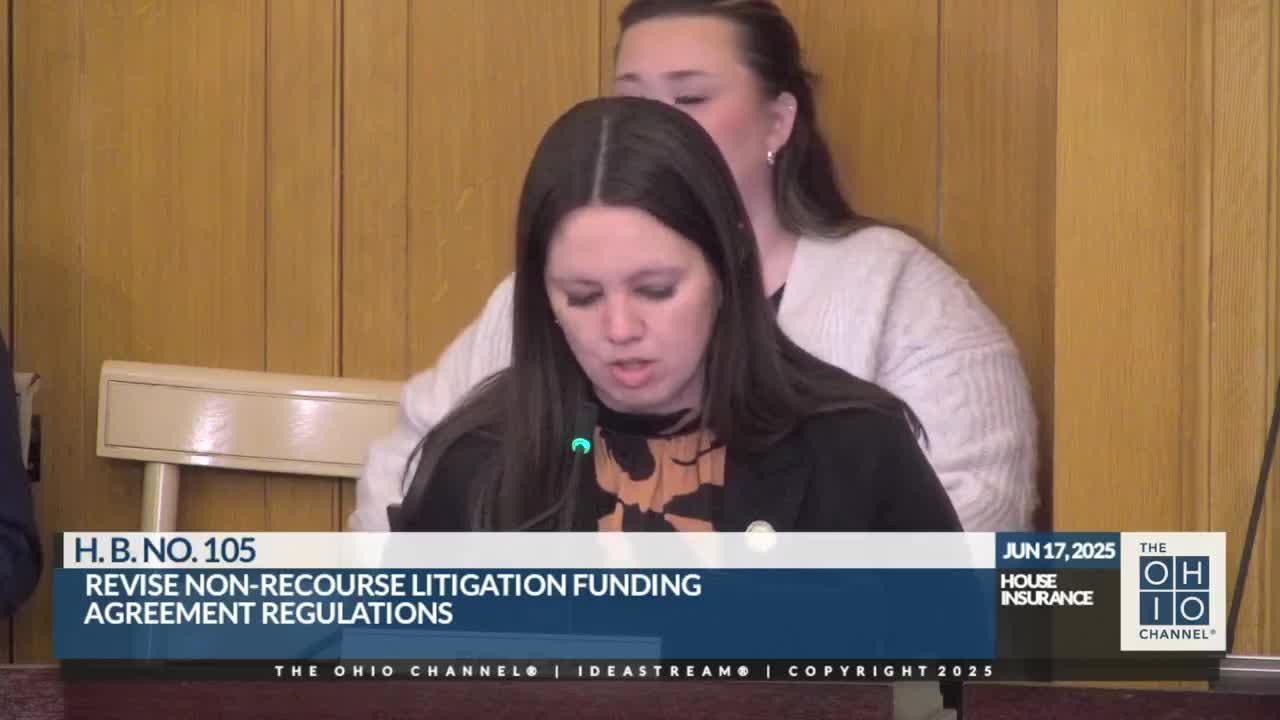
Chairman Lambton and members of the Ohio House Insurance Committee heard proponent testimony Oct. 12 on House Bill 276, the Ohio 340B Pharmacy Access Act, a bill that would bar drug manufacturers from imposing shipment or delivery restrictions on medications solely because a provider participates in the federal 340B Drug Pricing Program.
Julie DeRasi King, president and CEO of the Ohio Association of Community Health Centers, told the committee the 340B program allows federally qualified health centers to buy outpatient drugs at a discount and reinvest savings into patient care. "It simply prohibits drug manufacturers from imposing discriminatory restrictions on the shipment or delivery of medications solely because a provider is a 340B grantee," King said, describing the bill as “narrowly tailored” and saying it would cost the state nothing.
Why it matters: Witnesses said manufacturer restrictions on contract pharmacies have already reduced 340B savings for community health centers, forcing some service cutbacks, layoffs and even a site closure. Proponents argued the change undermines access to medications for low-income and rural patients who rely on local or multiple pharmacies and that states can act to preserve distribution methods used by safety-net providers.
What proponents said: King said Ohio’s community health centers—about 60 organizations operating more than 550 delivery sites and serving roughly 1 million Ohioans—rely on 340B savings to fund services such as extended hours, dental care and substance use disorder treatment. She told the panel that roughly 100 of those sites have on-site pharmacies and the remainder depend on contract pharmacies.
Peggy Anderson, CEO of Third Street Family Health Services, said manufacturer restrictions forced her organization to require patients from multiple counties to use a single pharmacy and that in the last year her center lost $1,900,000 in revenue and about 2,500 medication claims because manufacturers blocked contract-pharmacy claims. "We're very rural in most of our communities," Anderson said, and when contract options are narrowed patients must travel farther or go without medications.
Alyssa Huddleston, executive director of the LSS Health Center, described reliance on a network of about 30 contract pharmacies in Franklin County and said delivery is often not a reliable substitute for in-person pickup for patients experiencing homelessness or unstable housing. Huddleston said her center estimates up to a 10% reduction in 340B savings under current manufacturer restrictions.
Manufacturers and transparency concerns: Committee members pressed witnesses on transparency and audit concerns raised by manufacturers. King noted that federal law already requires grantees to report 340B data to HRSA and that grantees are prepared to work with the Ohio Department of Medicaid to provide claims-level information in a secure, periodic "flat file" to prevent duplicate discounts—situations where both a manufacturer discount and a state Medicaid rebate apply to the same drug, which federal rules prohibit. King said OACHC has retained a national FQHC compliance firm to work with ODM on the flat-file approach used in other states.
Scope and sponsors: Witnesses said the bill targets 340B grantees such as community health centers and Ryan White clinics, and does not extend to non‑grantees or hospitals. King thanked Representatives John and Holmes for sponsoring the legislation.
Outcome and next steps: The committee closed the second hearing on HB 276 after proponent testimony; members did not take a committee vote on the bill during the session.
Ending: Proponent written testimony from other community health centers and advocacy groups was filed with the committee. Committee members said they may follow up with requests for data from states that enacted similar protections and for the flat-file details mentioned by witnesses.
Julie DeRasi King, president and CEO of the Ohio Association of Community Health Centers, told the committee the 340B program allows federally qualified health centers to buy outpatient drugs at a discount and reinvest savings into patient care. "It simply prohibits drug manufacturers from imposing discriminatory restrictions on the shipment or delivery of medications solely because a provider is a 340B grantee," King said, describing the bill as “narrowly tailored” and saying it would cost the state nothing.
Why it matters: Witnesses said manufacturer restrictions on contract pharmacies have already reduced 340B savings for community health centers, forcing some service cutbacks, layoffs and even a site closure. Proponents argued the change undermines access to medications for low-income and rural patients who rely on local or multiple pharmacies and that states can act to preserve distribution methods used by safety-net providers.
What proponents said: King said Ohio’s community health centers—about 60 organizations operating more than 550 delivery sites and serving roughly 1 million Ohioans—rely on 340B savings to fund services such as extended hours, dental care and substance use disorder treatment. She told the panel that roughly 100 of those sites have on-site pharmacies and the remainder depend on contract pharmacies.
Peggy Anderson, CEO of Third Street Family Health Services, said manufacturer restrictions forced her organization to require patients from multiple counties to use a single pharmacy and that in the last year her center lost $1,900,000 in revenue and about 2,500 medication claims because manufacturers blocked contract-pharmacy claims. "We're very rural in most of our communities," Anderson said, and when contract options are narrowed patients must travel farther or go without medications.
Alyssa Huddleston, executive director of the LSS Health Center, described reliance on a network of about 30 contract pharmacies in Franklin County and said delivery is often not a reliable substitute for in-person pickup for patients experiencing homelessness or unstable housing. Huddleston said her center estimates up to a 10% reduction in 340B savings under current manufacturer restrictions.
Manufacturers and transparency concerns: Committee members pressed witnesses on transparency and audit concerns raised by manufacturers. King noted that federal law already requires grantees to report 340B data to HRSA and that grantees are prepared to work with the Ohio Department of Medicaid to provide claims-level information in a secure, periodic "flat file" to prevent duplicate discounts—situations where both a manufacturer discount and a state Medicaid rebate apply to the same drug, which federal rules prohibit. King said OACHC has retained a national FQHC compliance firm to work with ODM on the flat-file approach used in other states.
Scope and sponsors: Witnesses said the bill targets 340B grantees such as community health centers and Ryan White clinics, and does not extend to non‑grantees or hospitals. King thanked Representatives John and Holmes for sponsoring the legislation.
Outcome and next steps: The committee closed the second hearing on HB 276 after proponent testimony; members did not take a committee vote on the bill during the session.
Ending: Proponent written testimony from other community health centers and advocacy groups was filed with the committee. Committee members said they may follow up with requests for data from states that enacted similar protections and for the flat-file details mentioned by witnesses.
View the Full Meeting & All Its Details
This article offers just a summary. Unlock complete video, transcripts, and insights as a Founder Member.
✓
Watch full, unedited meeting videos
✓
Search every word spoken in unlimited transcripts
✓
AI summaries & real-time alerts (all government levels)
✓
Permanent access to expanding government content
30-day money-back guarantee
