Kansas Supreme Court justice outlines statewide court operations, caseload and technology priorities
June 09, 2025 | Judicial Branch, State Agencies, Organizations, Executive, Kansas
This article was created by AI summarizing key points discussed. AI makes mistakes, so for full details and context, please refer to the video of the full meeting. Please report any errors so we can fix them. Report an error »
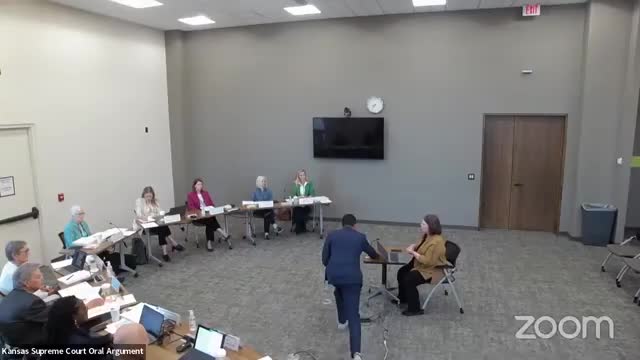
A Supreme Court justice gave commissioners a high-level briefing on how the Kansas Judicial Branch is organized, the branch’s staffing and caseload, and ongoing work to expand technology and specialty courts.
The justice said the Office of Judicial Administration functions as “a statewide network” with both a central hub building and many remote employees. “This really was accelerated during COVID,” the justice said, describing a shift to more remote workers and a distributed organization for budgeting, IT, cybersecurity, HR and judicial education.
The branch’s work was framed around access to justice and case processing. The justice said the system handles roughly 350,000 cases a year statewide, a number depressed by COVID but trending back toward pre-COVID volumes. “We have approximately 1,500 employees employed in the district courts that are around the state. Exactly 1,488,” they said, describing district-court clerks, jury administrators, court administrators, administrative assistants and a shrinking pool of court reporters.
Why it matters: The briefing emphasized that the Supreme Court’s administrative role is broad — it sets statewide policy, maintains standardized information technology and runs scores of committees that oversee operations across 31 judicial districts.
Supporting details and context
The justice said the branch now has about 195 administrative employees working across the state in IT, budgeting, cybersecurity and judicial education. “Our education department is very active and very, is over overworked, frankly,” they said, adding that committees and liaison responsibilities are a major part of the workload; the branch runs “just under 50 committees.”
Specialty courts were a recurring theme. The justice said Kansas has been adding specialty courts nearly every year and noted an expansion into child-in-need-of-care specialty dockets, describing five pilot courts currently operating and demand from other districts to join.
On technology, the justice said the branch is “almost entirely digital” for opinion drafting and case work and is pursuing electronic filing for self-represented litigants, guided by internal committees and a new cybersecurity committee. “We are working very diligently and hope to soon you know, as soon as we can add electronic filing for, self represented litigants,” the justice said, describing a guided form approach that would walk users through questions and produce pleadings.
The justice also flagged workforce issues: an ongoing shortage of court reporters and the administrative burden of moving cases and records from paper to digital formats.
Background numbers and practices cited
- Administrative employees statewide (administration/IT/education): “195 administrative employees around the state.”
- District-court employees: “approximately 1,500 employees … Exactly 1,488.”
- Annual case volume: “just around 350,000 cases a year … pre COVID … well over 400,000 cases a year.”
- Judicial districts: 31; number of statewide committees: “just under 50.”
- Specialty courts: the justice said the state expects to add 2 or 3 new specialty courts every year and has five child-in-need-of-care pilots in place.
What commissioners asked and next steps
After the overview the justice opened the floor for questions, and commissioners pressed on technology skills for prospective justices and how the branch is using digital tools to improve access to courts. The justice pointed to national resources and inter-state collaboration as part of the strategy.
Ending
The justice closed by emphasizing the dual role of the Supreme Court as a decisionmaker and as a “board of directors” that sets policy for the statewide court system and its committees.
The justice said the Office of Judicial Administration functions as “a statewide network” with both a central hub building and many remote employees. “This really was accelerated during COVID,” the justice said, describing a shift to more remote workers and a distributed organization for budgeting, IT, cybersecurity, HR and judicial education.
The branch’s work was framed around access to justice and case processing. The justice said the system handles roughly 350,000 cases a year statewide, a number depressed by COVID but trending back toward pre-COVID volumes. “We have approximately 1,500 employees employed in the district courts that are around the state. Exactly 1,488,” they said, describing district-court clerks, jury administrators, court administrators, administrative assistants and a shrinking pool of court reporters.
Why it matters: The briefing emphasized that the Supreme Court’s administrative role is broad — it sets statewide policy, maintains standardized information technology and runs scores of committees that oversee operations across 31 judicial districts.
Supporting details and context
The justice said the branch now has about 195 administrative employees working across the state in IT, budgeting, cybersecurity and judicial education. “Our education department is very active and very, is over overworked, frankly,” they said, adding that committees and liaison responsibilities are a major part of the workload; the branch runs “just under 50 committees.”
Specialty courts were a recurring theme. The justice said Kansas has been adding specialty courts nearly every year and noted an expansion into child-in-need-of-care specialty dockets, describing five pilot courts currently operating and demand from other districts to join.
On technology, the justice said the branch is “almost entirely digital” for opinion drafting and case work and is pursuing electronic filing for self-represented litigants, guided by internal committees and a new cybersecurity committee. “We are working very diligently and hope to soon you know, as soon as we can add electronic filing for, self represented litigants,” the justice said, describing a guided form approach that would walk users through questions and produce pleadings.
The justice also flagged workforce issues: an ongoing shortage of court reporters and the administrative burden of moving cases and records from paper to digital formats.
Background numbers and practices cited
- Administrative employees statewide (administration/IT/education): “195 administrative employees around the state.”
- District-court employees: “approximately 1,500 employees … Exactly 1,488.”
- Annual case volume: “just around 350,000 cases a year … pre COVID … well over 400,000 cases a year.”
- Judicial districts: 31; number of statewide committees: “just under 50.”
- Specialty courts: the justice said the state expects to add 2 or 3 new specialty courts every year and has five child-in-need-of-care pilots in place.
What commissioners asked and next steps
After the overview the justice opened the floor for questions, and commissioners pressed on technology skills for prospective justices and how the branch is using digital tools to improve access to courts. The justice pointed to national resources and inter-state collaboration as part of the strategy.
Ending
The justice closed by emphasizing the dual role of the Supreme Court as a decisionmaker and as a “board of directors” that sets policy for the statewide court system and its committees.
View the Full Meeting & All Its Details
This article offers just a summary. Unlock complete video, transcripts, and insights as a Founder Member.
✓
Watch full, unedited meeting videos
✓
Search every word spoken in unlimited transcripts
✓
AI summaries & real-time alerts (all government levels)
✓
Permanent access to expanding government content
30-day money-back guarantee
