Kansas judicial nominating commission interviews candidates; panel focuses on technology, administration and access to justice
June 09, 2025 | Judicial Branch, State Agencies, Organizations, Executive, Kansas
This article was created by AI summarizing key points discussed. AI makes mistakes, so for full details and context, please refer to the video of the full meeting. Please report any errors so we can fix them. Report an error »
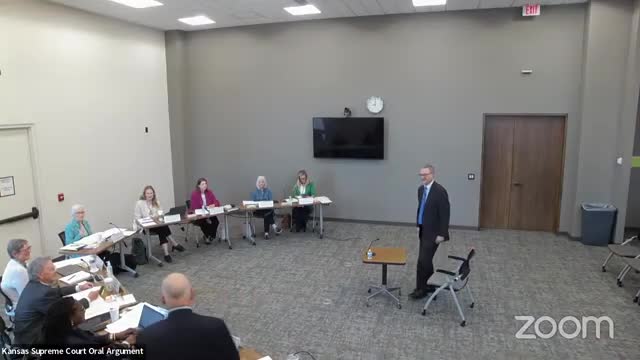
The Kansas Supreme Court Nominating Commission conducted interviews with a slate of candidates for a Supreme Court vacancy. Interviewers, led in several sessions by Tom Lasseter and other commission members, questioned nominees about courtroom experience, administrative skills, technology use, and views on precedent and public trust.
Candidates and themes
Carl Adrian Folsom III, a district judge from Douglas County, said his heavy docket and public‑defender background prepared him for the appellate role and that the Supreme Court should strive to “do everything in its power to make the court system accessible to everyone.” He noted extensive appellate experience: “I've argued 21 times in the Kansas Supreme Court, 46 times in the Court of Appeals, and 11 times in the the US Court of Appeals for the tenth Circuit.” Folsom described introducing an electronic-notice local rule for self‑represented litigants in Douglas County.
Judge Amy Hamley, a district court judge who chairs several statewide committees, emphasized courtroom and administrative experience. “I believe that litigation experience is crucial for this position,” she told the commission, and cited her work leading a jury‑trial resumption task force during COVID and ongoing involvement with pattern jury instructions and pretrial justice committees. She described veterans court work in Douglas County and said the court’s public image is a long‑term challenge best addressed through education and community engagement.
Judge Chris Jayaram described convening district judges to revise local rules after statewide Odyssey implementation and said he had helped craft a local generative‑AI rule for filings. He framed his value as experience across complex civil litigation and family/domestic court work, and stressed the benefit of trial‑court experience on an appellate bench: “I think I really bring that perspective.”
Judge Laura Johnson McNish, with prior experience at the Board of Tax Appeals and the Department of Revenue, highlighted written‑rule experience and the value of predictability: “Writing at that level, I think, would serve me well as Kansas Supreme Court.” She said travel across small counties and the state’s rural courthouses has shaped her view of access and administration.
Randall Hodgkinson, an appellate-practice attorney and visiting professor, emphasized legal writing and analysis and the teaching role of the court. He said the court must help Kansans understand the role of the judiciary as misinformation and politicization grow.
Why it matters: The interviews showed commissioners are weighing a mix of trial experience, appellate familiarity, administrative skills and technology fluency. Candidates from criminal defense, civil practice and tax administration framed different strengths for the court.
Formal action
Before adjourning for deliberations the commission recessed into executive session to review sensitive candidate financial and background materials. A motion was made to recess into executive session and allow staff Doug Shema and Michelle Moore to attend; the motion passed and the commission scheduled reconvening at 1:00 p.m.
Notable candidate details and program notes
- Folsom said his docket included heavy pro se work and limited‑actions dockets and that he implemented a rule allowing self‑represented litigants to opt for electronic notice.
- Hamley led a 17‑member jury‑trial resumption task force during the COVID suspension and said it produced a statewide report used by judges.
- Jayaram led local‑rule revisions to accommodate Odyssey statewide filing and helped draft a local AI certification rule.
- McNish combines tax‑administration experience (Department of Revenue and Board of Tax Appeals) and local rural judicial service; she is also a CPA and emphasized statewide rule writing and predictability.
- Hodgkinson described more than a thousand appellate matters and extensive appellate teaching and outreach.
Ending
After the interviews the commission recessed to executive session to review confidential candidate materials and planned to reconvene in open session for further business.
Candidates and themes
Carl Adrian Folsom III, a district judge from Douglas County, said his heavy docket and public‑defender background prepared him for the appellate role and that the Supreme Court should strive to “do everything in its power to make the court system accessible to everyone.” He noted extensive appellate experience: “I've argued 21 times in the Kansas Supreme Court, 46 times in the Court of Appeals, and 11 times in the the US Court of Appeals for the tenth Circuit.” Folsom described introducing an electronic-notice local rule for self‑represented litigants in Douglas County.
Judge Amy Hamley, a district court judge who chairs several statewide committees, emphasized courtroom and administrative experience. “I believe that litigation experience is crucial for this position,” she told the commission, and cited her work leading a jury‑trial resumption task force during COVID and ongoing involvement with pattern jury instructions and pretrial justice committees. She described veterans court work in Douglas County and said the court’s public image is a long‑term challenge best addressed through education and community engagement.
Judge Chris Jayaram described convening district judges to revise local rules after statewide Odyssey implementation and said he had helped craft a local generative‑AI rule for filings. He framed his value as experience across complex civil litigation and family/domestic court work, and stressed the benefit of trial‑court experience on an appellate bench: “I think I really bring that perspective.”
Judge Laura Johnson McNish, with prior experience at the Board of Tax Appeals and the Department of Revenue, highlighted written‑rule experience and the value of predictability: “Writing at that level, I think, would serve me well as Kansas Supreme Court.” She said travel across small counties and the state’s rural courthouses has shaped her view of access and administration.
Randall Hodgkinson, an appellate-practice attorney and visiting professor, emphasized legal writing and analysis and the teaching role of the court. He said the court must help Kansans understand the role of the judiciary as misinformation and politicization grow.
Why it matters: The interviews showed commissioners are weighing a mix of trial experience, appellate familiarity, administrative skills and technology fluency. Candidates from criminal defense, civil practice and tax administration framed different strengths for the court.
Formal action
Before adjourning for deliberations the commission recessed into executive session to review sensitive candidate financial and background materials. A motion was made to recess into executive session and allow staff Doug Shema and Michelle Moore to attend; the motion passed and the commission scheduled reconvening at 1:00 p.m.
Notable candidate details and program notes
- Folsom said his docket included heavy pro se work and limited‑actions dockets and that he implemented a rule allowing self‑represented litigants to opt for electronic notice.
- Hamley led a 17‑member jury‑trial resumption task force during the COVID suspension and said it produced a statewide report used by judges.
- Jayaram led local‑rule revisions to accommodate Odyssey statewide filing and helped draft a local AI certification rule.
- McNish combines tax‑administration experience (Department of Revenue and Board of Tax Appeals) and local rural judicial service; she is also a CPA and emphasized statewide rule writing and predictability.
- Hodgkinson described more than a thousand appellate matters and extensive appellate teaching and outreach.
Ending
After the interviews the commission recessed to executive session to review confidential candidate materials and planned to reconvene in open session for further business.
View the Full Meeting & All Its Details
This article offers just a summary. Unlock complete video, transcripts, and insights as a Founder Member.
✓
Watch full, unedited meeting videos
✓
Search every word spoken in unlimited transcripts
✓
AI summaries & real-time alerts (all government levels)
✓
Permanent access to expanding government content
30-day money-back guarantee
