Board approves higher land-use application fees, effective Oct. 1
August 04, 2025 | Winchester Town, Litchfield County, Connecticut
This article was created by AI summarizing key points discussed. AI makes mistakes, so for full details and context, please refer to the video of the full meeting. Please report any errors so we can fix them. Report an error »
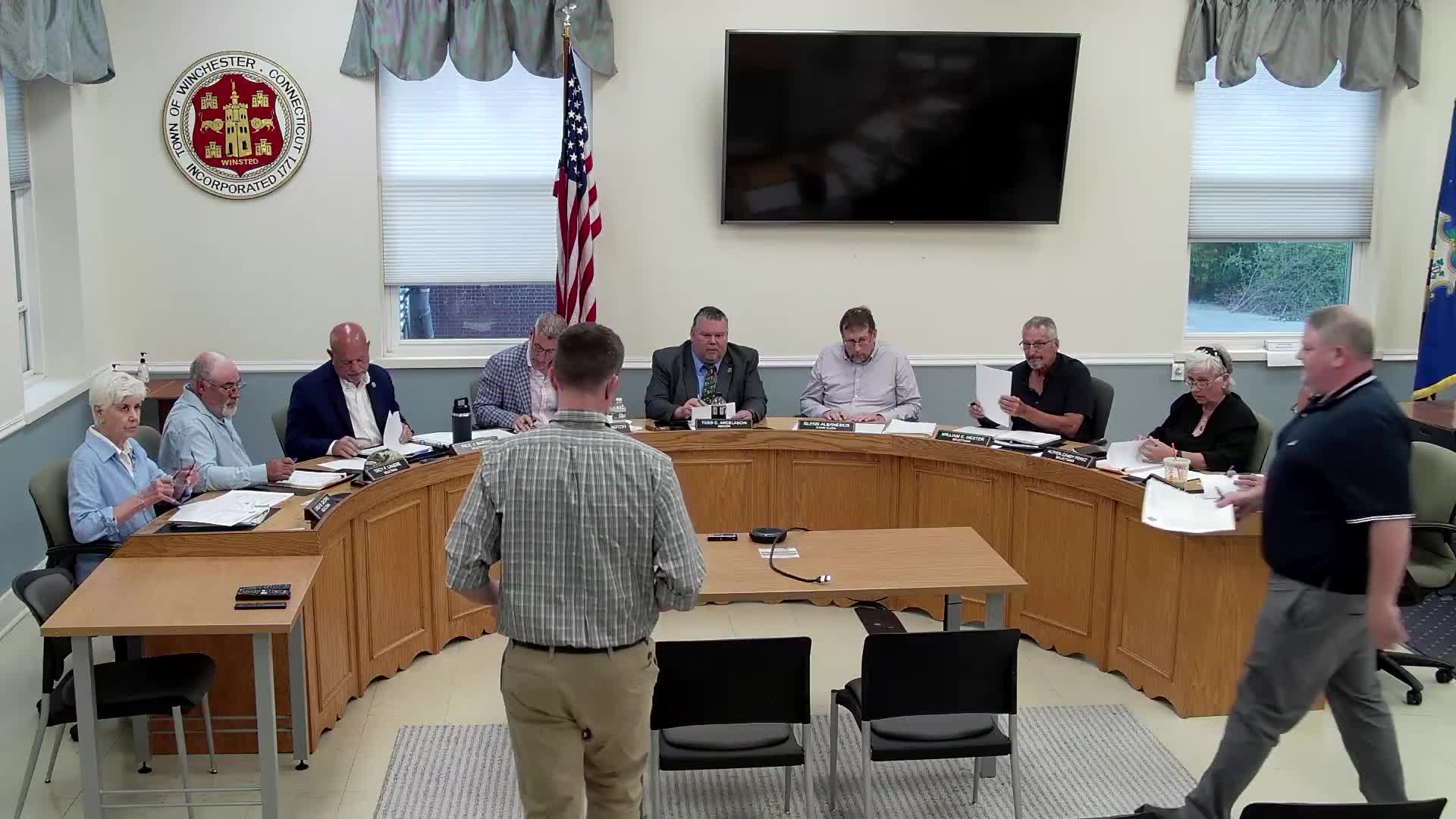
Winchester — The Board of Selectmen voted unanimously Thursday to raise multiple land‑use application fees for the Inland Wetlands and Watercourses Agency and the Planning & Zoning Commission, setting the new rates to take effect Oct. 1, 2025.
Board members said the increases are intended to recover the town’s hard costs for processing applications, including state fees and legally required newspaper notices.
Assistant Planner Jeff Green and consultant Jeremy DeCarli presented a benchmarking analysis showing that many neighboring towns last updated fees years ago and that current local fees were not covering costs. "The goal should be pay for play," DeCarli said, summarizing the consultants' view that contractor and applicant fees should cover staff time, DEP fees and required legal notices. Green noted that the town currently pays a $60 fee to the Connecticut Department of Energy and Environmental Protection for each land‑use application and that public hearings can add several hundred dollars for legal notices.
The board discussed timing and public notice; members agreed to delay the effective date to Oct. 1 to allow applicants time to file under the lower rates and to give staff time to publish the new fees. Selectwoman Candy Perez asked that the town post a clear news item explaining the rationale and cost comparisons. The board directed staff to publish an explanatory notice on the town website and through the town's subscription channels.
Motion and outcome: A board member moved to accept the proposed Planning & Zoning and Inland Wetlands fee schedules "as presented with an effective date of 10/01/2025." The motion carried unanimously. The board did not record individual roll‑call vote tallies in the minutes provided.
Background and next steps: The packet included two proposed fee schedules and a spreadsheet comparing fees from nearby towns. Staff said OpenGov (the town’s permitting system) would be updated before the Oct. 1 effective date. Officials also noted that increasing fees may prompt a short‑term rise in filings before the new rates begin.
The board noted this was a substantive change to long‑standing local practice and agreed to publicize the cost basis for the increases and the commissions’ prior review of the proposals.
Board members said the increases are intended to recover the town’s hard costs for processing applications, including state fees and legally required newspaper notices.
Assistant Planner Jeff Green and consultant Jeremy DeCarli presented a benchmarking analysis showing that many neighboring towns last updated fees years ago and that current local fees were not covering costs. "The goal should be pay for play," DeCarli said, summarizing the consultants' view that contractor and applicant fees should cover staff time, DEP fees and required legal notices. Green noted that the town currently pays a $60 fee to the Connecticut Department of Energy and Environmental Protection for each land‑use application and that public hearings can add several hundred dollars for legal notices.
The board discussed timing and public notice; members agreed to delay the effective date to Oct. 1 to allow applicants time to file under the lower rates and to give staff time to publish the new fees. Selectwoman Candy Perez asked that the town post a clear news item explaining the rationale and cost comparisons. The board directed staff to publish an explanatory notice on the town website and through the town's subscription channels.
Motion and outcome: A board member moved to accept the proposed Planning & Zoning and Inland Wetlands fee schedules "as presented with an effective date of 10/01/2025." The motion carried unanimously. The board did not record individual roll‑call vote tallies in the minutes provided.
Background and next steps: The packet included two proposed fee schedules and a spreadsheet comparing fees from nearby towns. Staff said OpenGov (the town’s permitting system) would be updated before the Oct. 1 effective date. Officials also noted that increasing fees may prompt a short‑term rise in filings before the new rates begin.
The board noted this was a substantive change to long‑standing local practice and agreed to publicize the cost basis for the increases and the commissions’ prior review of the proposals.
Don't Miss a Word: See the Full Meeting!
Go beyond summaries. Unlock every video, transcript, and key insight with a Founder Membership.
✓
Get instant access to full meeting videos
✓
Search and clip any phrase from complete transcripts
✓
Receive AI-powered summaries & custom alerts
✓
Enjoy lifetime, unrestricted access to government data
30-day money-back guarantee
