House committee hears proposal to let Ohio’s strategic reserve invest in Bitcoin
June 17, 2025 | Technology and Innovation, House of Representatives, Committees, Legislative, Ohio
This article was created by AI summarizing key points discussed. AI makes mistakes, so for full details and context, please refer to the video of the full meeting. Please report any errors so we can fix them. Report an error »
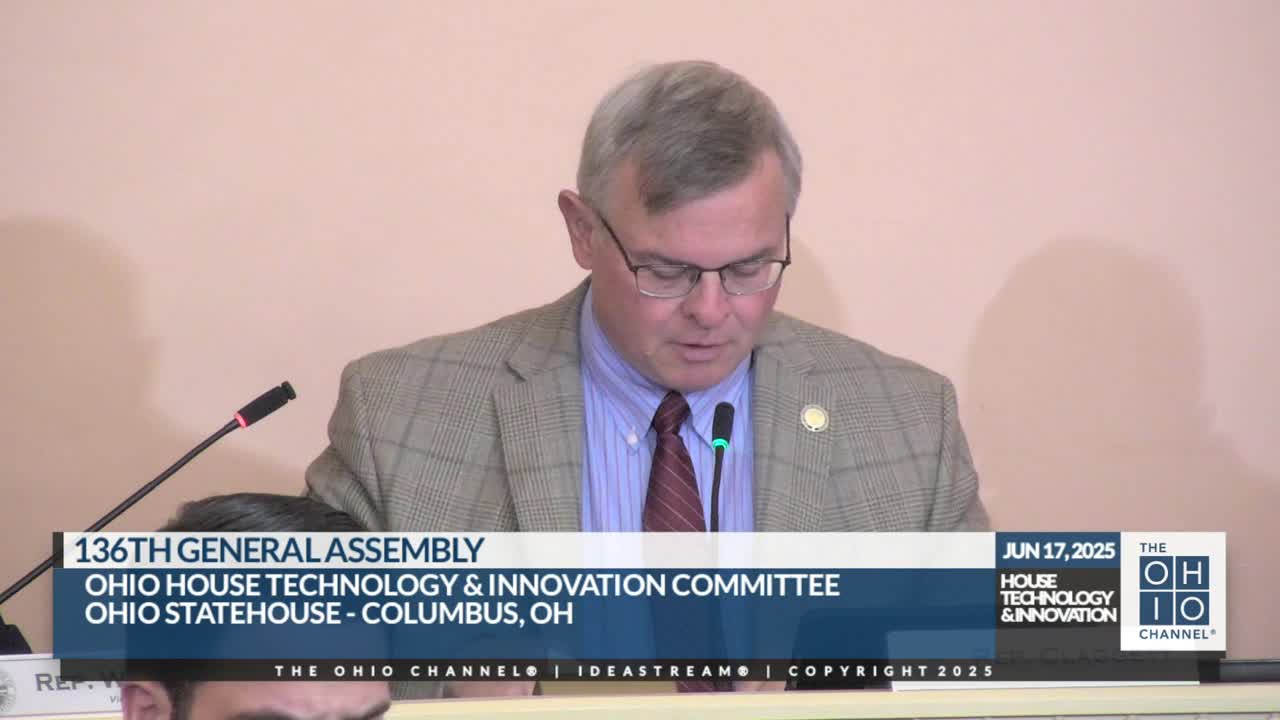
Chairman Claggett called the House Technology and Innovation Committee to order on June 17 and opened the panel’s third hearing on House Bill 18, which would create an Ohio Strategic Reserve Fund and an Ohio Strategic Reserve Authority and authorize money in the reserve to be invested in Bitcoin.
The bill’s principal proponent, Zach Prouty, director of policy and legislative affairs at the Ohio Treasurer’s Office, told the committee the proposal would create a new classification of state investments intended to be held longer than the current maximum maturity of five years. “Safety and liquidity are first 2 primary our first 2 objectives and then earnings come third,” Prouty said, describing the treasurer’s current investment priorities and how a strategic reserve would differ from the state’s interim cash investments.
The nut graf: supporters said the reserve would let the state earmark truly long-term savings for higher-yielding investments and create an oversight structure modeled on other state authorities; critics and questioners sought clarity on volatility, liquidity and governance.
Prouty said the full treasury is about $25,000,000,000 and that the treasurer’s office expects to have generated more than $2,000,000,000 in investment income for the state over the last two fiscal years. He described the strategic reserve as a long-term pool that could be invested in a “wider array of instruments” than interim funds, adding the authority would include representatives from the Office of Budget and Management and the auditor’s office and could include two outside investment experts to advise on nontraditional assets.
Prouty said the proposal is flexible about revenue sources for the reserve, including the option to sweep year-end surpluses into the new fund instead of the Budget Stabilization Fund. He told members that state law and the Ohio Constitution currently bar states from investing in equities, so the bill’s scope will be limited by that constitutional constraint.
Committee members pressed witnesses on risk and liquidity. A committee member asked whether Bitcoin is a “safe investment” and how volatility fits with the treasurer’s mandate to protect state funds. Prouty answered that Bitcoin is a commodity rather than a credit-rated security and that the strategic-reserve concept accepts short-term volatility in exchange for long-term holding: the authority would “write out short term volatility because we intend to hold these funds for 5, 10, 15, 20 years into the future,” he said.
Private-sector witnesses supported the bill at the third hearing. Christopher Mast, a CPA and partner at GBQ Partners, testified that Bitcoin’s capped supply and institutional developments make it a viable diversification tool; Joshua Bohinck, chief financial officer of Continental Building Company, described Bitcoin as a long-term store of value and urged Ohio to adopt the legislation to be an early adopter.
Committee members emphasized oversight and implementation details. One member said the committee should “pay special attention” to the composition and authorities of the board that would advise and oversee reserve investments. Prouty and members noted that operational dollars and short-term liquidity would be insulated from reserve investments because the reserve is intended to hold excess savings rather than funds the state will need immediately.
This hearing resulted in discussion but no committee vote on the bill; proponents said further, minor amendments may be forthcoming and that treasurer’s office staff would be available to answer additional committee questions.
Ending: The committee concluded the third hearing on House Bill 18 and invited witnesses to remain available for follow-up questions after committee business.
The bill’s principal proponent, Zach Prouty, director of policy and legislative affairs at the Ohio Treasurer’s Office, told the committee the proposal would create a new classification of state investments intended to be held longer than the current maximum maturity of five years. “Safety and liquidity are first 2 primary our first 2 objectives and then earnings come third,” Prouty said, describing the treasurer’s current investment priorities and how a strategic reserve would differ from the state’s interim cash investments.
The nut graf: supporters said the reserve would let the state earmark truly long-term savings for higher-yielding investments and create an oversight structure modeled on other state authorities; critics and questioners sought clarity on volatility, liquidity and governance.
Prouty said the full treasury is about $25,000,000,000 and that the treasurer’s office expects to have generated more than $2,000,000,000 in investment income for the state over the last two fiscal years. He described the strategic reserve as a long-term pool that could be invested in a “wider array of instruments” than interim funds, adding the authority would include representatives from the Office of Budget and Management and the auditor’s office and could include two outside investment experts to advise on nontraditional assets.
Prouty said the proposal is flexible about revenue sources for the reserve, including the option to sweep year-end surpluses into the new fund instead of the Budget Stabilization Fund. He told members that state law and the Ohio Constitution currently bar states from investing in equities, so the bill’s scope will be limited by that constitutional constraint.
Committee members pressed witnesses on risk and liquidity. A committee member asked whether Bitcoin is a “safe investment” and how volatility fits with the treasurer’s mandate to protect state funds. Prouty answered that Bitcoin is a commodity rather than a credit-rated security and that the strategic-reserve concept accepts short-term volatility in exchange for long-term holding: the authority would “write out short term volatility because we intend to hold these funds for 5, 10, 15, 20 years into the future,” he said.
Private-sector witnesses supported the bill at the third hearing. Christopher Mast, a CPA and partner at GBQ Partners, testified that Bitcoin’s capped supply and institutional developments make it a viable diversification tool; Joshua Bohinck, chief financial officer of Continental Building Company, described Bitcoin as a long-term store of value and urged Ohio to adopt the legislation to be an early adopter.
Committee members emphasized oversight and implementation details. One member said the committee should “pay special attention” to the composition and authorities of the board that would advise and oversee reserve investments. Prouty and members noted that operational dollars and short-term liquidity would be insulated from reserve investments because the reserve is intended to hold excess savings rather than funds the state will need immediately.
This hearing resulted in discussion but no committee vote on the bill; proponents said further, minor amendments may be forthcoming and that treasurer’s office staff would be available to answer additional committee questions.
Ending: The committee concluded the third hearing on House Bill 18 and invited witnesses to remain available for follow-up questions after committee business.
Don't Miss a Word: See the Full Meeting!
Go beyond summaries. Unlock every video, transcript, and key insight with a Founder Membership.
✓
Get instant access to full meeting videos
✓
Search and clip any phrase from complete transcripts
✓
Receive AI-powered summaries & custom alerts
✓
Enjoy lifetime, unrestricted access to government data
30-day money-back guarantee
