State health information exchange SHARE discussed; panel fields questions on AI, consent and payer access
August 06, 2025 | 2025 Legislative Meetings, Arkansas
This article was created by AI summarizing key points discussed. AI makes mistakes, so for full details and context, please refer to the video of the full meeting. Please report any errors so we can fix them. Report an error »
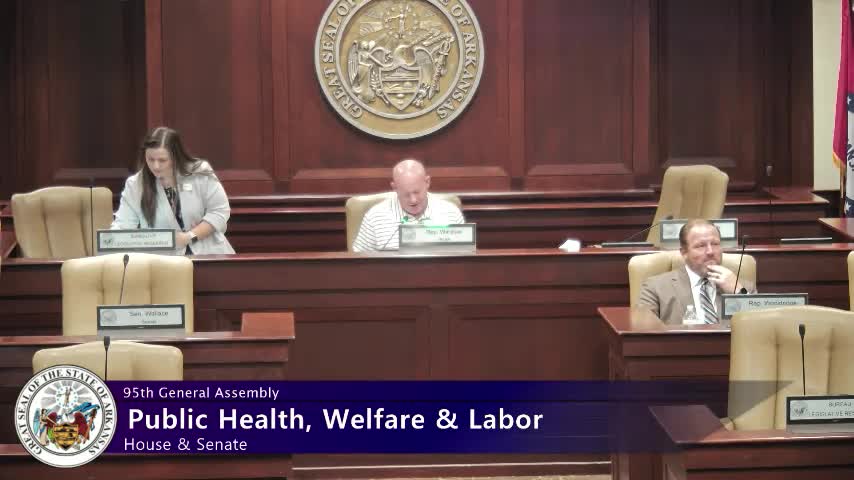
The committee heard an overview of SHARE, Arkansas's statewide health information exchange, and questioned Department of Health staff about artificial intelligence in electronic health records, how patients can opt out of data sharing and which organizations can access clinical information.
Anne Sanifer, director of the Office of Health Information Technology at the Arkansas Department of Health, told the committee, "We are the health information exchange for the state. . . . The data comes in real time, and it's available to the patient's care team." Sanifer said SHARE aggregates records from multiple electronic medical record systems so providers can see allergies, medications, diagnoses and procedures in a single, centralized record regardless of where care occurred.
Sanifer emphasized that Arkansas is an opt-out state and that patients who choose to opt out will have their records excluded from electronic sharing; those records can still be exchanged by non-electronic means such as fax or paper. She described permissible uses of SHARE data as treatment, payment or operational need (TPO) and said organizations that have a relationship with a patient must be identified before they may view that patient's records.
The committee asked detailed questions about emerging uses of artificial intelligence. Representative Woolridge asked about the "AI component of EHRs and medical health records" and whether the state is monitoring that use. Sanifer said AI is "on its way to health care" and is being used now by some providers more to draft or summarize notes than to make direct clinical decisions; she described examples such as AI-assisted clinical note-taking and a provider using a generative tool to draft a treatment guide. She said electronic medical record vendors and individual hospitals or clinics generally manage and contract for any AI tools and that hospitals may adopt internal policies governing their use.
On oversight, Sanifer said new AI uses that fall outside SHARE's traditional data use — for example, nonclinical uses such as fraud detection — would be presented to the state Board of Health as a "new use case." She also said the department would "look into" whether providers are seeking explicit patient consent for AI-assisted tools and would follow up with the committee.
Lawmakers pressed the panel on who can access data in SHARE. Sanifer said SHARE receives funding from a mix of federal Medicaid funds, fees from participating providers and fees from payers who subscribe to receive clinical data about their members. She gave the example of sending A1C results to a payer so the insurer can enroll members identified as prediabetic in prevention programs. Sanifer said most payers in Arkansas participate in SHARE; accountable care organizations and clinically integrated networks that assume financial risk for patient populations also receive data when contracted to do so on behalf of providers.
Senator Mark Payton (Senator Payton) raised a routine-practice concern after surgery, saying patients are repeatedly asked to complete intake questionnaires even when records should be available electronically. "Why are we required to fill out the stupid form every time?" Payton asked, describing repeated follow-up visits. Sanifer attributed some repeated paperwork to legacy clinic and hospital workflows and said both Baptist Health and Ortho Arkansas are connected to SHARE and could access each other's records through the exchange.
Representative Long asked about a recent executive order that the governor issued directing the health department to provide information about COVID vaccine adverse reactions. Matt Gilmore of the Department of Health told the committee that the law or order in question required posting information on the department website and that staff would verify local health unit compliance and follow up with Representative Long.
Procedural action: the committee took a verbal vote to accept the minutes from the prior meeting. The chair called for a motion to accept the minutes; members voiced assent and the chair announced, "Ayes have it." The transcript does not record who moved or seconded the motion or the count of ayes and nays.
The panel concluded with staff offers to research whether patients must give explicit informed consent for providers' AI use and to confirm whether local health units are distributing materials required by the executive order. The committee adjourned after closing remarks.
Anne Sanifer, director of the Office of Health Information Technology at the Arkansas Department of Health, told the committee, "We are the health information exchange for the state. . . . The data comes in real time, and it's available to the patient's care team." Sanifer said SHARE aggregates records from multiple electronic medical record systems so providers can see allergies, medications, diagnoses and procedures in a single, centralized record regardless of where care occurred.
Sanifer emphasized that Arkansas is an opt-out state and that patients who choose to opt out will have their records excluded from electronic sharing; those records can still be exchanged by non-electronic means such as fax or paper. She described permissible uses of SHARE data as treatment, payment or operational need (TPO) and said organizations that have a relationship with a patient must be identified before they may view that patient's records.
The committee asked detailed questions about emerging uses of artificial intelligence. Representative Woolridge asked about the "AI component of EHRs and medical health records" and whether the state is monitoring that use. Sanifer said AI is "on its way to health care" and is being used now by some providers more to draft or summarize notes than to make direct clinical decisions; she described examples such as AI-assisted clinical note-taking and a provider using a generative tool to draft a treatment guide. She said electronic medical record vendors and individual hospitals or clinics generally manage and contract for any AI tools and that hospitals may adopt internal policies governing their use.
On oversight, Sanifer said new AI uses that fall outside SHARE's traditional data use — for example, nonclinical uses such as fraud detection — would be presented to the state Board of Health as a "new use case." She also said the department would "look into" whether providers are seeking explicit patient consent for AI-assisted tools and would follow up with the committee.
Lawmakers pressed the panel on who can access data in SHARE. Sanifer said SHARE receives funding from a mix of federal Medicaid funds, fees from participating providers and fees from payers who subscribe to receive clinical data about their members. She gave the example of sending A1C results to a payer so the insurer can enroll members identified as prediabetic in prevention programs. Sanifer said most payers in Arkansas participate in SHARE; accountable care organizations and clinically integrated networks that assume financial risk for patient populations also receive data when contracted to do so on behalf of providers.
Senator Mark Payton (Senator Payton) raised a routine-practice concern after surgery, saying patients are repeatedly asked to complete intake questionnaires even when records should be available electronically. "Why are we required to fill out the stupid form every time?" Payton asked, describing repeated follow-up visits. Sanifer attributed some repeated paperwork to legacy clinic and hospital workflows and said both Baptist Health and Ortho Arkansas are connected to SHARE and could access each other's records through the exchange.
Representative Long asked about a recent executive order that the governor issued directing the health department to provide information about COVID vaccine adverse reactions. Matt Gilmore of the Department of Health told the committee that the law or order in question required posting information on the department website and that staff would verify local health unit compliance and follow up with Representative Long.
Procedural action: the committee took a verbal vote to accept the minutes from the prior meeting. The chair called for a motion to accept the minutes; members voiced assent and the chair announced, "Ayes have it." The transcript does not record who moved or seconded the motion or the count of ayes and nays.
The panel concluded with staff offers to research whether patients must give explicit informed consent for providers' AI use and to confirm whether local health units are distributing materials required by the executive order. The committee adjourned after closing remarks.
View the Full Meeting & All Its Details
This article offers just a summary. Unlock complete video, transcripts, and insights as a Founder Member.
✓
Watch full, unedited meeting videos
✓
Search every word spoken in unlimited transcripts
✓
AI summaries & real-time alerts (all government levels)
✓
Permanent access to expanding government content
30-day money-back guarantee
