Task force: Louisiana lacks mandated suicide reporting on college campuses; calls for state data hub
August 11, 2025 | 2025 Legislature LA, Louisiana
This article was created by AI summarizing key points discussed. AI makes mistakes, so for full details and context, please refer to the video of the full meeting. Please report any errors so we can fix them. Report an error »
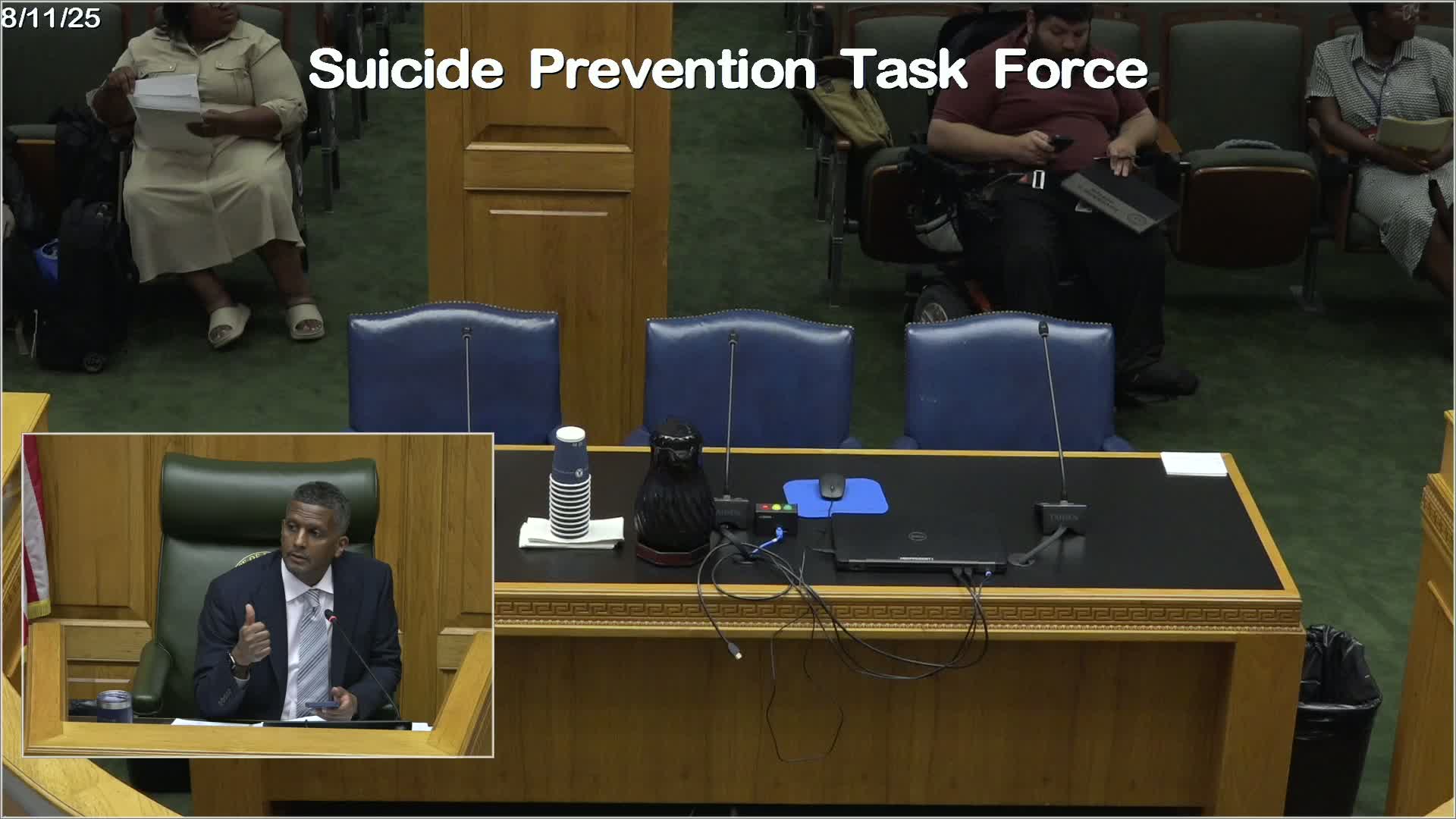
Members of the Louisiana Suicide Prevention Among African Americans Task Force heard on Aug. 11 that the state lacks a legal requirement for colleges and universities to report student suicides and that researchers recommend creating a statewide data hub and mandated reporting to improve prevention efforts.
Dr. Charmaine Williams, a researcher with Southern University’s Nelson Mandela College of Government and Social Sciences, told the task force, "There is no legislation that mandates that suicide data is, collected, reported, and captured on university and college campuses." She said the team’s review of earlier work under HCR 84 and follow-up under HCR 86 found inconsistent campus reporting, limited voluntary sharing with national databases, and institutional reluctance to provide data without legislative direction.
The lack of consistent campus reporting makes it difficult to measure and target prevention, the presenters said. Williams said the team found only eight Louisiana schools that share data voluntarily with a national suicide database maintained by Penn State and that even that source would not provide identifying campus-level detail to the task force, citing de-identification rules. The researchers used the CDC WONDER database to update statewide suicide counts through 2023 and to project trends through 2030.
The task force heard data showing rising suicide counts among African American males aged 20–34, with a sharp peak in the 25‑to‑29 group. Williams summarized counts presented to the panel: 98 deaths in the 25–29 bracket and counts in nearby brackets of 84 (30–34) and 85 (20–24). A representative of the Louisiana Office of Public Health provided data noted by presenters that firearms accounted for a majority of suicide deaths in 2023.
Vanessa Green Spade, a co-researcher with Nelson Mandela College, outlined prevention priorities for the age groups identified as highest-risk. For people aged 25–44, the report recommends expanding primary‑care detection, integrating behavioral health into primary care, workplace suicide prevention training, and firearm and medication‑safety counseling. The researchers also emphasized peer-focused outreach and focus groups to capture youth language and help-seeking patterns.
Presenters described practical next steps and resources. Southern University offered space and staff capacity for a centralized data hub: Williams said the university already hosts other federal data centers and training and that "it's about 7 professors and about 12 students that have been working on it, and they're all doctoral level students." The task force discussed the need for a legislative mandate and compliance mechanisms for campus reporting; Williams said, "There has to be literally a legislative mandate to share."
The meeting also included testimony calling for broader, non-data interventions. Dr. Forte Benson, who identified himself as a physician, urged attention to nutrition and vitamin D and told the panel, "By far, vitamin D is the issue," arguing that biological and lifestyle factors deserve study alongside mental‑health supports. The researchers and several legislators agreed the task force should pursue evidence-based, multi-pronged strategies rather than single-solution approaches.
Senators and representatives on the panel agreed to seek federal engagement: the task force plans to contact U.S. Reps. Troy Carter and Troy Fields’ offices to identify staff who can coordinate federal support and to discuss where federal oversight or incentives could strengthen state reporting. The researchers said the HCR 86 deliverable is due Feb. 1 and that they can provide interim updates; the panel discussed reconvening in roughly six to eight weeks with additional mental‑health witnesses and congressional staff.
Why it matters: Without mandated, de‑identified, centralized data, researchers and policymakers said they cannot reliably track trends or evaluate targeted prevention for African Americans across Louisiana’s campuses and communities. The task force’s recommended central hub and mandated reporting are aimed at filling those gaps and enabling interventions for the highest‑risk age groups.
The task force adjourned after scheduling follow up and asking staff to coordinate congressional outreach and additional witnesses for the next meeting.
Dr. Charmaine Williams, a researcher with Southern University’s Nelson Mandela College of Government and Social Sciences, told the task force, "There is no legislation that mandates that suicide data is, collected, reported, and captured on university and college campuses." She said the team’s review of earlier work under HCR 84 and follow-up under HCR 86 found inconsistent campus reporting, limited voluntary sharing with national databases, and institutional reluctance to provide data without legislative direction.
The lack of consistent campus reporting makes it difficult to measure and target prevention, the presenters said. Williams said the team found only eight Louisiana schools that share data voluntarily with a national suicide database maintained by Penn State and that even that source would not provide identifying campus-level detail to the task force, citing de-identification rules. The researchers used the CDC WONDER database to update statewide suicide counts through 2023 and to project trends through 2030.
The task force heard data showing rising suicide counts among African American males aged 20–34, with a sharp peak in the 25‑to‑29 group. Williams summarized counts presented to the panel: 98 deaths in the 25–29 bracket and counts in nearby brackets of 84 (30–34) and 85 (20–24). A representative of the Louisiana Office of Public Health provided data noted by presenters that firearms accounted for a majority of suicide deaths in 2023.
Vanessa Green Spade, a co-researcher with Nelson Mandela College, outlined prevention priorities for the age groups identified as highest-risk. For people aged 25–44, the report recommends expanding primary‑care detection, integrating behavioral health into primary care, workplace suicide prevention training, and firearm and medication‑safety counseling. The researchers also emphasized peer-focused outreach and focus groups to capture youth language and help-seeking patterns.
Presenters described practical next steps and resources. Southern University offered space and staff capacity for a centralized data hub: Williams said the university already hosts other federal data centers and training and that "it's about 7 professors and about 12 students that have been working on it, and they're all doctoral level students." The task force discussed the need for a legislative mandate and compliance mechanisms for campus reporting; Williams said, "There has to be literally a legislative mandate to share."
The meeting also included testimony calling for broader, non-data interventions. Dr. Forte Benson, who identified himself as a physician, urged attention to nutrition and vitamin D and told the panel, "By far, vitamin D is the issue," arguing that biological and lifestyle factors deserve study alongside mental‑health supports. The researchers and several legislators agreed the task force should pursue evidence-based, multi-pronged strategies rather than single-solution approaches.
Senators and representatives on the panel agreed to seek federal engagement: the task force plans to contact U.S. Reps. Troy Carter and Troy Fields’ offices to identify staff who can coordinate federal support and to discuss where federal oversight or incentives could strengthen state reporting. The researchers said the HCR 86 deliverable is due Feb. 1 and that they can provide interim updates; the panel discussed reconvening in roughly six to eight weeks with additional mental‑health witnesses and congressional staff.
Why it matters: Without mandated, de‑identified, centralized data, researchers and policymakers said they cannot reliably track trends or evaluate targeted prevention for African Americans across Louisiana’s campuses and communities. The task force’s recommended central hub and mandated reporting are aimed at filling those gaps and enabling interventions for the highest‑risk age groups.
The task force adjourned after scheduling follow up and asking staff to coordinate congressional outreach and additional witnesses for the next meeting.
Don't Miss a Word: See the Full Meeting!
Go beyond summaries. Unlock every video, transcript, and key insight with a Founder Membership.
✓
Get instant access to full meeting videos
✓
Search and clip any phrase from complete transcripts
✓
Receive AI-powered summaries & custom alerts
✓
Enjoy lifetime, unrestricted access to government data
30-day money-back guarantee
