Council reviews House Bill 96 retirement provisions; staff recommends approval of some items, disapproval of School Social Security change
June 12, 2025 | Retirement Study Council , Joint, Committees, Legislative, Ohio
This article was created by AI summarizing key points discussed. AI makes mistakes, so for full details and context, please refer to the video of the full meeting. Please report any errors so we can fix them. Report an error »
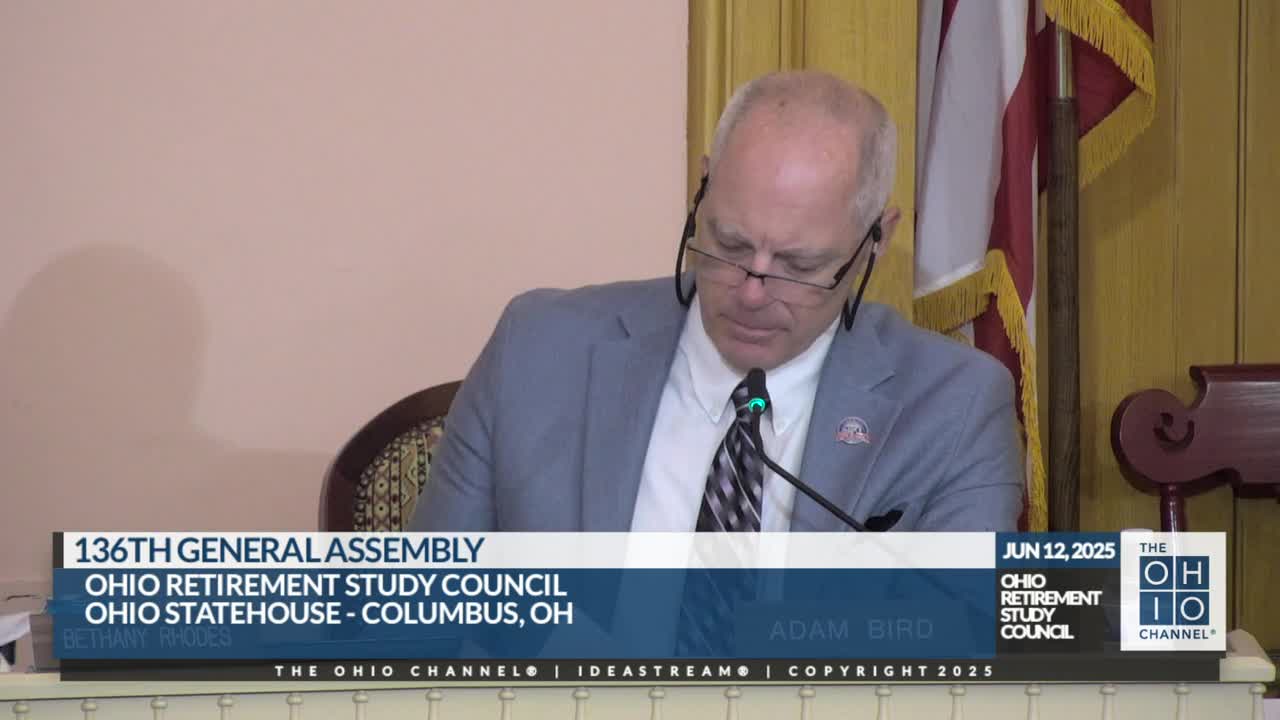
The Retirement Study Council reviewed updated staff recommendations on House Bill 96, the biennial budget bill, on June 12 and moved to adopt the council staff’s updated recommendations after a detailed briefing on several retirement‑related provisions.
Jeff Bernard, ORSC staff, told the council the staff paper is an update reflecting recent Senate changes and new language added the prior week. Bernard said ORSC staff continue to recommend keeping the transfer of administration of the public employees’ deferred compensation program to the Ohio Public Employees Retirement System in the bill and approved an exclusion of precinct election workers from public retirement system service credit as revised in the Senate language.
On withholding of school‑district income taxes from retirement payments, staff reported the Senate version moved the effective date to Jan. 1, 2027, and removed the tax commissioner’s rule‑making authority over retirement systems; staff said those changes addressed earlier administrative concerns. “The implementation date is moved back to 01/01/2027, and the tax commissioner, rule making authority over the state retirement systems has been removed,” Bernard said.
The council spent extended time on a Senate amendment that would exclude from membership in the School Employees Retirement System certain people providing school health services to children with disabilities when those workers are employed and paid by a contractor rather than directly by a district. Bernard explained that changing coverage in that way could trigger federal Social Security Section 218 procedures and produce a broader coverage group than the bill intends, potentially shifting substantial numbers of public employees into Social Security and removing them from state retirement coverage.
“This change could prevent those members from earning additional service credit and could make many ineligible for future SERS benefits,” Bernard said. ORSC staff recommended disapproval of the provision because it would alter long‑standing state policy regarding Social Security coverage and because it does not amend the state’s Section 218 agreement required to move groups into Social Security.
Representative Brennan raised statutory and ethics concerns about consolidating governance of the deferred compensation program into one board, citing fiduciary duties and conflict‑of‑interest rules; Director Caraher said the boards have been working together for more than two years, that counsel and ethics advice were sought, and that many deferred compensation participants are already OPERS members.
On employer pickups — the practice of an employer paying an employee’s retirement contribution — staff said the Senate version would prohibit school districts from picking up employee contributions to SERS. ORSC staff said they are neutral on the policy but suggested a time lag to allow collective bargaining and employer contracts to adjust if the change remains.
After discussion, the council chair moved to adopt the updated House Bill 96 recommendations; the motion was seconded and carried on a roll call. Representative Brennan and Senator Blackshear recorded “no” votes; Representative Plummer, Vice Chairman Romanchuk, Senator Blessing, Doctor Pottingill and Mr. Scherer recorded “yes” votes.
ORSC staff summarized their recommendations in a final page of the briefing packet: approve the administrative updates incorporated into the Senate language (deferred comp transfer, precinct worker exclusion, state agency definition change, and school withholding timing), disapprove the School Employees Retirement System coverage change tied to Social Security, and comment on employer pickup timing and contract impacts.
Council members and representatives of affected retirement systems said they would continue to press for removal or clarification of the Social Security coverage language during the legislative process.
Jeff Bernard, ORSC staff, told the council the staff paper is an update reflecting recent Senate changes and new language added the prior week. Bernard said ORSC staff continue to recommend keeping the transfer of administration of the public employees’ deferred compensation program to the Ohio Public Employees Retirement System in the bill and approved an exclusion of precinct election workers from public retirement system service credit as revised in the Senate language.
On withholding of school‑district income taxes from retirement payments, staff reported the Senate version moved the effective date to Jan. 1, 2027, and removed the tax commissioner’s rule‑making authority over retirement systems; staff said those changes addressed earlier administrative concerns. “The implementation date is moved back to 01/01/2027, and the tax commissioner, rule making authority over the state retirement systems has been removed,” Bernard said.
The council spent extended time on a Senate amendment that would exclude from membership in the School Employees Retirement System certain people providing school health services to children with disabilities when those workers are employed and paid by a contractor rather than directly by a district. Bernard explained that changing coverage in that way could trigger federal Social Security Section 218 procedures and produce a broader coverage group than the bill intends, potentially shifting substantial numbers of public employees into Social Security and removing them from state retirement coverage.
“This change could prevent those members from earning additional service credit and could make many ineligible for future SERS benefits,” Bernard said. ORSC staff recommended disapproval of the provision because it would alter long‑standing state policy regarding Social Security coverage and because it does not amend the state’s Section 218 agreement required to move groups into Social Security.
Representative Brennan raised statutory and ethics concerns about consolidating governance of the deferred compensation program into one board, citing fiduciary duties and conflict‑of‑interest rules; Director Caraher said the boards have been working together for more than two years, that counsel and ethics advice were sought, and that many deferred compensation participants are already OPERS members.
On employer pickups — the practice of an employer paying an employee’s retirement contribution — staff said the Senate version would prohibit school districts from picking up employee contributions to SERS. ORSC staff said they are neutral on the policy but suggested a time lag to allow collective bargaining and employer contracts to adjust if the change remains.
After discussion, the council chair moved to adopt the updated House Bill 96 recommendations; the motion was seconded and carried on a roll call. Representative Brennan and Senator Blackshear recorded “no” votes; Representative Plummer, Vice Chairman Romanchuk, Senator Blessing, Doctor Pottingill and Mr. Scherer recorded “yes” votes.
ORSC staff summarized their recommendations in a final page of the briefing packet: approve the administrative updates incorporated into the Senate language (deferred comp transfer, precinct worker exclusion, state agency definition change, and school withholding timing), disapprove the School Employees Retirement System coverage change tied to Social Security, and comment on employer pickup timing and contract impacts.
Council members and representatives of affected retirement systems said they would continue to press for removal or clarification of the Social Security coverage language during the legislative process.
View the Full Meeting & All Its Details
This article offers just a summary. Unlock complete video, transcripts, and insights as a Founder Member.
✓
Watch full, unedited meeting videos
✓
Search every word spoken in unlimited transcripts
✓
AI summaries & real-time alerts (all government levels)
✓
Permanent access to expanding government content
30-day money-back guarantee
