Planning commission agrees to initiate general-plan change for Cherry Valley site amid resident opposition
August 06, 2025 | Riverside County, California
This article was created by AI summarizing key points discussed. AI makes mistakes, so for full details and context, please refer to the video of the full meeting. Please report any errors so we can fix them. Report an error »
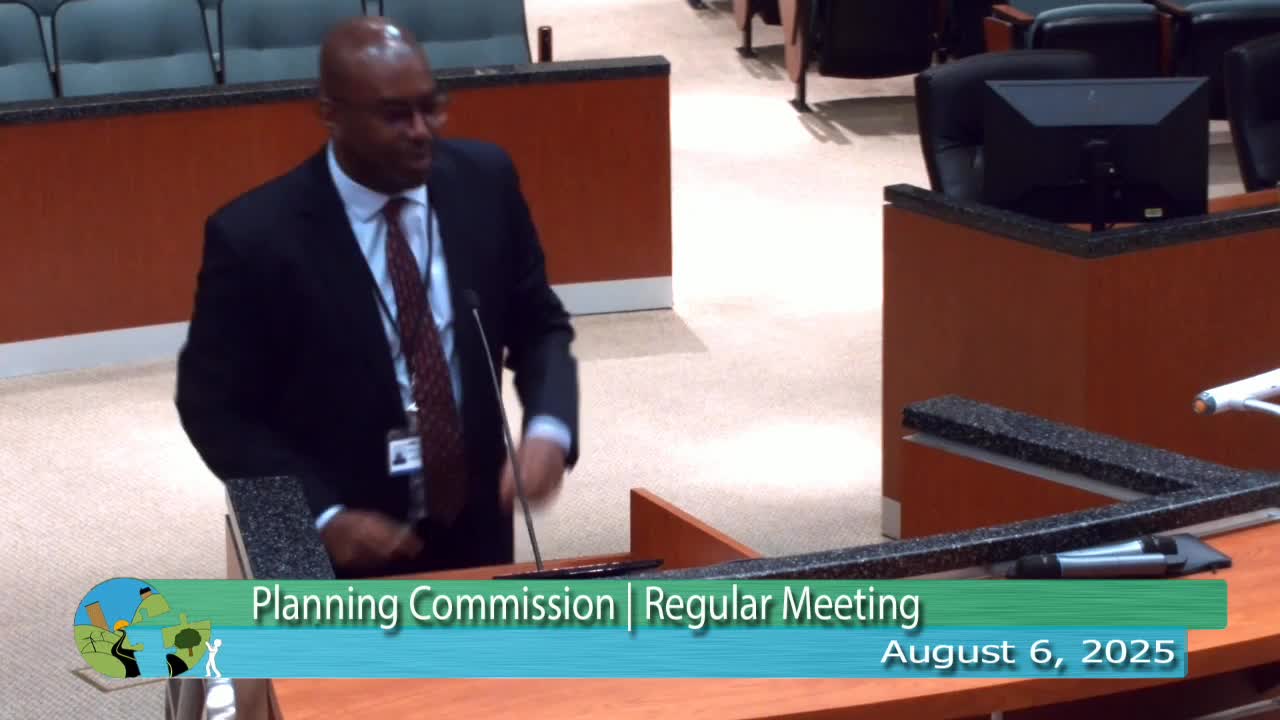
Riverside County Planning Commission members on Aug. 6 voted to initiate a Foundation Component General Plan Amendment (FCGPA 24047) to change the land‑use foundation for an approximately 84‑acre property in Cherry Valley from agriculture and rural community very low‑density residential to community development low‑density residential and commercial retail.
The change, proposed by the property applicant, would allow half‑acre residential lots and a community‑serving commercial strip along Union Street. Staff and the applicant described the request as a prelude to a future project application; the commission’s action was to consider the foundation‑component change only, not to approve any development permits.
The applicant’s representative, Travis Siefs of West Coast Entitlement, said the site sits between Nancy Avenue, Union Street and Brookside Avenue and that the area has seen increasing development intensity. “It is our opinion that this change to community development, low density residential, and commercial retail, it provides a more appropriate land use pattern that more closely aligns with the development trends of this area,” Siefs said.
Residents who called in urged denial. Mary Daniel told the commission that the county general plan “is a blueprint and a constitution” and warned that rezoning to allow denser development would break the plan’s “certainty system” and harm people who moved to the unincorporated area expecting a rural lifestyle. Sharon Hamilton, a Cherry Valley resident, said the area has a longstanding one‑acre minimum parcel policy and argued the amendment would “permanently alter the vision of Riverside County regarding the rural characteristics of Cherry Valley.” Rachel Lyon raised traffic and groundwater concerns and asked how added homes would be served by water and sewage.
A nearby resident, Callie Atencio, said she lives directly across Nancy Avenue from one of the parcels and urged the commission to maintain the one house per acre standard. “A half acre is just too small,” Atencio said, describing worries about livestock living too close to houses, increased traffic at school commute times, and loss of wildlife habitat and night skies.
Commissioners emphasized the limited scope of the current action. Staff reiterated that foundation‑component initiation does not approve a project and that environmental studies, traffic and hydrology analyses, and more detailed outreach would be required if the applicant submits a project application. As staff explained, the county’s FCGPA cycle gives applicants an opportunity to seek foundation changes and that project‑level studies occur later if the general‑plan change is recommended and accepted by the Board of Supervisors.
Several commissioners said they would support initiation to allow the applicant to bring back a project plan for full review, while urging the applicant to increase open space, preserve rural character where feasible and do robust neighborhood outreach before filing a project application. One commissioner said the half‑acre lots could provide a transition from higher density to the south and that detailed project review is the correct time to analyze traffic, water and environmental impacts.
The commission recorded four votes in support of initiating FCGPA 24047, with commissioners noting the need for future project‑level scrutiny of traffic, hydrology, environmental impacts and neighborhood design features such as open space and trails. The initiation does not authorize grading or construction; any future subdivision or building permits will require separate environmental review and approvals.
Next steps: If the Board of Supervisors elects to proceed after hearings, the applicant would be allowed to submit a specific project application. That later application would trigger detailed environmental review, public hearings and requirements for traffic, water and biological studies before any permits could be granted.
The change, proposed by the property applicant, would allow half‑acre residential lots and a community‑serving commercial strip along Union Street. Staff and the applicant described the request as a prelude to a future project application; the commission’s action was to consider the foundation‑component change only, not to approve any development permits.
The applicant’s representative, Travis Siefs of West Coast Entitlement, said the site sits between Nancy Avenue, Union Street and Brookside Avenue and that the area has seen increasing development intensity. “It is our opinion that this change to community development, low density residential, and commercial retail, it provides a more appropriate land use pattern that more closely aligns with the development trends of this area,” Siefs said.
Residents who called in urged denial. Mary Daniel told the commission that the county general plan “is a blueprint and a constitution” and warned that rezoning to allow denser development would break the plan’s “certainty system” and harm people who moved to the unincorporated area expecting a rural lifestyle. Sharon Hamilton, a Cherry Valley resident, said the area has a longstanding one‑acre minimum parcel policy and argued the amendment would “permanently alter the vision of Riverside County regarding the rural characteristics of Cherry Valley.” Rachel Lyon raised traffic and groundwater concerns and asked how added homes would be served by water and sewage.
A nearby resident, Callie Atencio, said she lives directly across Nancy Avenue from one of the parcels and urged the commission to maintain the one house per acre standard. “A half acre is just too small,” Atencio said, describing worries about livestock living too close to houses, increased traffic at school commute times, and loss of wildlife habitat and night skies.
Commissioners emphasized the limited scope of the current action. Staff reiterated that foundation‑component initiation does not approve a project and that environmental studies, traffic and hydrology analyses, and more detailed outreach would be required if the applicant submits a project application. As staff explained, the county’s FCGPA cycle gives applicants an opportunity to seek foundation changes and that project‑level studies occur later if the general‑plan change is recommended and accepted by the Board of Supervisors.
Several commissioners said they would support initiation to allow the applicant to bring back a project plan for full review, while urging the applicant to increase open space, preserve rural character where feasible and do robust neighborhood outreach before filing a project application. One commissioner said the half‑acre lots could provide a transition from higher density to the south and that detailed project review is the correct time to analyze traffic, water and environmental impacts.
The commission recorded four votes in support of initiating FCGPA 24047, with commissioners noting the need for future project‑level scrutiny of traffic, hydrology, environmental impacts and neighborhood design features such as open space and trails. The initiation does not authorize grading or construction; any future subdivision or building permits will require separate environmental review and approvals.
Next steps: If the Board of Supervisors elects to proceed after hearings, the applicant would be allowed to submit a specific project application. That later application would trigger detailed environmental review, public hearings and requirements for traffic, water and biological studies before any permits could be granted.
Don't Miss a Word: See the Full Meeting!
Go beyond summaries. Unlock every video, transcript, and key insight with a Founder Membership.
✓
Get instant access to full meeting videos
✓
Search and clip any phrase from complete transcripts
✓
Receive AI-powered summaries & custom alerts
✓
Enjoy lifetime, unrestricted access to government data
30-day money-back guarantee
