Clallam Conservation District seeks $5 per-parcel charge; outlines programs at risk and public hearing plan
August 11, 2025 | Clallam County, Washington
This article was created by AI summarizing key points discussed. AI makes mistakes, so for full details and context, please refer to the video of the full meeting. Please report any errors so we can fix them. Report an error »
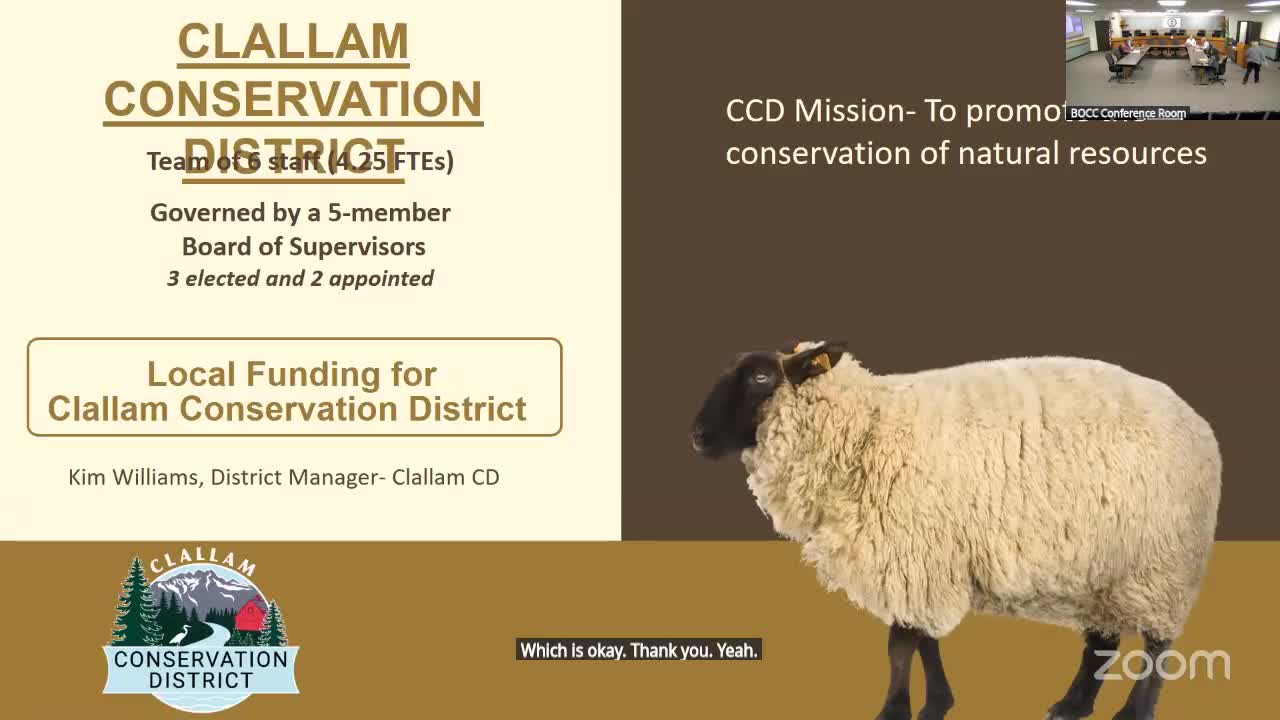
The Clallam Conservation District asked the County Board of Commissioners on Aug. as part of a work session to support adoption of a local rates-and-charges program that would levy a per-parcel fee capped at $5 to create a more stable revenue stream for the district.
Kim Williams, district manager at the Clallam Conservation District, said the district now operates with six staff (4.25 full-time equivalents) and that most of the district’s roughly $1.1 million annual budget comes from grants. “We run really tight budgets because we are pretty much 90% grant funded,” Williams said.
The district’s consulting analysis found a budget gap of about $158,750 in the coming year and proposed a per-parcel charge to recover part of that shortfall. Williams said the consultant and district calculated 39,791 billable parcels after applying exemptions for federal properties, mobile home improvement properties, parcels under $500 in value and the county’s senior/disabled exemption. The district is targeting a $5 per-parcel rate with the stated goal of filling its funding gap without producing a large net revenue increase beyond current needs.
Why it matters: the district provides local services—soil testing, native-plant sales, onsite septic technical assistance, drought and wildfire mitigation workshops and habitat technical assistance—that county officials and the district said would be pared back without stable, local revenue.
Williams told the commissioners that several programs would be reduced or cut entirely if the district cannot secure a stable funding source. She said the soil testing program, which does not carry grant funding for staff time, is tightly subsidized (people pay $32 per test to cover lab and postage but not staff time). The district’s annual native-plant sale, which has supplied about 25,000–35,000 plants per year and has sold roughly 492,000 plants since 1990, would need higher prices or reduced scale. Education and wildfire prevention programs, the district said, could be greatly scaled back.
The district noted a recent state change: Williams told the board that House Bill 1488 increased the statutory cap that had previously limited parcel charges to $5 per parcel; she said the new law permits higher per-parcel rates (Williams cited a new cap of up to $25 per parcel). Williams also described a separate cap in statute for designated forest land charge limited to $3 per landowner, not per parcel.
Public process and legal questions: Williams said the district will ask the county to approve a public hearing on a rates-and-charges proposal; if approved, the charges would appear on county tax bills beginning in 2026 for a 10-year term. The district proposed to adopt the county’s existing exemptions (senior/disabled, federal lands, certain low-value parcels) and to establish an appeal process that would run to the district’s board of supervisors. Williams said the RCW authorizes conservation districts to seek a per-parcel or per-acre charge and that the district used guidance under RCW 89.08.405 in preparing its proposal.
Commissioners pressed for more detail on several points: several asked the consultant methodology be shared ahead of the formal public hearing so the county and public could see how the district quantified “public benefit” and translated program benefits into the proposed parcel rates. Commissioners also asked the district to specify how the proposed parcel revenue would interact with the county’s current $60,000 contribution to the district for 2025 and whether new revenue would replace or supplement existing county funding.
The district said it has engaged FCS Baumann & Company to model program benefits by parcel type and that the consultant’s work will be part of the public hearing materials. Williams also confirmed the district had reviewed parcel data with the county assessor to build the chargeable-parcel list and that certain federal properties (about 137 parcels) would be excluded.
Next steps: the district asked the board to place a public hearing on the schedule (the district already has outreach meetings planned), provide clarification on county assumptions about replacement versus additive revenue, and recommended the district present the consultant’s methodology and measurable success metrics—such as numbers of grants leveraged, dollars brought into the county, workshops held and septic repairs completed—at the public hearing.
Kim Williams, district manager at the Clallam Conservation District, said the district now operates with six staff (4.25 full-time equivalents) and that most of the district’s roughly $1.1 million annual budget comes from grants. “We run really tight budgets because we are pretty much 90% grant funded,” Williams said.
The district’s consulting analysis found a budget gap of about $158,750 in the coming year and proposed a per-parcel charge to recover part of that shortfall. Williams said the consultant and district calculated 39,791 billable parcels after applying exemptions for federal properties, mobile home improvement properties, parcels under $500 in value and the county’s senior/disabled exemption. The district is targeting a $5 per-parcel rate with the stated goal of filling its funding gap without producing a large net revenue increase beyond current needs.
Why it matters: the district provides local services—soil testing, native-plant sales, onsite septic technical assistance, drought and wildfire mitigation workshops and habitat technical assistance—that county officials and the district said would be pared back without stable, local revenue.
Williams told the commissioners that several programs would be reduced or cut entirely if the district cannot secure a stable funding source. She said the soil testing program, which does not carry grant funding for staff time, is tightly subsidized (people pay $32 per test to cover lab and postage but not staff time). The district’s annual native-plant sale, which has supplied about 25,000–35,000 plants per year and has sold roughly 492,000 plants since 1990, would need higher prices or reduced scale. Education and wildfire prevention programs, the district said, could be greatly scaled back.
The district noted a recent state change: Williams told the board that House Bill 1488 increased the statutory cap that had previously limited parcel charges to $5 per parcel; she said the new law permits higher per-parcel rates (Williams cited a new cap of up to $25 per parcel). Williams also described a separate cap in statute for designated forest land charge limited to $3 per landowner, not per parcel.
Public process and legal questions: Williams said the district will ask the county to approve a public hearing on a rates-and-charges proposal; if approved, the charges would appear on county tax bills beginning in 2026 for a 10-year term. The district proposed to adopt the county’s existing exemptions (senior/disabled, federal lands, certain low-value parcels) and to establish an appeal process that would run to the district’s board of supervisors. Williams said the RCW authorizes conservation districts to seek a per-parcel or per-acre charge and that the district used guidance under RCW 89.08.405 in preparing its proposal.
Commissioners pressed for more detail on several points: several asked the consultant methodology be shared ahead of the formal public hearing so the county and public could see how the district quantified “public benefit” and translated program benefits into the proposed parcel rates. Commissioners also asked the district to specify how the proposed parcel revenue would interact with the county’s current $60,000 contribution to the district for 2025 and whether new revenue would replace or supplement existing county funding.
The district said it has engaged FCS Baumann & Company to model program benefits by parcel type and that the consultant’s work will be part of the public hearing materials. Williams also confirmed the district had reviewed parcel data with the county assessor to build the chargeable-parcel list and that certain federal properties (about 137 parcels) would be excluded.
Next steps: the district asked the board to place a public hearing on the schedule (the district already has outreach meetings planned), provide clarification on county assumptions about replacement versus additive revenue, and recommended the district present the consultant’s methodology and measurable success metrics—such as numbers of grants leveraged, dollars brought into the county, workshops held and septic repairs completed—at the public hearing.
Don't Miss a Word: See the Full Meeting!
Go beyond summaries. Unlock every video, transcript, and key insight with a Founder Membership.
✓
Get instant access to full meeting videos
✓
Search and clip any phrase from complete transcripts
✓
Receive AI-powered summaries & custom alerts
✓
Enjoy lifetime, unrestricted access to government data
30-day money-back guarantee
