Glamping permit conditions for 'Under Canvas' draw trail-safety objections from advocates
August 06, 2025 | Clallam County, Washington
This article was created by AI summarizing key points discussed. AI makes mistakes, so for full details and context, please refer to the video of the full meeting. Please report any errors so we can fix them. Report an error »
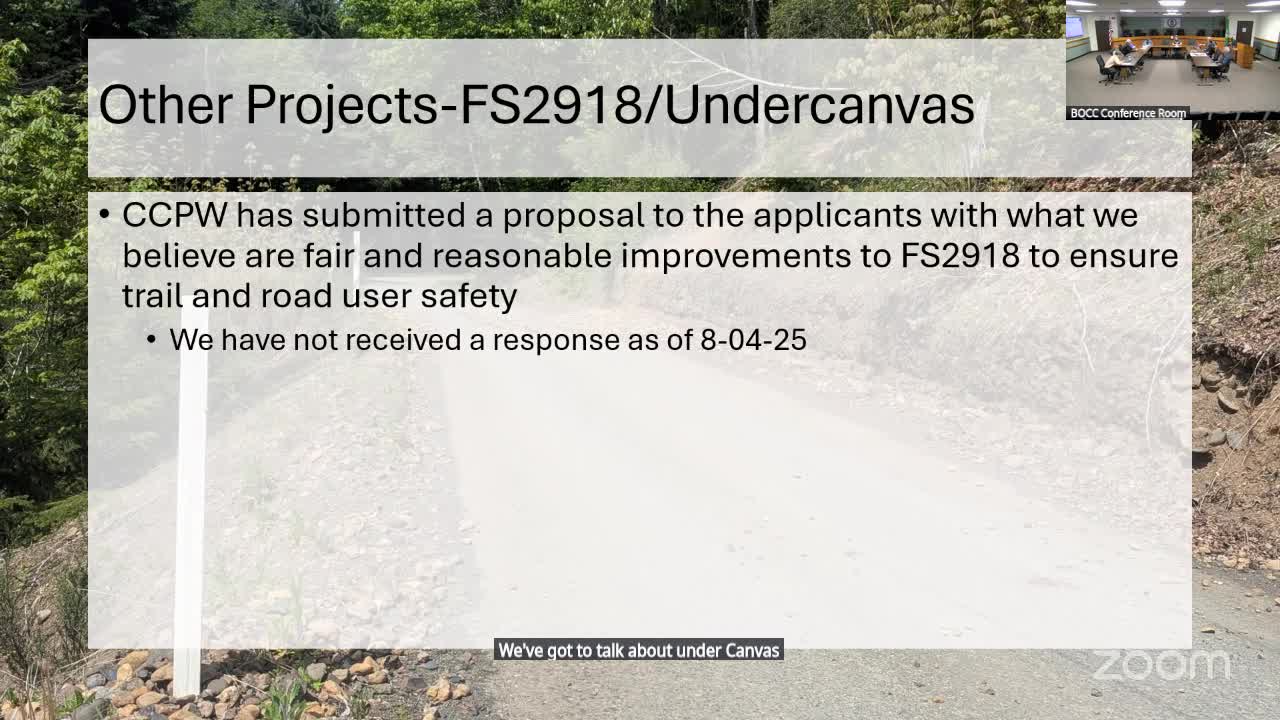
Clallam County staff described conditions attached to a conditional-use permit for an Under Canvas glamping operation and committee members and trail advocates debated whether the conditions sufficiently protect trail users.
Under the permit review, the county requested the applicant work with the U.S. Forest Service and Clallam County public works to address trail and road impacts on a narrow, multiuse segment used by bicyclists and equestrians. County staff said the conditions submitted to the operator call for three principal elements: widening a narrow county road to a 24-foot minimum standard where feasible, providing a gravel base (roughly 15 feet off the pavement) at one location to create a future trail base, and a $50,000 contribution toward interim repairs and mitigation at a known pinch point that causes gravel slide and visibility concerns.
Peninsula Trails Coalition members and other advocates argued the conditions fall short of the group’s written request, which asked for a fully separated 10-foot paved multiuse trail to replace the existing county trail route. Advocates said the proposed conditions would leave cyclists and horses sharing a narrow roadway and that the narrower mitigation would prioritize vehicular circulation over a fully off-road trail.
County staff said the hearing examiner did not require a full paved multiuse trail as a condition, and that the conditions in the permit were drafted to provide a reasonable nexus between the glamping operation’s impacts and the mitigation the county could require. The county noted limitations on right-of-way width and the higher cost of constructing a separated paved trail in that corridor.
Committee discussion included concerns about impacts to equestrian users, potential displacement of trail users onto unsafe shoulders, and the possibility that the proposed requirements could either materially raise the project’s cost or, conversely, fail to address trail safety sufficiently. Some speakers warned the conditions could jeopardize the project’s viability; others said the mitigation represented a practical compromise given current right-of-way and budget constraints.
Direction/next steps: staff said they will continue engineering review with public works and the Forest Service and will refine cost estimates and design options as comments come back from those agencies.
Formal action: the committee did not adopt or veto permit conditions; it discussed the county’s proposed mitigation and recorded stakeholder concerns for the record.
Under the permit review, the county requested the applicant work with the U.S. Forest Service and Clallam County public works to address trail and road impacts on a narrow, multiuse segment used by bicyclists and equestrians. County staff said the conditions submitted to the operator call for three principal elements: widening a narrow county road to a 24-foot minimum standard where feasible, providing a gravel base (roughly 15 feet off the pavement) at one location to create a future trail base, and a $50,000 contribution toward interim repairs and mitigation at a known pinch point that causes gravel slide and visibility concerns.
Peninsula Trails Coalition members and other advocates argued the conditions fall short of the group’s written request, which asked for a fully separated 10-foot paved multiuse trail to replace the existing county trail route. Advocates said the proposed conditions would leave cyclists and horses sharing a narrow roadway and that the narrower mitigation would prioritize vehicular circulation over a fully off-road trail.
County staff said the hearing examiner did not require a full paved multiuse trail as a condition, and that the conditions in the permit were drafted to provide a reasonable nexus between the glamping operation’s impacts and the mitigation the county could require. The county noted limitations on right-of-way width and the higher cost of constructing a separated paved trail in that corridor.
Committee discussion included concerns about impacts to equestrian users, potential displacement of trail users onto unsafe shoulders, and the possibility that the proposed requirements could either materially raise the project’s cost or, conversely, fail to address trail safety sufficiently. Some speakers warned the conditions could jeopardize the project’s viability; others said the mitigation represented a practical compromise given current right-of-way and budget constraints.
Direction/next steps: staff said they will continue engineering review with public works and the Forest Service and will refine cost estimates and design options as comments come back from those agencies.
Formal action: the committee did not adopt or veto permit conditions; it discussed the county’s proposed mitigation and recorded stakeholder concerns for the record.
Don't Miss a Word: See the Full Meeting!
Go beyond summaries. Unlock every video, transcript, and key insight with a Founder Membership.
✓
Get instant access to full meeting videos
✓
Search and clip any phrase from complete transcripts
✓
Receive AI-powered summaries & custom alerts
✓
Enjoy lifetime, unrestricted access to government data
30-day money-back guarantee
