Commission reviews draft water-use and preservation element; consultants urge data updates and emphasis on agricultural preservation
August 14, 2025 | Cache County School District, School Boards, Utah
This article was created by AI summarizing key points discussed. AI makes mistakes, so for full details and context, please refer to the video of the full meeting. Please report any errors so we can fix them. Report an error »
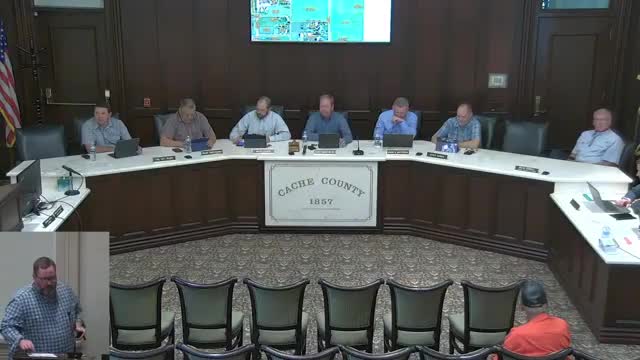
Aug. 7, 2025 — Planning staff and consultants presented a draft water-use and preservation element required by 2022 state legislation (SB 110) and requested commissioner review and comment ahead of a fall recommendation process.
Brandon Bell, countywide planner, introduced the project and said the draft focuses on unincorporated Cache County and aims to meet the state law while respecting private property and water-rights concerns. He said a consultant team (Landmark Design and Hansen Allen Luce) worked with a steering committee that included county staff, a commissioner and a council member. Consultants Aubrey Larson (Landmark Design) and Easton Hopkins (Hansen Allen Luce) reviewed the draft’s objectives, data sources and recommended strategies for water preservation and demand management.
Easton Hopkins summarized the statutory driver (SB 110) and said the draft assesses how land-use patterns affect water demand and infrastructure. The presentation noted that much of unincorporated Cache County is agricultural and that surface water is used primarily for irrigation while residential development typically relies on groundwater. Consultants estimated current annual water use (agriculture much larger in total volume) and modeled a scenario of 1,500–1,750 new homes in unincorporated areas over the next several decades; the consultants said that development at the modeled scale could add roughly 2,000 acre-feet of annual culinary demand and reduce about 1,000 acres of agricultural land in unincorporated areas.
The draft and discussion highlighted two central points the consultants asked commissioners to consider: (1) when agricultural land converts to residential use, per-acre residential water demand can exceed prior agricultural per-acre use because residential supply typically relies on groundwater and includes outdoor irrigation; and (2) preserving agricultural lands and water-efficient agricultural practices can be a component of county water-preservation strategy. Consultants and staff also warned that some datasets used (state crop maps, historical use numbers) are imperfect and that updated or local data would improve analysis; commissioners asked staff to seek more current crop and flood mapping data where possible.
Easton Hopkins said, “We want this to match the vision for the people who live and work here,” and noted the element must meet the state deadline. Commissioners asked for an updated draft and for staff to circulate sample data and the next revision; staff said they would deliver a revised draft and pursue legal and data updates with the goal of completing the element before the statutory deadline at the end of 2025.
Ending: Staff will circulate an updated draft and data notes to commissioners for review and will return to planning commission meetings later this fall for recommendation to county council.
Brandon Bell, countywide planner, introduced the project and said the draft focuses on unincorporated Cache County and aims to meet the state law while respecting private property and water-rights concerns. He said a consultant team (Landmark Design and Hansen Allen Luce) worked with a steering committee that included county staff, a commissioner and a council member. Consultants Aubrey Larson (Landmark Design) and Easton Hopkins (Hansen Allen Luce) reviewed the draft’s objectives, data sources and recommended strategies for water preservation and demand management.
Easton Hopkins summarized the statutory driver (SB 110) and said the draft assesses how land-use patterns affect water demand and infrastructure. The presentation noted that much of unincorporated Cache County is agricultural and that surface water is used primarily for irrigation while residential development typically relies on groundwater. Consultants estimated current annual water use (agriculture much larger in total volume) and modeled a scenario of 1,500–1,750 new homes in unincorporated areas over the next several decades; the consultants said that development at the modeled scale could add roughly 2,000 acre-feet of annual culinary demand and reduce about 1,000 acres of agricultural land in unincorporated areas.
The draft and discussion highlighted two central points the consultants asked commissioners to consider: (1) when agricultural land converts to residential use, per-acre residential water demand can exceed prior agricultural per-acre use because residential supply typically relies on groundwater and includes outdoor irrigation; and (2) preserving agricultural lands and water-efficient agricultural practices can be a component of county water-preservation strategy. Consultants and staff also warned that some datasets used (state crop maps, historical use numbers) are imperfect and that updated or local data would improve analysis; commissioners asked staff to seek more current crop and flood mapping data where possible.
Easton Hopkins said, “We want this to match the vision for the people who live and work here,” and noted the element must meet the state deadline. Commissioners asked for an updated draft and for staff to circulate sample data and the next revision; staff said they would deliver a revised draft and pursue legal and data updates with the goal of completing the element before the statutory deadline at the end of 2025.
Ending: Staff will circulate an updated draft and data notes to commissioners for review and will return to planning commission meetings later this fall for recommendation to county council.
View the Full Meeting & All Its Details
This article offers just a summary. Unlock complete video, transcripts, and insights as a Founder Member.
✓
Watch full, unedited meeting videos
✓
Search every word spoken in unlimited transcripts
✓
AI summaries & real-time alerts (all government levels)
✓
Permanent access to expanding government content
30-day money-back guarantee
