Board attorney briefs members on public‑comment rules, First Amendment limits and social‑media risks
August 14, 2025 | Alachua, School Districts, Florida
This article was created by AI summarizing key points discussed. AI makes mistakes, so for full details and context, please refer to the video of the full meeting. Please report any errors so we can fix them. Report an error »
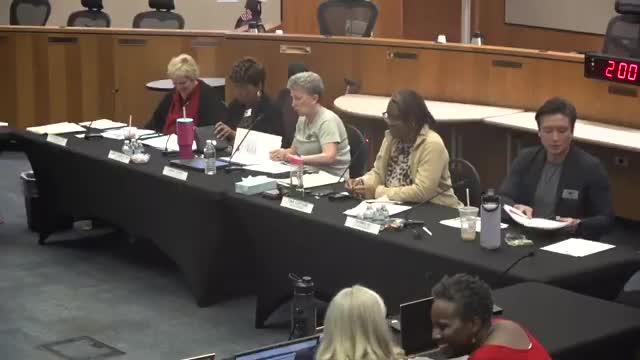
The board’s attorney delivered a legal briefing on First Amendment limits for public comment periods and the district’s recently updated public‑comment policy, warning that inconsistent enforcement can create constitutional problems. The presentation cited recent case law to explain when the district may reasonably restrict conduct at meetings and when a board member’s personal social‑media account is distinct from an official public forum.
Why it matters: A school board that applies public‑comment rules in a haphazard or viewpoint‑preferential way risks successful legal challenges that can overturn enforcement decisions or require litigation; consistent, neutral enforcement is the key legal standard.
Attorney Delaney told the board that public comment at government meetings is a “limited public forum” and that the district must preserve viewpoint neutrality and clear, reasonable rules. “The government is limited in what speech it can prevent,” Delaney said while explaining the constitutional frame and the board’s obligations when it invites public comment.
Delaney summarized relevant legal precedent the board should consider in applying its policy. He discussed the Eleventh Circuit’s ruling on the Moms for Liberty v. Brevard County School Board case, which criticized a policy applied inconsistently and stressed that restrictions must be reasonable and viewpoint neutral. He also reviewed the Miller v. California obscenity test and noted that the standard for suppressing obscene speech in a constitutional context is high: speech must lack serious political value to be excluded under the Miller test. To illustrate social‑media issues, Delaney described the U.S. Supreme Court’s Linke v. Fried holding that a government official’s private social‑media page is not automatically a public forum and that officials retain First Amendment rights on privately maintained accounts.
Practical guidance and district steps: Delaney recommended clear, pre‑meeting notices, consistent enforcement of time limits and decorum, and an escalation plan that starts with a warning and proceeds to removal only for persistent disruption. He highlighted Florida statute citation 877.13 (disorderly conduct or knowingly disrupting a function) as relevant when a speaker’s behavior prevents the meeting from continuing. Several board members and staff discussed operational details: printing and posting norms on the public‑comment sign‑up form, projecting the norms on screens at meetings, and having a standard script read at the start of every meeting so the public understands the rules.
Board preferences and next steps: Members debated who should read the suggested script at the start of meetings. Some members preferred the board attorney to read the posted norms because that would communicate both legal clarity and neutrality; others said the chair could perform the welcome and norms read‑out. Board members asked staff and the attorney to prepare a short, posted script and a consistent set of on‑screen cues (including a timed speaker light) for the next board meeting. No formal policy changes were adopted in the workshop; the attorney and staff will prepare draft language for an upcoming business meeting.
Ending note: The attorney urged the board to treat public comment as an invited but limited forum and to apply rules consistently to avoid viewpoint discrimination claims. Board members agreed to publish the rules on the sign‑up form, post them on screens during meetings, and return with a scripted statement and staff guidance at a subsequent meeting.
Why it matters: A school board that applies public‑comment rules in a haphazard or viewpoint‑preferential way risks successful legal challenges that can overturn enforcement decisions or require litigation; consistent, neutral enforcement is the key legal standard.
Attorney Delaney told the board that public comment at government meetings is a “limited public forum” and that the district must preserve viewpoint neutrality and clear, reasonable rules. “The government is limited in what speech it can prevent,” Delaney said while explaining the constitutional frame and the board’s obligations when it invites public comment.
Delaney summarized relevant legal precedent the board should consider in applying its policy. He discussed the Eleventh Circuit’s ruling on the Moms for Liberty v. Brevard County School Board case, which criticized a policy applied inconsistently and stressed that restrictions must be reasonable and viewpoint neutral. He also reviewed the Miller v. California obscenity test and noted that the standard for suppressing obscene speech in a constitutional context is high: speech must lack serious political value to be excluded under the Miller test. To illustrate social‑media issues, Delaney described the U.S. Supreme Court’s Linke v. Fried holding that a government official’s private social‑media page is not automatically a public forum and that officials retain First Amendment rights on privately maintained accounts.
Practical guidance and district steps: Delaney recommended clear, pre‑meeting notices, consistent enforcement of time limits and decorum, and an escalation plan that starts with a warning and proceeds to removal only for persistent disruption. He highlighted Florida statute citation 877.13 (disorderly conduct or knowingly disrupting a function) as relevant when a speaker’s behavior prevents the meeting from continuing. Several board members and staff discussed operational details: printing and posting norms on the public‑comment sign‑up form, projecting the norms on screens at meetings, and having a standard script read at the start of every meeting so the public understands the rules.
Board preferences and next steps: Members debated who should read the suggested script at the start of meetings. Some members preferred the board attorney to read the posted norms because that would communicate both legal clarity and neutrality; others said the chair could perform the welcome and norms read‑out. Board members asked staff and the attorney to prepare a short, posted script and a consistent set of on‑screen cues (including a timed speaker light) for the next board meeting. No formal policy changes were adopted in the workshop; the attorney and staff will prepare draft language for an upcoming business meeting.
Ending note: The attorney urged the board to treat public comment as an invited but limited forum and to apply rules consistently to avoid viewpoint discrimination claims. Board members agreed to publish the rules on the sign‑up form, post them on screens during meetings, and return with a scripted statement and staff guidance at a subsequent meeting.
Don't Miss a Word: See the Full Meeting!
Go beyond summaries. Unlock every video, transcript, and key insight with a Founder Membership.
✓
Get instant access to full meeting videos
✓
Search and clip any phrase from complete transcripts
✓
Receive AI-powered summaries & custom alerts
✓
Enjoy lifetime, unrestricted access to government data
30-day money-back guarantee
