Metro planning staff outline Unified Housing Strategy, call for 90,000 new homes over 10 years
August 14, 2025 | Homelessness Planning Council Meetings, Nashville, Davidson County, Tennessee
This article was created by AI summarizing key points discussed. AI makes mistakes, so for full details and context, please refer to the video of the full meeting. Please report any errors so we can fix them. Report an error »
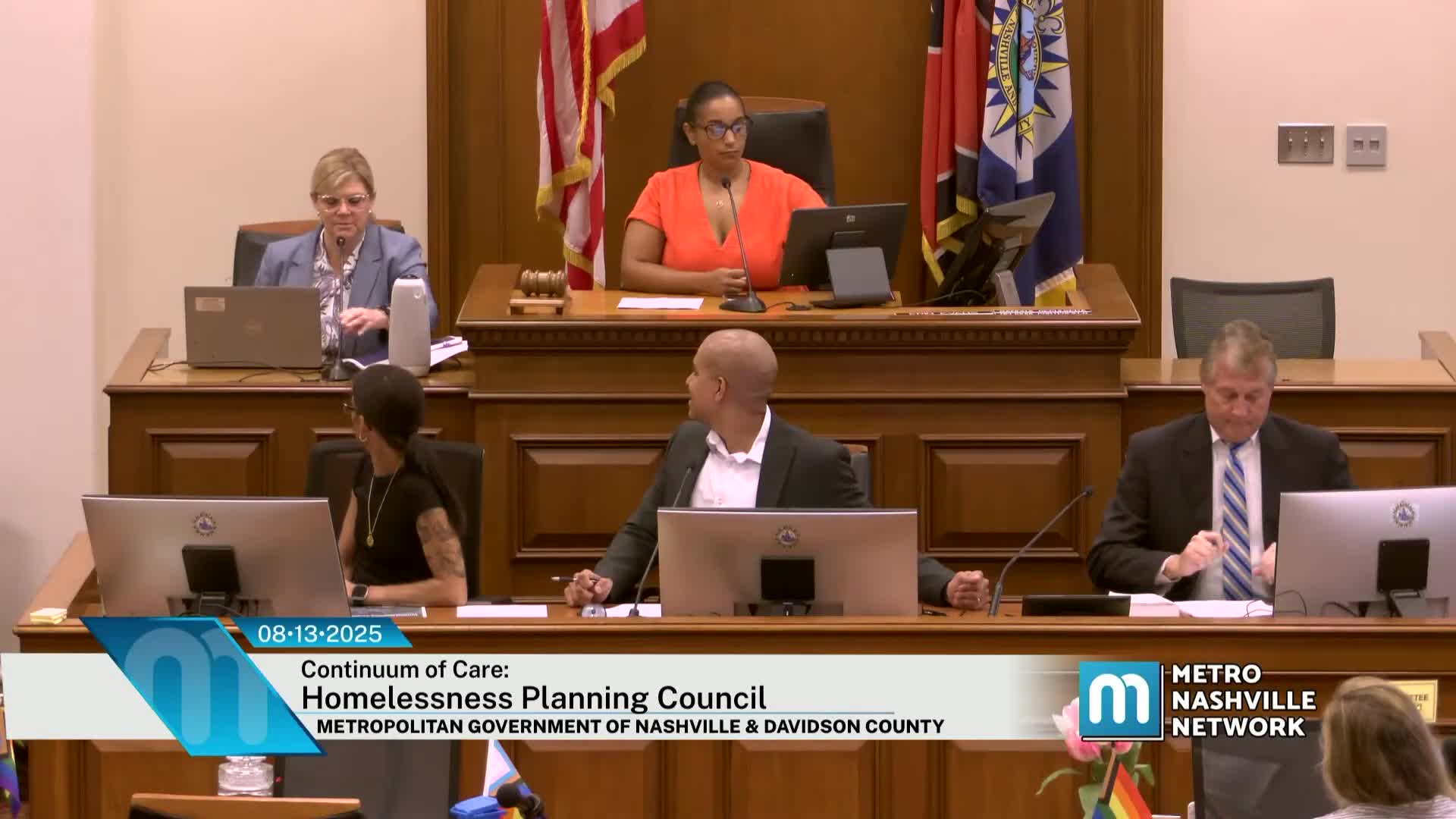
Metro Planning Department housing director Angie Hubbard outlined the city’s Unified Housing Strategy on Aug. 14 and said Nashville needs roughly 90,000 new homes over the next 10 years to meet demand, with priority on deeply affordable units for households below 30% of area median income (AMI).
Hubbard said the UHS sets a 10-year implementation plan, more than 40 actions with assigned lead agencies and annual performance metrics to be published on a housing dashboard so the strategy can be revisited and adjusted to changing market conditions.
The strategy matters because Hubbard said market forces and limited public subsidy leave a structural shortfall for lower-income households. “The market will never become naturally affordable with new construction for households at or below 60% AMI,” Hubbard said, adding that the city must target subsidies and preserve existing affordability.
Hubbard presented the UHS as an “ecosystem” effort that requires coordination among Metro departments, the philanthropic sector and private developers. She described components that include increasing supply, preserving long-term affordability, expanding homeownership pathways, creating permanent supportive housing for people experiencing homelessness, and improving access to housing services. The plan includes a proposal to create an executive-level position in the mayor’s office to coordinate housing across departments.
Hubbard walked the council through key data points she said the UHS uses: an estimated need for over 90,000 new homes across the market over 10 years; roughly half of that demand is for homeownership; a gap of about 20,000 rental homes affordable to households at or below 60% AMI, with the largest deficit in units for households below 30% AMI; and a recommended scaling goal to add supportive housing at a capacity that Hubbard estimated would need to approach roughly 900 homes per year to meet demand.
She also described limits on the city’s authority. “We cannot require affordability as a condition of zoning — that was preempted by the state of Tennessee,” Hubbard said, and she said local rent control of privately owned properties is likewise not permitted unless rents are restricted through a subsidy program. Hubbard said the UHS therefore focuses on voluntary incentives, use of public land for affordable projects, and aligning Metro funding such as Barnes Fund investments with deeper affordability.
Councilman Jordan Huffman pressed for clarification about the geography and AMI calculations underlying the 90,000 figure; Hubbard said the housing counts are for Davidson County and that the AMI used in many programs is the standard 10-county HUD area AMI, which the city adjusts when targeting Davidson County residents.
Hubbard said the UHS will include an annual set of policy priorities and a public tracking dashboard and that the document is intended to be updated routinely — “a living strategy” — to respond to market or disaster-driven shifts in demand.
The presentation concluded with an invitation to council and community partners to engage in implementation, especially around scaling permanent supportive housing and aligning philanthropic and private capital with public subsidy.
A copy of the UHS and its 10-year implementation plan are posted at nashville.gov/uhs; Hubbard told the council the website also hosts videos and section-level materials for members who want to review specifics.
Ending: The council did not take a formal vote on the UHS at this meeting; staff said they will continue outreach and return with additional briefings and materials as implementation planning proceeds.
Hubbard said the UHS sets a 10-year implementation plan, more than 40 actions with assigned lead agencies and annual performance metrics to be published on a housing dashboard so the strategy can be revisited and adjusted to changing market conditions.
The strategy matters because Hubbard said market forces and limited public subsidy leave a structural shortfall for lower-income households. “The market will never become naturally affordable with new construction for households at or below 60% AMI,” Hubbard said, adding that the city must target subsidies and preserve existing affordability.
Hubbard presented the UHS as an “ecosystem” effort that requires coordination among Metro departments, the philanthropic sector and private developers. She described components that include increasing supply, preserving long-term affordability, expanding homeownership pathways, creating permanent supportive housing for people experiencing homelessness, and improving access to housing services. The plan includes a proposal to create an executive-level position in the mayor’s office to coordinate housing across departments.
Hubbard walked the council through key data points she said the UHS uses: an estimated need for over 90,000 new homes across the market over 10 years; roughly half of that demand is for homeownership; a gap of about 20,000 rental homes affordable to households at or below 60% AMI, with the largest deficit in units for households below 30% AMI; and a recommended scaling goal to add supportive housing at a capacity that Hubbard estimated would need to approach roughly 900 homes per year to meet demand.
She also described limits on the city’s authority. “We cannot require affordability as a condition of zoning — that was preempted by the state of Tennessee,” Hubbard said, and she said local rent control of privately owned properties is likewise not permitted unless rents are restricted through a subsidy program. Hubbard said the UHS therefore focuses on voluntary incentives, use of public land for affordable projects, and aligning Metro funding such as Barnes Fund investments with deeper affordability.
Councilman Jordan Huffman pressed for clarification about the geography and AMI calculations underlying the 90,000 figure; Hubbard said the housing counts are for Davidson County and that the AMI used in many programs is the standard 10-county HUD area AMI, which the city adjusts when targeting Davidson County residents.
Hubbard said the UHS will include an annual set of policy priorities and a public tracking dashboard and that the document is intended to be updated routinely — “a living strategy” — to respond to market or disaster-driven shifts in demand.
The presentation concluded with an invitation to council and community partners to engage in implementation, especially around scaling permanent supportive housing and aligning philanthropic and private capital with public subsidy.
A copy of the UHS and its 10-year implementation plan are posted at nashville.gov/uhs; Hubbard told the council the website also hosts videos and section-level materials for members who want to review specifics.
Ending: The council did not take a formal vote on the UHS at this meeting; staff said they will continue outreach and return with additional briefings and materials as implementation planning proceeds.
View the Full Meeting & All Its Details
This article offers just a summary. Unlock complete video, transcripts, and insights as a Founder Member.
✓
Watch full, unedited meeting videos
✓
Search every word spoken in unlimited transcripts
✓
AI summaries & real-time alerts (all government levels)
✓
Permanent access to expanding government content
30-day money-back guarantee
