Public commenters press Cobb commissioners on transparency, board conduct and recent elections appointments
August 14, 2025 | Cobb County, Georgia
This article was created by AI summarizing key points discussed. AI makes mistakes, so for full details and context, please refer to the video of the full meeting. Please report any errors so we can fix them. Report an error »
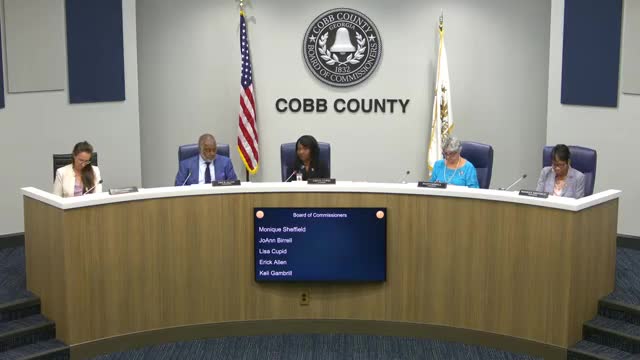
A range of public speakers addressed the Cobb County Board of Commissioners during the Aug. 12 public-comment period, voicing concerns about board conduct, government transparency and the recent state-level appointment to the county Board of Elections, while others thanked the board for recognizing diverse communities through proclamations.
Key themes from public comment:
- Board conduct and decorum: Several speakers criticized the chairwoman’s lengthy responses to public speakers and requested time limits for commissioners’ remarks. One longtime citizen asked that commissioners be subject to a time limit comparable to the three minutes allotted to public speakers.
- Transparency and the Board of Elections: Commenters called the state’s appointment of a board member to the local Board of Elections “clandestine” and said the process lacked transparency and perceived due process, even as they acknowledged state authority to make the appointment.
- Proclamations and community recognition: Some speakers praised the board for issuing proclamations that acknowledge religious and minority communities; one representative of a local Muslim organization thanked the board for a prior proclamation and said it encouraged civic engagement.
Speakers who addressed the board included Christine Rosman, Denny Wilson (District 4), Tracy Stevenson, Eman Embad (representing Care Georgia / Muslim residents), and Susie Clark. Remarks alternated between criticism of process and expressions of appreciation for engagement with underrepresented communities.
Why it matters: Public-comment periods provide a direct forum for residents to express concerns about county governance, appointments and public process. Several speakers tied transparency and perceptions of due process to recent political changes involving the Board of Elections.
Discussion vs. decision: The comment period is advisory; the board heard remarks but did not take formal action during this portion of the agenda. The chairwoman announced she would leave the meeting early for a funeral and the vice chair would preside in her absence.
Key themes from public comment:
- Board conduct and decorum: Several speakers criticized the chairwoman’s lengthy responses to public speakers and requested time limits for commissioners’ remarks. One longtime citizen asked that commissioners be subject to a time limit comparable to the three minutes allotted to public speakers.
- Transparency and the Board of Elections: Commenters called the state’s appointment of a board member to the local Board of Elections “clandestine” and said the process lacked transparency and perceived due process, even as they acknowledged state authority to make the appointment.
- Proclamations and community recognition: Some speakers praised the board for issuing proclamations that acknowledge religious and minority communities; one representative of a local Muslim organization thanked the board for a prior proclamation and said it encouraged civic engagement.
Speakers who addressed the board included Christine Rosman, Denny Wilson (District 4), Tracy Stevenson, Eman Embad (representing Care Georgia / Muslim residents), and Susie Clark. Remarks alternated between criticism of process and expressions of appreciation for engagement with underrepresented communities.
Why it matters: Public-comment periods provide a direct forum for residents to express concerns about county governance, appointments and public process. Several speakers tied transparency and perceptions of due process to recent political changes involving the Board of Elections.
Discussion vs. decision: The comment period is advisory; the board heard remarks but did not take formal action during this portion of the agenda. The chairwoman announced she would leave the meeting early for a funeral and the vice chair would preside in her absence.
Don't Miss a Word: See the Full Meeting!
Go beyond summaries. Unlock every video, transcript, and key insight with a Founder Membership.
✓
Get instant access to full meeting videos
✓
Search and clip any phrase from complete transcripts
✓
Receive AI-powered summaries & custom alerts
✓
Enjoy lifetime, unrestricted access to government data
30-day money-back guarantee
