Flagstaff council signals support for revised water-rate plan after weeks of debate
August 14, 2025 | Flagstaff City, Coconino County, Arizona
This article was created by AI summarizing key points discussed. AI makes mistakes, so for full details and context, please refer to the video of the full meeting. Please report any errors so we can fix them. Report an error »
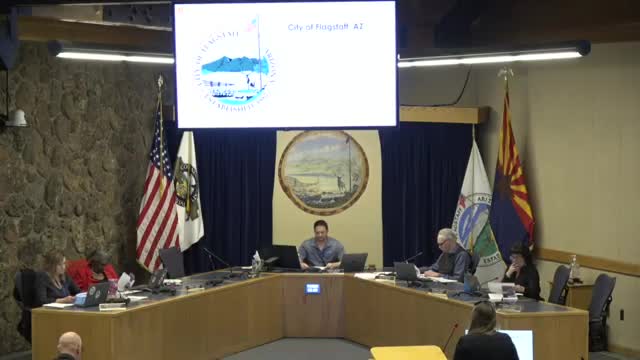
Flagstaff city staff presented a revised version of “Option 3” for water rates to the City Council on April 2, asking for direction before the full rate package returns for formal consideration on April 16.
The revised plan would (1) set fixed monthly meter charges to recover a minimum of 25% of system revenue and (2) change single-family volumetric tiers so the lowest tiers reflect indoor (essential) use while higher tiers shoulder more of the peak/landscape costs. Carol (staff member) described the rationale: “the essential use that is indoor usage is approximately 50 gallons per person per day in a house.” Aaron Young, the city’s water resources manager, opened the presentation and said staff was back to respond to council questions after a March joint meeting with the Water Commission.
Why it matters: the city is seeking to align rates with a five-year capital program that staff estimates at about $208 million. Carol said that, under the revised option, staff expects to collect roughly 12% more revenue in the next fiscal year (FY25) to begin funding operations and the capital program. Because the revision reallocates costs between fixed and volumetric charges and among customer classes, different kinds of customers would see different first-year impacts: the presentation used representative meters and usages drawn from FY23 billing data and showed, for example, an illustrative single-family account using 4,000 gallons per month would see a roughly $1.13 monthly increase (about 3.7%) in FY25 and larger commercial or institutional accounts could see larger percent increases in the first year; landscape accounts in the examples showed the largest percentage jump in year one.
Details and council direction: staff showed the full set of FY25–FY29 projected bills for several representative customers and explained that the revised Option 3 keeps the first two tiers aimed at efficient indoor use and shifts peaking and outdoor demands into tiers 3 and 4. Carol and Aaron emphasized the need to align customers’ rates with their proportional cost to the system while protecting essential indoor use. Several council members asked how low-usage households (including seniors or single-person households on fixed incomes) would be affected and how the city could help people reduce bills through conservation programs, rebates, or other outreach. Council members repeatedly urged that staff make outreach materials available (including a rate calculator and clear tier explanations) and noted Earth Day and an April 8 public event at the East Flagstaff Community Library where staff will be tabling and collecting comments.
Next steps and reclaimed water: the council provided direction to proceed with Option 3 revised for the packet that will return April 16, and asked staff to add clearer bill calculators and outreach showing how tiers work and how customers can reduce bills. On reclaimed water, staff recommended keeping the current policy of setting reclaimed-water volumetric rates as a percentage of potable rates (plus a fixed energy add-on) and pausing a deeper reclaimed-water cost-of-service study until the council can consider a fuller, separate discussion. Staff explained that, under current policy percentages, reclaimed-water revenues would cover existing operations and a modest set of capital repairs but would not fund the larger unfunded reclaimed program in the $11–69 million range without additional rate changes. Several council members asked staff to return with a detailed reclaimed-water policy discussion in the coming months rather than adopt a small percentage adjustment on the spot.
What the public said: council members and staff emphasized equity concerns and asked staff to provide targeted assistance and plain-language materials for residents on fixed incomes or those with large households so they can understand which tier they will fall into and how to reduce usage. Aaron Young and Carol committed to a public-facing rate calculator and more outreach before the formal vote.
Outcome: Council signaled broad support for staff to proceed with Option 3 revised and return a complete rates package (including bill impacts and the draft rate study report) for formal action at the April 16 meeting; staff will post the draft study and continue public outreach in April and May.
The revised plan would (1) set fixed monthly meter charges to recover a minimum of 25% of system revenue and (2) change single-family volumetric tiers so the lowest tiers reflect indoor (essential) use while higher tiers shoulder more of the peak/landscape costs. Carol (staff member) described the rationale: “the essential use that is indoor usage is approximately 50 gallons per person per day in a house.” Aaron Young, the city’s water resources manager, opened the presentation and said staff was back to respond to council questions after a March joint meeting with the Water Commission.
Why it matters: the city is seeking to align rates with a five-year capital program that staff estimates at about $208 million. Carol said that, under the revised option, staff expects to collect roughly 12% more revenue in the next fiscal year (FY25) to begin funding operations and the capital program. Because the revision reallocates costs between fixed and volumetric charges and among customer classes, different kinds of customers would see different first-year impacts: the presentation used representative meters and usages drawn from FY23 billing data and showed, for example, an illustrative single-family account using 4,000 gallons per month would see a roughly $1.13 monthly increase (about 3.7%) in FY25 and larger commercial or institutional accounts could see larger percent increases in the first year; landscape accounts in the examples showed the largest percentage jump in year one.
Details and council direction: staff showed the full set of FY25–FY29 projected bills for several representative customers and explained that the revised Option 3 keeps the first two tiers aimed at efficient indoor use and shifts peaking and outdoor demands into tiers 3 and 4. Carol and Aaron emphasized the need to align customers’ rates with their proportional cost to the system while protecting essential indoor use. Several council members asked how low-usage households (including seniors or single-person households on fixed incomes) would be affected and how the city could help people reduce bills through conservation programs, rebates, or other outreach. Council members repeatedly urged that staff make outreach materials available (including a rate calculator and clear tier explanations) and noted Earth Day and an April 8 public event at the East Flagstaff Community Library where staff will be tabling and collecting comments.
Next steps and reclaimed water: the council provided direction to proceed with Option 3 revised for the packet that will return April 16, and asked staff to add clearer bill calculators and outreach showing how tiers work and how customers can reduce bills. On reclaimed water, staff recommended keeping the current policy of setting reclaimed-water volumetric rates as a percentage of potable rates (plus a fixed energy add-on) and pausing a deeper reclaimed-water cost-of-service study until the council can consider a fuller, separate discussion. Staff explained that, under current policy percentages, reclaimed-water revenues would cover existing operations and a modest set of capital repairs but would not fund the larger unfunded reclaimed program in the $11–69 million range without additional rate changes. Several council members asked staff to return with a detailed reclaimed-water policy discussion in the coming months rather than adopt a small percentage adjustment on the spot.
What the public said: council members and staff emphasized equity concerns and asked staff to provide targeted assistance and plain-language materials for residents on fixed incomes or those with large households so they can understand which tier they will fall into and how to reduce usage. Aaron Young and Carol committed to a public-facing rate calculator and more outreach before the formal vote.
Outcome: Council signaled broad support for staff to proceed with Option 3 revised and return a complete rates package (including bill impacts and the draft rate study report) for formal action at the April 16 meeting; staff will post the draft study and continue public outreach in April and May.
View the Full Meeting & All Its Details
This article offers just a summary. Unlock complete video, transcripts, and insights as a Founder Member.
✓
Watch full, unedited meeting videos
✓
Search every word spoken in unlimited transcripts
✓
AI summaries & real-time alerts (all government levels)
✓
Permanent access to expanding government content
30-day money-back guarantee
