Committee advances ordinance to disclose nonmonetary public-safety settlement terms
August 06, 2025 | Denver (Consolidated County and City), Colorado
This article was created by AI summarizing key points discussed. AI makes mistakes, so for full details and context, please refer to the video of the full meeting. Please report any errors so we can fix them. Report an error »
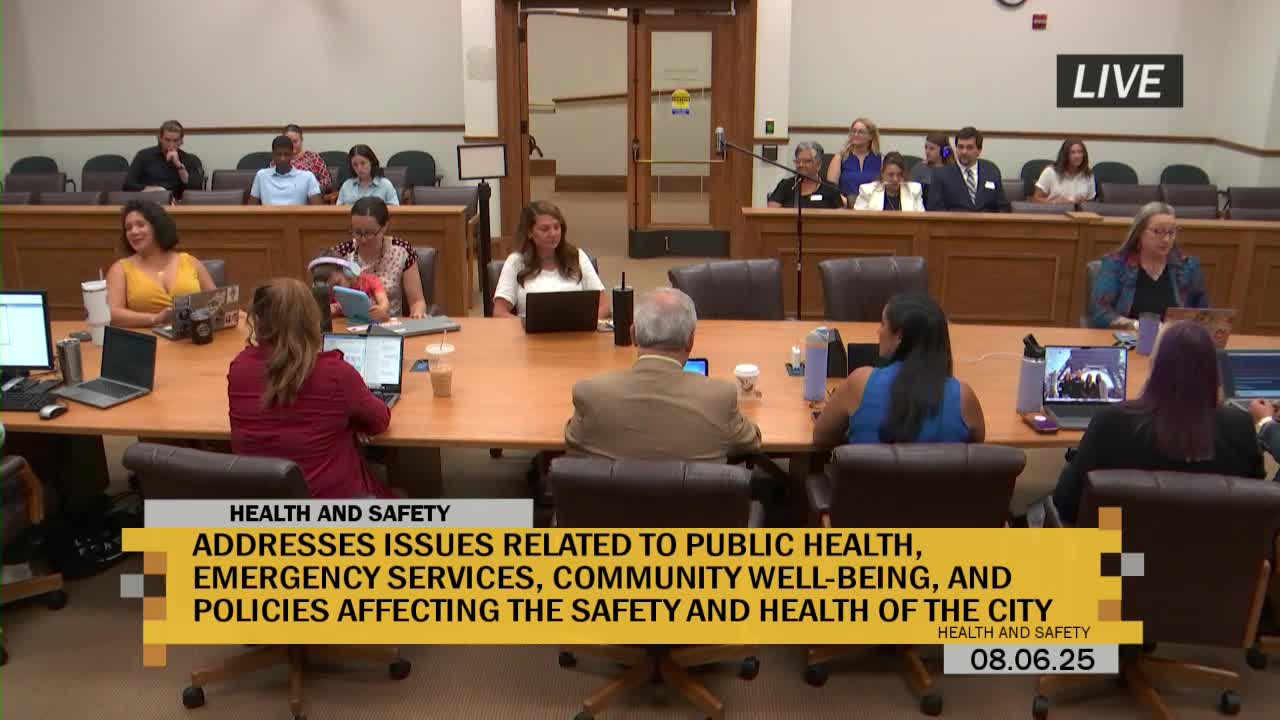
The Denver City Council Health and Safety Committee on Aug. 6 advanced an ordinance requiring disclosure of nonmonetary terms in final settlement agreements related to public-safety agencies, committee sponsors said.
The proposal, introduced by Council Member Jamie Torres (West Denver, District 3) and co-sponsored by Council Member Stacy Gilmore (District 11), would add a new section to the Denver Revised Municipal Code to require the city attorney to forward copies of final, council-approved settlement agreements that include nonmonetary obligations to the Office of the Independent Monitor (OIM) and the Citizen Oversight Board (COB) within 30 days.
The measure is intended to give the OIM and the COB the ability to review implementation of nonmonetary commitments — such as training, community meetings or policy changes — that accompany monetary payouts in lawsuits involving the Department of Safety and its component agencies. "What it ultimately does is ensure transparency in all of our public safety settlement agreements," Torres said.
Why it matters
The Citizen Oversight Board reviewed roughly 150 settlement agreements as part of its review and found several instances where nonmonetary terms were not being disclosed to outside oversight bodies, board chair Julia Richmond told the committee. "The board fully supports the changes to the Denver revised municipal code that the council members have introduced," Richmond said.
Those undisclosed terms can include mandated trainings, community meetings or operational changes that the COB and OIM said are important to track to verify compliance and measure whether the obligations reduce future harm.
Key provisions and limits
Under the proposed language presented to the committee, the disclosure requirement would apply to two categories: allegations of improper conduct by public-safety personnel and settlement agreements that require departmental action. The proposal would not apply to discipline or disqualification appeals initiated through uniform personnel processes, which have separate procedures, sponsors said.
The ordinance sets a 30-day timeline: the city attorney would forward the full final agreement to the OIM and the COB within 30 days of final settlement or 30 days after council approval, Torres said. Council members clarified the 30-day clock begins after council approval or finalization of signatures.
Examples and oversight findings
Committee members and oversight officials cited several cases where nonmonetary terms had been important or where tracking was incomplete. The COB and OIM identified a small number of notable matters, including a 2017 fatal-shooting settlement (Jessica Hernandez), a 2017 Michael Marshall case, a 2019 wrongful-arrest matter (Susan Green) and a 2023 curfew-related class action involving protesters. The COB said some additional historical cases (for example, Jamal Hunter and Emily Rice) predated its 2017–2024 review period but were referenced as instances when nonmonetary terms were applied.
Implementation and next steps
Committee discussion focused on how disclosure would work in practice. Independent Monitor Elizabeth "Liz" Castle said the OIM supports the ordinance and that it would allow review for systemic issues as well as individual harms: "The OAM supports the addition, to the ordinance as it will increase transparency and provide accountability for harm done by law enforcement." Ashley Kelleher, director of civil litigation for the Denver City Attorney's Office, told the committee the office will "be working with the OAM to establish a process." Emily Locke, legislation and policy director for the Department of Public Safety, said the department will post finalized nonmonetary terms on its transparency webpage when notified: "we will ensure that that's posted on the transparency section of our website."
Committee action and schedule
Committee members moved and seconded the item and, following a brief confirmation by the chair that there were no objections, advanced the ordinance to the full City Council. Sponsors said they anticipate the ordinance could come back for second and final reading on Aug. 25, subject to council scheduling and any further edits.
Unresolved questions and context
Council members pressed oversight officials and the city attorney's office for additional details on how often nonmonetary terms appear in settlements and how the OIM and COB would be notified in edge cases (for example, where confidentiality or record-keeping gaps exist). Julia Richmond and OIM staff described staffing and record challenges; Flynn requested a memo summarizing the four identified post-2017 cases with nonmonetary terms and the specific obligations in each.
Several council members and oversight officials also used the discussion to flag broader topics for future work, including whether some settlement-derived policies should be elevated to legislation, how to clarify the scope of deliberative-process privilege when the OIM advises on policy, and ongoing concerns about OIM and COB staffing and resources.
The committee's approval sends the ordinance to the council floor for further consideration. If enacted, the change would formalize a disclosure pathway intended to allow outside oversight bodies to track and independently verify the city's compliance with nonmonetary settlement obligations.
The proposal, introduced by Council Member Jamie Torres (West Denver, District 3) and co-sponsored by Council Member Stacy Gilmore (District 11), would add a new section to the Denver Revised Municipal Code to require the city attorney to forward copies of final, council-approved settlement agreements that include nonmonetary obligations to the Office of the Independent Monitor (OIM) and the Citizen Oversight Board (COB) within 30 days.
The measure is intended to give the OIM and the COB the ability to review implementation of nonmonetary commitments — such as training, community meetings or policy changes — that accompany monetary payouts in lawsuits involving the Department of Safety and its component agencies. "What it ultimately does is ensure transparency in all of our public safety settlement agreements," Torres said.
Why it matters
The Citizen Oversight Board reviewed roughly 150 settlement agreements as part of its review and found several instances where nonmonetary terms were not being disclosed to outside oversight bodies, board chair Julia Richmond told the committee. "The board fully supports the changes to the Denver revised municipal code that the council members have introduced," Richmond said.
Those undisclosed terms can include mandated trainings, community meetings or operational changes that the COB and OIM said are important to track to verify compliance and measure whether the obligations reduce future harm.
Key provisions and limits
Under the proposed language presented to the committee, the disclosure requirement would apply to two categories: allegations of improper conduct by public-safety personnel and settlement agreements that require departmental action. The proposal would not apply to discipline or disqualification appeals initiated through uniform personnel processes, which have separate procedures, sponsors said.
The ordinance sets a 30-day timeline: the city attorney would forward the full final agreement to the OIM and the COB within 30 days of final settlement or 30 days after council approval, Torres said. Council members clarified the 30-day clock begins after council approval or finalization of signatures.
Examples and oversight findings
Committee members and oversight officials cited several cases where nonmonetary terms had been important or where tracking was incomplete. The COB and OIM identified a small number of notable matters, including a 2017 fatal-shooting settlement (Jessica Hernandez), a 2017 Michael Marshall case, a 2019 wrongful-arrest matter (Susan Green) and a 2023 curfew-related class action involving protesters. The COB said some additional historical cases (for example, Jamal Hunter and Emily Rice) predated its 2017–2024 review period but were referenced as instances when nonmonetary terms were applied.
Implementation and next steps
Committee discussion focused on how disclosure would work in practice. Independent Monitor Elizabeth "Liz" Castle said the OIM supports the ordinance and that it would allow review for systemic issues as well as individual harms: "The OAM supports the addition, to the ordinance as it will increase transparency and provide accountability for harm done by law enforcement." Ashley Kelleher, director of civil litigation for the Denver City Attorney's Office, told the committee the office will "be working with the OAM to establish a process." Emily Locke, legislation and policy director for the Department of Public Safety, said the department will post finalized nonmonetary terms on its transparency webpage when notified: "we will ensure that that's posted on the transparency section of our website."
Committee action and schedule
Committee members moved and seconded the item and, following a brief confirmation by the chair that there were no objections, advanced the ordinance to the full City Council. Sponsors said they anticipate the ordinance could come back for second and final reading on Aug. 25, subject to council scheduling and any further edits.
Unresolved questions and context
Council members pressed oversight officials and the city attorney's office for additional details on how often nonmonetary terms appear in settlements and how the OIM and COB would be notified in edge cases (for example, where confidentiality or record-keeping gaps exist). Julia Richmond and OIM staff described staffing and record challenges; Flynn requested a memo summarizing the four identified post-2017 cases with nonmonetary terms and the specific obligations in each.
Several council members and oversight officials also used the discussion to flag broader topics for future work, including whether some settlement-derived policies should be elevated to legislation, how to clarify the scope of deliberative-process privilege when the OIM advises on policy, and ongoing concerns about OIM and COB staffing and resources.
The committee's approval sends the ordinance to the council floor for further consideration. If enacted, the change would formalize a disclosure pathway intended to allow outside oversight bodies to track and independently verify the city's compliance with nonmonetary settlement obligations.
View the Full Meeting & All Its Details
This article offers just a summary. Unlock complete video, transcripts, and insights as a Founder Member.
✓
Watch full, unedited meeting videos
✓
Search every word spoken in unlimited transcripts
✓
AI summaries & real-time alerts (all government levels)
✓
Permanent access to expanding government content
30-day money-back guarantee
