Denver Airport releases RFP for small modular reactor feasibility study; council members press on water, waste and outreach
August 06, 2025 | Denver (Consolidated County and City), Colorado
This article was created by AI summarizing key points discussed. AI makes mistakes, so for full details and context, please refer to the video of the full meeting. Please report any errors so we can fix them. Report an error »
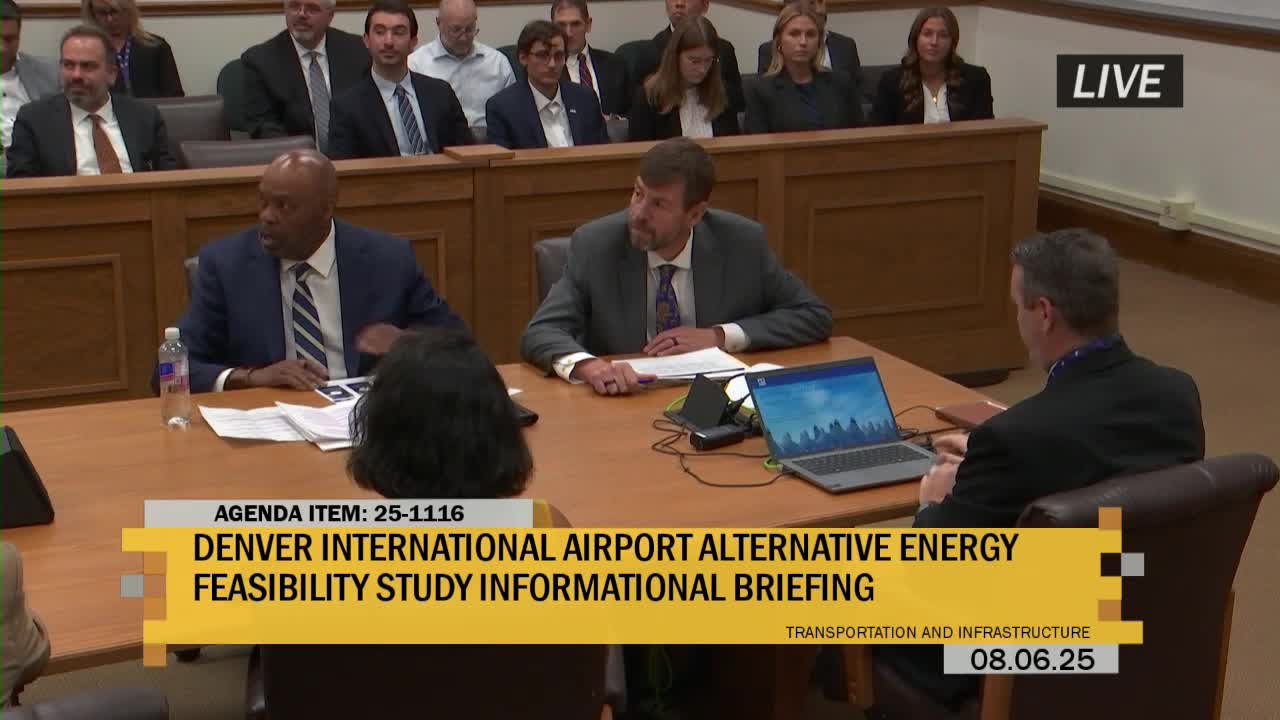
Denver International Airport officials told the City Council’s Transportation & Infrastructure Committee on Aug. 21 that the airport has released a request for proposals for a feasibility study on small modular nuclear reactors and will return with the study’s findings before the council would be asked to approve any contract or construction. Phil Washington, chief executive officer of Denver International Airport, said, “That RFP went out at 08:18 this morning.”
The study is meant to assess whether small modular reactors—factory-built nuclear fission units that can be “stacked” to add capacity—are a viable way to meet growing airport electricity needs, improve resilience and support future development. Dave LaPorte, chief operating officer at the airport, told the committee the airport’s current load is about 45 megawatts and that new and planned facilities could increase demand substantially: the consolidated rental car facility alone will require roughly 40 megawatts, ground support equipment could add about 60 megawatts, and a recent Xcel Energy estimate cited by the airport suggests a likely need for about 235 additional megawatts (with a high-end estimate near 400 megawatts) as projects and advanced air mobility options develop.
Why it matters: Denver’s airport is a major regional economic engine and is expanding facilities and services as part of a 12-year, $12 billion capital improvement program. Airport leaders told the committee that the SMR study would consider safety, security, costs, permitting and regulatory requirements and that any future construction would be contingent on study results and subsequent council approvals.
What the airport proposes: The RFP frames the study as a 6–12 month effort that the airport expects to cost in the order of $1 million, according to committee discussion. The airport’s timeline shown to the committee calls for selection of a vendor in the fourth quarter of the year, presentation of study results to the committee and then, if recommended, a contract award that would come back to the full council for approval. Phil Washington and airport staff emphasized that releasing the RFP does not commit the city to build an SMR.
Key technical and program details discussed at the meeting included:
- Reported current peak demand: about 45 megawatts for airport operations and tenants (Dave LaPorte).
- Identified near-term loads: consolidated rental car facility ≈40 MW; potential ground-support equipment charging ≈60 MW (LaPorte).
- Airport’s illustrative starting module: roughly 75 megawatts per SMR module, with the ability to add modules over time (airport presentation).
- Physical footprint: staff said a single SMR installation would likely require about 30–35 acres and could be sited underground; build time for a module was described as 3–5 years after decisions to build.
- Existing renewables: Scott Morsey, senior vice president for sustainability at the airport, told the committee the airport has about 50 megawatts of on-site solar and is bringing a new 18-megawatt solar project (“Solar 10”) to the committee in August.
Council concerns and requested study scope: Several committee members said the airport should expand the study’s community engagement, environmental and regulatory analysis. Councilwoman Stacy Gilmore (District 11) pressed airport leaders about water use, coolant and radioactive waste handling, and local community outreach. Gilmore said there had been no direct outreach to her office before the RFP went public and asked how coolant, waste transport and disposal would be handled. She warned of community sensitivity because the airport sits near the Rocky Mountain Arsenal National Wildlife Refuge, a former Superfund site, and said residents “don’t want something done to them. They want it done with them.”
Phil Washington and other airport staff told the committee the RFP includes tasks on regulatory and permitting requirements (including potential state and federal approvals) and that the airport plans to add community education as part of the program. Washington said the airport has four anchor themes for the study—safety, security, cost and compliance—and stated the airport’s commitment to perform community outreach and to follow environmental protections it deems appropriate, regardless of any change in federal rules.
Specific technical questions raised by council members included whether SMRs require potable water for cooling, whether recycled or wastewater could be used, and how much cooling water a reactor would need; council members asked the RFP respondents to address water sourcing and rights and to assess whether SMR cooling would trigger additional environmental reviews (including NEPA or other federal reviews). LaPorte confirmed the RFP asks about regulatory requirements, grid interconnection and public-utility issues and that the study will evaluate whether an airport microgrid using SMRs would be subject to Public Utilities Commission oversight.
Waste management and decommissioning were recurring concerns. Council members asked how radioactive waste or spent coolant would be stored and transported, whether long-term disposal pathways exist and how a decommissioned reactor would be handled. The airport told the committee that those topics are included in the RFP and that the contract is structured as a task-based scope so the airport can add or modify tasks as technical questions arise.
Process, cost and oversight: Committee members sought clarity on procurement and oversight. Airport staff said the RFP is posted to the airport procurement portal; the solicitation period is roughly 90 days, and the airport will take time to evaluate proposals. Staff reiterated that once a proposer is selected and a contract is negotiated, any contract that requires council approval would come to the council through the normal process. Councilmember questions also asked whether the airport would charge tenants for power if the airport supplied electricity directly and whether electricity sales or taxes from potential future development would flow to the city general fund or be subject to diversion-of-revenue rules; airport staff said taxes from new development would go to the general fund, but sale of electricity to off‑site users would require careful review to avoid revenue diversion rules and that airport coffers would likely be used for revenue tied to airport operations.
Commitments made to the committee: Airport leaders said they will provide the full RFP to the committee and that they plan to return to the committee with study results. The airport also told members it is committed to community outreach during the study and to meeting the city’s stated environmental and equity expectations even if federal requirements change.
What was not decided: Committee members and airport officials emphasized that no decision to build an SMR has been made. The RFP seeks feasibility information; the airport said the study could show the option is infeasible, and the airport would stop pursuing it. The committee did not vote on any ordinance, contract award or land transaction at the meeting.
Context: Airport leaders linked the study to broader goals: Denver’s Vision 100 passenger-growth planning and a stated objective to become the world’s greenest airport. The airport said SMRs could offer a resilient, low‑carbon source of baseload power and could support nonaeronautical uses such as data centers or sustainable aviation fuel production if those markets develop. Airport staff also emphasized existing work on renewables and energy performance contracts.
Next steps and timeline cited by airport staff: the RFP was released Aug. 18; the solicitation will remain open approximately 90 days; the airport expects to select a vendor in the fourth quarter; the feasibility study is estimated at 6–12 months; any contract award or construction decision would return to the council for approval.
Who to contact / follow-up: Airport staff committed to provide committee members a copy of the RFP and to work with council offices on meeting schedules and community briefings while the study is underway.
Ending note: The committee treated the briefing as informational; airport leaders said they intend to use the study to inform any future decisions and repeatedly underscored that the RFP and study do not commit the city to construction or to a particular technology.
The study is meant to assess whether small modular reactors—factory-built nuclear fission units that can be “stacked” to add capacity—are a viable way to meet growing airport electricity needs, improve resilience and support future development. Dave LaPorte, chief operating officer at the airport, told the committee the airport’s current load is about 45 megawatts and that new and planned facilities could increase demand substantially: the consolidated rental car facility alone will require roughly 40 megawatts, ground support equipment could add about 60 megawatts, and a recent Xcel Energy estimate cited by the airport suggests a likely need for about 235 additional megawatts (with a high-end estimate near 400 megawatts) as projects and advanced air mobility options develop.
Why it matters: Denver’s airport is a major regional economic engine and is expanding facilities and services as part of a 12-year, $12 billion capital improvement program. Airport leaders told the committee that the SMR study would consider safety, security, costs, permitting and regulatory requirements and that any future construction would be contingent on study results and subsequent council approvals.
What the airport proposes: The RFP frames the study as a 6–12 month effort that the airport expects to cost in the order of $1 million, according to committee discussion. The airport’s timeline shown to the committee calls for selection of a vendor in the fourth quarter of the year, presentation of study results to the committee and then, if recommended, a contract award that would come back to the full council for approval. Phil Washington and airport staff emphasized that releasing the RFP does not commit the city to build an SMR.
Key technical and program details discussed at the meeting included:
- Reported current peak demand: about 45 megawatts for airport operations and tenants (Dave LaPorte).
- Identified near-term loads: consolidated rental car facility ≈40 MW; potential ground-support equipment charging ≈60 MW (LaPorte).
- Airport’s illustrative starting module: roughly 75 megawatts per SMR module, with the ability to add modules over time (airport presentation).
- Physical footprint: staff said a single SMR installation would likely require about 30–35 acres and could be sited underground; build time for a module was described as 3–5 years after decisions to build.
- Existing renewables: Scott Morsey, senior vice president for sustainability at the airport, told the committee the airport has about 50 megawatts of on-site solar and is bringing a new 18-megawatt solar project (“Solar 10”) to the committee in August.
Council concerns and requested study scope: Several committee members said the airport should expand the study’s community engagement, environmental and regulatory analysis. Councilwoman Stacy Gilmore (District 11) pressed airport leaders about water use, coolant and radioactive waste handling, and local community outreach. Gilmore said there had been no direct outreach to her office before the RFP went public and asked how coolant, waste transport and disposal would be handled. She warned of community sensitivity because the airport sits near the Rocky Mountain Arsenal National Wildlife Refuge, a former Superfund site, and said residents “don’t want something done to them. They want it done with them.”
Phil Washington and other airport staff told the committee the RFP includes tasks on regulatory and permitting requirements (including potential state and federal approvals) and that the airport plans to add community education as part of the program. Washington said the airport has four anchor themes for the study—safety, security, cost and compliance—and stated the airport’s commitment to perform community outreach and to follow environmental protections it deems appropriate, regardless of any change in federal rules.
Specific technical questions raised by council members included whether SMRs require potable water for cooling, whether recycled or wastewater could be used, and how much cooling water a reactor would need; council members asked the RFP respondents to address water sourcing and rights and to assess whether SMR cooling would trigger additional environmental reviews (including NEPA or other federal reviews). LaPorte confirmed the RFP asks about regulatory requirements, grid interconnection and public-utility issues and that the study will evaluate whether an airport microgrid using SMRs would be subject to Public Utilities Commission oversight.
Waste management and decommissioning were recurring concerns. Council members asked how radioactive waste or spent coolant would be stored and transported, whether long-term disposal pathways exist and how a decommissioned reactor would be handled. The airport told the committee that those topics are included in the RFP and that the contract is structured as a task-based scope so the airport can add or modify tasks as technical questions arise.
Process, cost and oversight: Committee members sought clarity on procurement and oversight. Airport staff said the RFP is posted to the airport procurement portal; the solicitation period is roughly 90 days, and the airport will take time to evaluate proposals. Staff reiterated that once a proposer is selected and a contract is negotiated, any contract that requires council approval would come to the council through the normal process. Councilmember questions also asked whether the airport would charge tenants for power if the airport supplied electricity directly and whether electricity sales or taxes from potential future development would flow to the city general fund or be subject to diversion-of-revenue rules; airport staff said taxes from new development would go to the general fund, but sale of electricity to off‑site users would require careful review to avoid revenue diversion rules and that airport coffers would likely be used for revenue tied to airport operations.
Commitments made to the committee: Airport leaders said they will provide the full RFP to the committee and that they plan to return to the committee with study results. The airport also told members it is committed to community outreach during the study and to meeting the city’s stated environmental and equity expectations even if federal requirements change.
What was not decided: Committee members and airport officials emphasized that no decision to build an SMR has been made. The RFP seeks feasibility information; the airport said the study could show the option is infeasible, and the airport would stop pursuing it. The committee did not vote on any ordinance, contract award or land transaction at the meeting.
Context: Airport leaders linked the study to broader goals: Denver’s Vision 100 passenger-growth planning and a stated objective to become the world’s greenest airport. The airport said SMRs could offer a resilient, low‑carbon source of baseload power and could support nonaeronautical uses such as data centers or sustainable aviation fuel production if those markets develop. Airport staff also emphasized existing work on renewables and energy performance contracts.
Next steps and timeline cited by airport staff: the RFP was released Aug. 18; the solicitation will remain open approximately 90 days; the airport expects to select a vendor in the fourth quarter; the feasibility study is estimated at 6–12 months; any contract award or construction decision would return to the council for approval.
Who to contact / follow-up: Airport staff committed to provide committee members a copy of the RFP and to work with council offices on meeting schedules and community briefings while the study is underway.
Ending note: The committee treated the briefing as informational; airport leaders said they intend to use the study to inform any future decisions and repeatedly underscored that the RFP and study do not commit the city to construction or to a particular technology.
Don't Miss a Word: See the Full Meeting!
Go beyond summaries. Unlock every video, transcript, and key insight with a Founder Membership.
✓
Get instant access to full meeting videos
✓
Search and clip any phrase from complete transcripts
✓
Receive AI-powered summaries & custom alerts
✓
Enjoy lifetime, unrestricted access to government data
30-day money-back guarantee
