Angry public turns out as Grand Junction council considers reverting Fourth and Fifth Street pilot
August 06, 2025 | Grand Junction, Mesa County, Colorado
This article was created by AI summarizing key points discussed. AI makes mistakes, so for full details and context, please refer to the video of the full meeting. Please report any errors so we can fix them. Report an error »
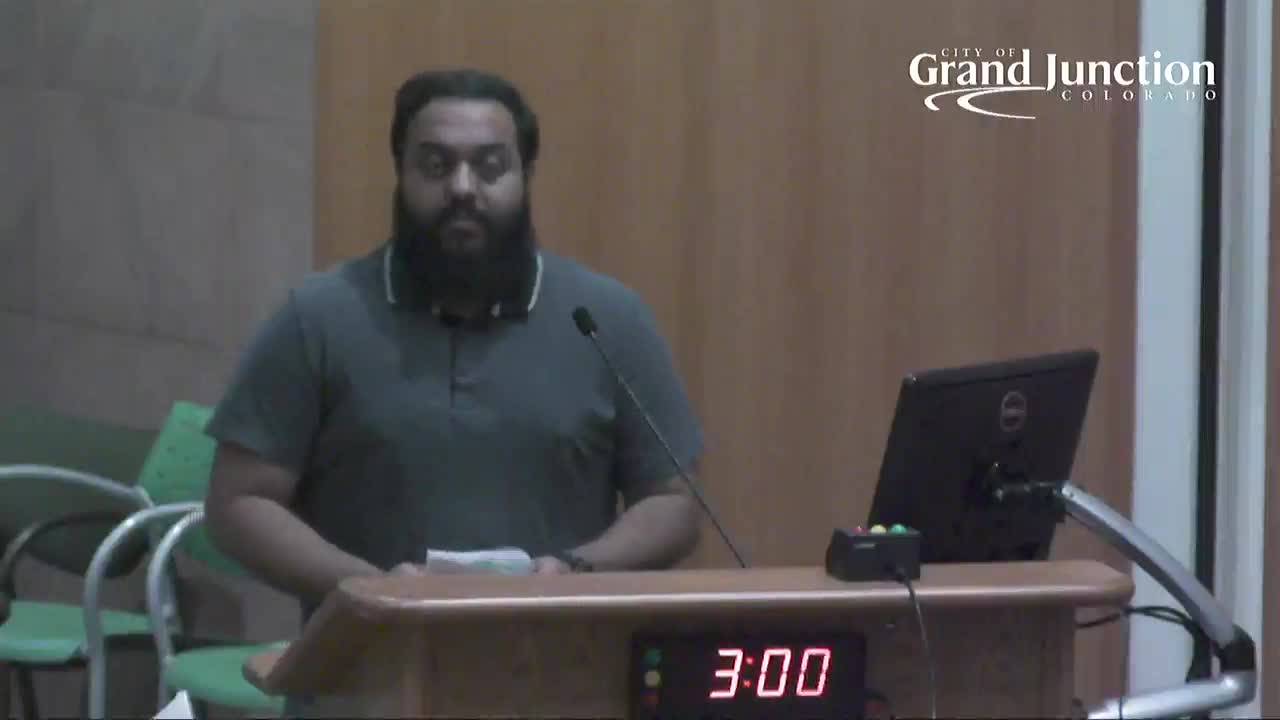
Dozens of downtown residents and business owners packed the Grand Junction City Council meeting on Aug. 6 to press elected officials to return Fourth and Fifth Street south of Grand Avenue to their pre-pilot configuration.
Speakers said the pilot conversion — which narrowed travel lanes and added protected bike facilities and bollards — has reduced parking and pushed traffic and higher speeds onto parallel residential streets. “Fourth and Fifth Street has always been our corridors through downtown,” resident Patricia Eddy said. “Let's put it back the way it was.”
Why it matters: The configuration affects downtown parking, pedestrian crossings and emergency-vehicle access on some of the city’s busiest corridors. Supporters of the pilot pointed to engineering and safety data used when the project was first designed; opponents described business losses, lost parking and newly fast traffic on nearby neighborhood streets.
What speakers said: Several longtime residents and business owners said they’ve stopped coming downtown or changed routines because of the pilot. Downtown resident and former worker Julia Wildman said she “feels safer ... with one lane, a protected bike lane, and the more narrow lanes” and argued removing the bike lane would “encourage speeding.” By contrast, Donald Hunger, who collected signatures opposing the pilot, said “it disrupted parking, made businesses harder to access” and urged a full reversion. Multiple speakers described crashes or vehicle damage on nearby Sixth Street and nearby residential blocks where they say traffic has increased.
Some commenters pushed for a middle ground. Julia Circus asked the council to consider a “partial reversion” (previously called “phase 2” in staff documents) that would place the bike lane between parked cars and traffic and remove bollards, arguing that would be “a real compromise” that addresses safety and cost concerns. David Lehman and others urged that the council explicitly consider the staff’s “alternative 2.1” and its data showing reduced crashes during the pilot.
Council and staff responses: Council members raised procedural and cost questions during recent workshops; city staff and engineers have presented multiple options, including a compromise alternative. At the meeting, several council liaisons and staff described outreach efforts and called for discussion of both safety data and fiscal implications. No formal council action on Fourth and Fifth Street design occurred at this meeting; public comment was the principal forum for debate.
What wasn’t decided: The council did not vote to change the pilot configuration on Aug. 6, and did not adopt any streets-related ordinance or funding allocation at this session. Several speakers asked council to act consistent with voter sentiment in an April election; others asked the council to weigh engineering crash reductions cited by staff. The transcript does not record any formal motion or direction by the council to implement a particular design change.
Context and next steps: Several commenters asked the council to discuss alternatives — including staff’s “Alternative 2.1” — and to publish the underlying safety and utilization data for public review. Some asked for a rapid reversal; others urged a reset that keeps protected bike facilities without bollards. Council members have indicated the item remains under review in follow-up workshops and staff briefings; residents were told to watch the council agenda page for any future hearings or actions on the corridor.
Speakers said the pilot conversion — which narrowed travel lanes and added protected bike facilities and bollards — has reduced parking and pushed traffic and higher speeds onto parallel residential streets. “Fourth and Fifth Street has always been our corridors through downtown,” resident Patricia Eddy said. “Let's put it back the way it was.”
Why it matters: The configuration affects downtown parking, pedestrian crossings and emergency-vehicle access on some of the city’s busiest corridors. Supporters of the pilot pointed to engineering and safety data used when the project was first designed; opponents described business losses, lost parking and newly fast traffic on nearby neighborhood streets.
What speakers said: Several longtime residents and business owners said they’ve stopped coming downtown or changed routines because of the pilot. Downtown resident and former worker Julia Wildman said she “feels safer ... with one lane, a protected bike lane, and the more narrow lanes” and argued removing the bike lane would “encourage speeding.” By contrast, Donald Hunger, who collected signatures opposing the pilot, said “it disrupted parking, made businesses harder to access” and urged a full reversion. Multiple speakers described crashes or vehicle damage on nearby Sixth Street and nearby residential blocks where they say traffic has increased.
Some commenters pushed for a middle ground. Julia Circus asked the council to consider a “partial reversion” (previously called “phase 2” in staff documents) that would place the bike lane between parked cars and traffic and remove bollards, arguing that would be “a real compromise” that addresses safety and cost concerns. David Lehman and others urged that the council explicitly consider the staff’s “alternative 2.1” and its data showing reduced crashes during the pilot.
Council and staff responses: Council members raised procedural and cost questions during recent workshops; city staff and engineers have presented multiple options, including a compromise alternative. At the meeting, several council liaisons and staff described outreach efforts and called for discussion of both safety data and fiscal implications. No formal council action on Fourth and Fifth Street design occurred at this meeting; public comment was the principal forum for debate.
What wasn’t decided: The council did not vote to change the pilot configuration on Aug. 6, and did not adopt any streets-related ordinance or funding allocation at this session. Several speakers asked council to act consistent with voter sentiment in an April election; others asked the council to weigh engineering crash reductions cited by staff. The transcript does not record any formal motion or direction by the council to implement a particular design change.
Context and next steps: Several commenters asked the council to discuss alternatives — including staff’s “Alternative 2.1” — and to publish the underlying safety and utilization data for public review. Some asked for a rapid reversal; others urged a reset that keeps protected bike facilities without bollards. Council members have indicated the item remains under review in follow-up workshops and staff briefings; residents were told to watch the council agenda page for any future hearings or actions on the corridor.
View the Full Meeting & All Its Details
This article offers just a summary. Unlock complete video, transcripts, and insights as a Founder Member.
✓
Watch full, unedited meeting videos
✓
Search every word spoken in unlimited transcripts
✓
AI summaries & real-time alerts (all government levels)
✓
Permanent access to expanding government content
30-day money-back guarantee
