CPRB reviews wrong‑address raids, Columbia police describe checks, debriefs and risk process
August 13, 2025 | Columbia, Boone County, Missouri
This article was created by AI summarizing key points discussed. AI makes mistakes, so for full details and context, please refer to the video of the full meeting. Please report any errors so we can fix them. Report an error »
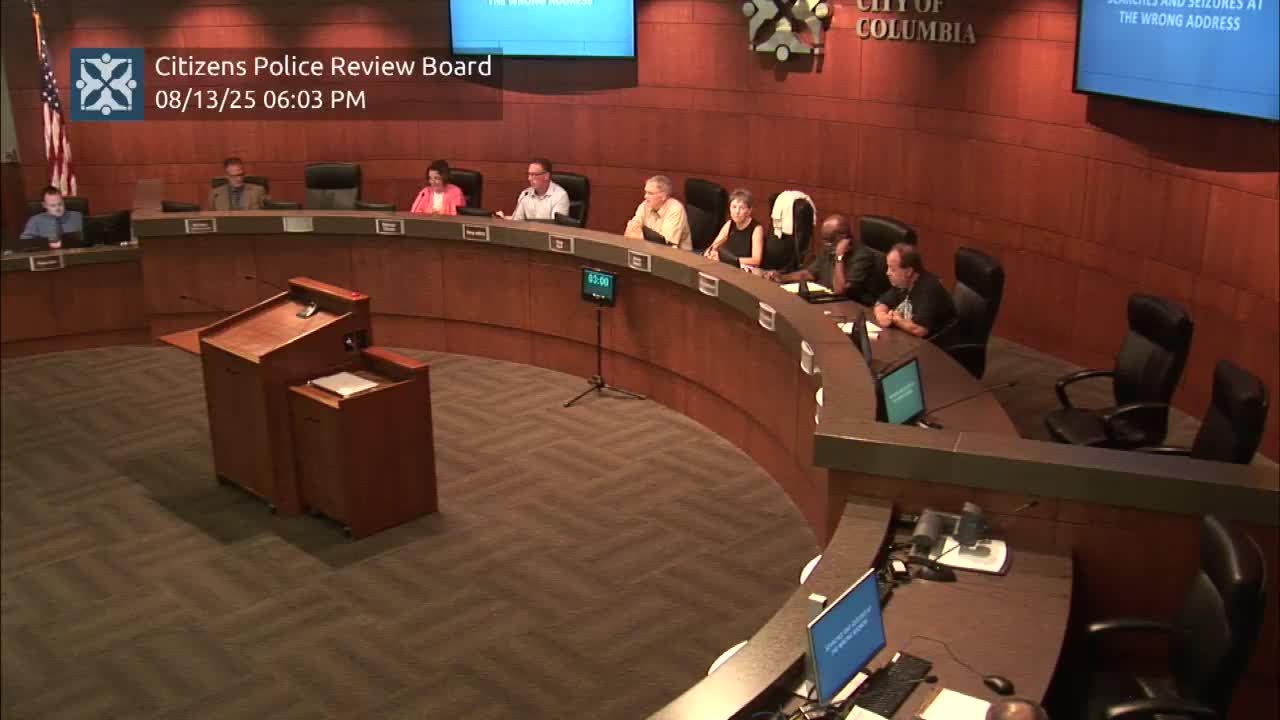
At a meeting of the Citizens Police Review Board, members discussed police entries and seizures at the wrong address and reviewed how the Columbia Police Department seeks to prevent and respond to such incidents. Board Chair Doug Hunt laid out a high‑profile example discussed in court and asked the department about local policy, training and follow‑up.
Hunt described a wrongful‑address raid that he said was the subject of a U.S. Supreme Court case, Martin v. United States, and summarized the facts as presented to the board: agents executed a predawn raid on the wrong house, used a battering ram and a flashbang, and family members — including a 7‑year‑old — were confronted with rifles. Hunt said the household identified about $5,000 in physical damage and alleged psychological harm. "Searches and seizures at the wrong address," he said, "we are talking about Fourth Amendment rights when police answer a call and arrive at the wrong address." Hunt also noted he was discussing an Atlanta case, not a Columbia incident.
Assistant Chief Richard Horell, Columbia Police Department, responded that the Martin matter had been remanded to the lower court and emphasized the legal and factual complexity of tort claims. Horell said Columbia has not had an execution of a search warrant at a wrong address in his knowledge: "Search warrants, I'm not aware of any execution of a search warrant at any wrong address in the last 30 years here in Columbia that I know of." He described the process for search warrants as multiple internal reviews, a prosecuting‑attorney review and judicial approval.
On calls for service — which staff described as distinct from executing court‑issued search warrants — Horell said officers verify location and caller information when they arrive: "Our first step is verification of our location. We always gotta do that. Nowadays, we have a GPS system in the cars." He added that dispatch information, caller confusion, or addresses with similar names can create risks and that officers attempt to call back or verify callers when possible.
Board members raised questions about policies for apologizing and compensating civilians when police discover they went to the wrong address. Horell said officers typically explain the situation and apologize when an error is identified and that property damage claims are handled through the city's risk management process: "If there is something where there's damage to someone's personal property, we would send that through risk management." He said photographs and a risk‑management claim form are standard practice.
Horell described routine accountability and learning measures: supervisors conduct after‑action reviews on critical events and debriefs after search‑warrant executions, and sergeants follow up with officers after larger calls for service. For more serious or potentially criminal errors, Horell said the department uses an internal affairs process.
Swatting calls drew separate discussion. Horell said 9‑1‑1 center staff and communications personnel look for red flags in call patterns and that officers try to call back numbers provided. "When we get numbers that we can't call back, that's another red flag for us," he said. He warned that technological spoofing and cross‑jurisdictional tactics make investigation difficult.
The board and department framed most of the session as discussion and review; no policy changes or formal directives were taken at the meeting.
Hunt described a wrongful‑address raid that he said was the subject of a U.S. Supreme Court case, Martin v. United States, and summarized the facts as presented to the board: agents executed a predawn raid on the wrong house, used a battering ram and a flashbang, and family members — including a 7‑year‑old — were confronted with rifles. Hunt said the household identified about $5,000 in physical damage and alleged psychological harm. "Searches and seizures at the wrong address," he said, "we are talking about Fourth Amendment rights when police answer a call and arrive at the wrong address." Hunt also noted he was discussing an Atlanta case, not a Columbia incident.
Assistant Chief Richard Horell, Columbia Police Department, responded that the Martin matter had been remanded to the lower court and emphasized the legal and factual complexity of tort claims. Horell said Columbia has not had an execution of a search warrant at a wrong address in his knowledge: "Search warrants, I'm not aware of any execution of a search warrant at any wrong address in the last 30 years here in Columbia that I know of." He described the process for search warrants as multiple internal reviews, a prosecuting‑attorney review and judicial approval.
On calls for service — which staff described as distinct from executing court‑issued search warrants — Horell said officers verify location and caller information when they arrive: "Our first step is verification of our location. We always gotta do that. Nowadays, we have a GPS system in the cars." He added that dispatch information, caller confusion, or addresses with similar names can create risks and that officers attempt to call back or verify callers when possible.
Board members raised questions about policies for apologizing and compensating civilians when police discover they went to the wrong address. Horell said officers typically explain the situation and apologize when an error is identified and that property damage claims are handled through the city's risk management process: "If there is something where there's damage to someone's personal property, we would send that through risk management." He said photographs and a risk‑management claim form are standard practice.
Horell described routine accountability and learning measures: supervisors conduct after‑action reviews on critical events and debriefs after search‑warrant executions, and sergeants follow up with officers after larger calls for service. For more serious or potentially criminal errors, Horell said the department uses an internal affairs process.
Swatting calls drew separate discussion. Horell said 9‑1‑1 center staff and communications personnel look for red flags in call patterns and that officers try to call back numbers provided. "When we get numbers that we can't call back, that's another red flag for us," he said. He warned that technological spoofing and cross‑jurisdictional tactics make investigation difficult.
The board and department framed most of the session as discussion and review; no policy changes or formal directives were taken at the meeting.
View the Full Meeting & All Its Details
This article offers just a summary. Unlock complete video, transcripts, and insights as a Founder Member.
✓
Watch full, unedited meeting videos
✓
Search every word spoken in unlimited transcripts
✓
AI summaries & real-time alerts (all government levels)
✓
Permanent access to expanding government content
30-day money-back guarantee
